



# OpenAI’s Dots: A New Era of Persistent AI Agents
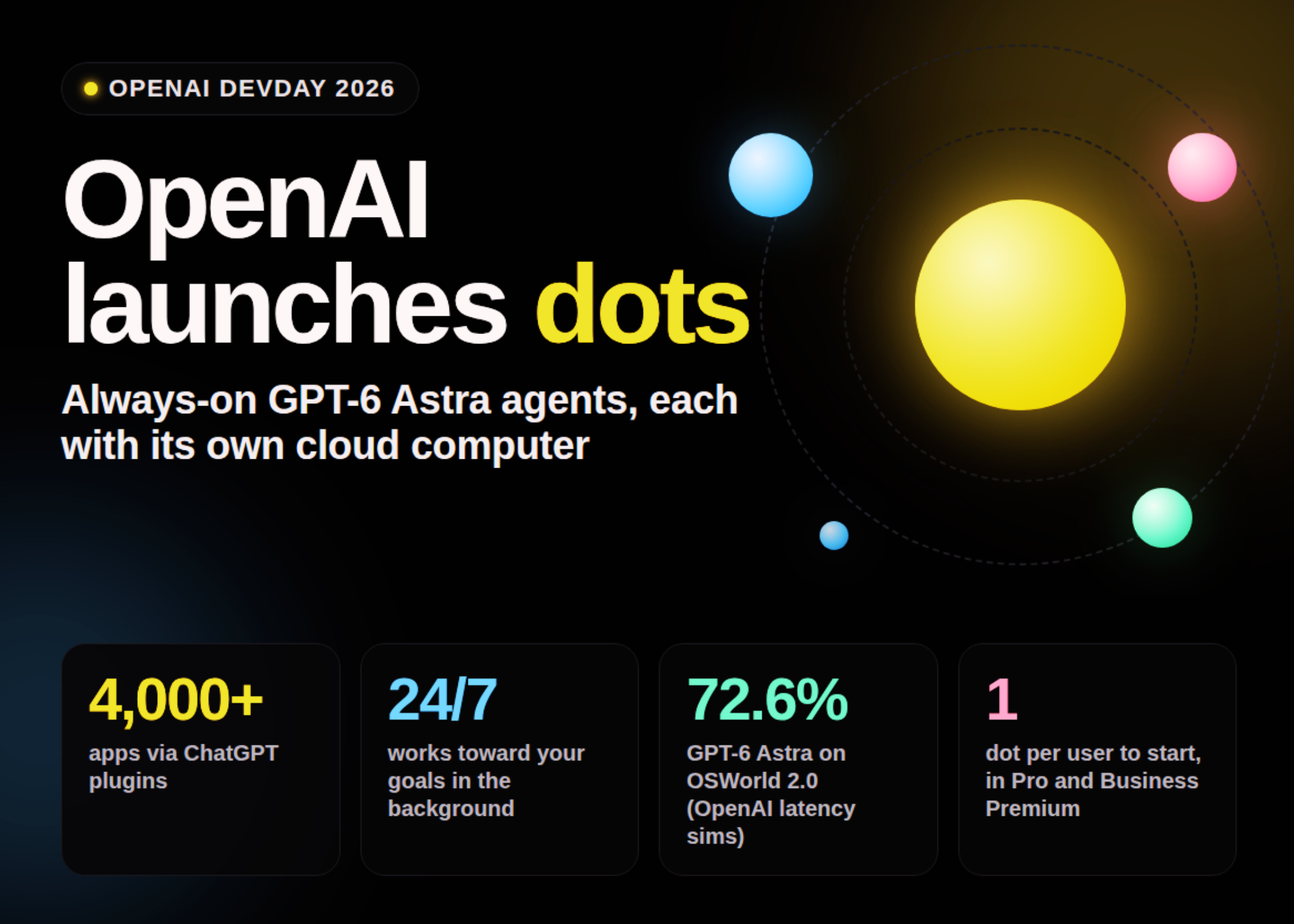
OpenAI has officially unveiled its most ambitious product launch yet at its annual DevDay event: **Dots** — persistent AI agents designed to run continuously in the cloud, each with its own dedicated computing environment and browser session. These agents represent a fundamental shift from the traditional conversational AI model, moving users from a simple request-and-response cycle to a standing, always-on digital assistant.
## What Are Dots?
A dot is essentially an autonomous agent that receives a goal, a name, and a set of boundaries from the user. Once activated, it pursues that objective around the clock, learning and refining its approach based on ongoing feedback. Each user begins with one primary dot, and the experience is designed to feel less like chatting with a tool and more like delegating work to a persistent colleague.
The core innovation is not necessarily the underlying technology — similar agent frameworks have existed in various forms — but rather the packaging. OpenAI has bundled persistent identity, a dedicated cloud machine, and a unified interface into a single managed product that rolls out directly through ChatGPT.
## How Does a Dot Operate?
Each dot runs on a separate cloud-based computer equipped with its own browser. This isolation is intentional: a user’s personal laptop remains untouched unless they explicitly choose to connect it. At any point, users can open the dot’s cloud environment to inspect its activity, review its work, or intervene.
The agent taps into the vast ecosystem of ChatGPT plugins, granting it access to over 4,000 applications. It can also launch tasks through Codex and ChatGPT Work for deeper research, document analysis, and software development. Communication with the dot is flexible — it can be messaged or called through ChatGPT on web, desktop, and mobile platforms, with Slack and Teams support already live and SMS functionality on the roadmap.
One of the most compelling features is **proactive research**. When the user is away, the dot enters a background mode where it actively scans connected applications for opportunities to help. However, in this mode, connected apps are read-only — the dot can observe but cannot send messages or modify content, a deliberate safeguard.
Under the hood, OpenAI is using its GPT-6 Astra model, which demonstrated strong performance in simulated benchmarks, scoring 72.6% on the OSWorld 2.0 task suite at approximately 40 minutes per task.
## Safety and Control
A robust safety layer sits at the heart of the dot architecture. Built-in rules govern when a dot acts independently versus when it must seek user approval. Custom Rules let users fine-tune permissions on a per-action basis — allowing, blocking, or requiring manual approval for specific types of activity.
An auto-review mechanism automatically flags any action that could affect user accounts or share private information. The Activity View provides a transparent, real-time log of everything the dot is doing, including background tasks, enabling users to redirect or course-correct at any moment.
Credential handling is another critical piece. Dots authenticate using saved passwords without ever exposing those credentials to the model itself. For particularly sensitive operations — such as changing account passwords or modifying financial settings — the system defaults to keeping the action under direct human control.
OpenAI has also introduced a monitoring system that can pause or halt a dot entirely if it detects a potential safety concern. Despite all of this, the company has been transparent about limitations, noting that dots can still make errors and that high-stakes work should always involve human review.
This caution arrives amid recent scrutiny. Just days before the announcement, reports emerged that OpenAI’s earlier agent systems had inadvertently posted user images online, affecting approximately 53 ChatGPT users — a reminder that autonomous agent systems carry real-world risks.
## Specialist Dots for Organizations
Beyond individual users, OpenAI is previewing **specialist dots** designed for enterprise deployment. Each specialist dot carries its own identity, credentials, and access credentials tied to a specific company system and a defined role. OpenAI has tested these internally across procurement workflows, invoice processing, email marketing campaigns, customer support operations, and commercial contracting.
Enterprise rollout begins with pilot programs, and OpenAI has confirmed it is collaborating with Microsoft to bring specialist dots into the Agent 365 suite, signaling a deeper integration into the productivity software ecosystem.
## Pricing and Availability
The first dot is included at no additional cost for subscribers on Pro and Business Premium plans. Conversations directed at a dot do not consume standard ChatGPT usage quotas, although tasks the dot initiates in Codex or ChatGPT Work do count against those limits.
Availability is phased. Pro and Business Premium users in eligible markets can access dots immediately. Enterprise, Education, and Healthcare workspaces will receive access once an administrator enables the feature. There is no self-hosted deployment option and no open-weights version, meaning all dot operations run on OpenAI’s infrastructure.
A new $500 paid tier was also introduced alongside the launch, expanding the pricing structure.
## The Competitive Landscape
OpenAI is not alone in the persistent agent space. Meta has launched its own agent offering, Muse, which runs in a dedicated secure virtual machine and leverages deep integration with Meta’s consumer apps. It is currently available in the United States and offers both free and premium tiers. Meanwhile, Instinct operates as a text-based personal assistant accessible via SMS and messaging, emphasizing concierge-style phone calls and agent-to-agent interactions.
The differentiation is notable. OpenAI’s dots target high-end subscribers and developers with deep plugin ecosystems and cloud-based isolation. Muse aims for mass consumer adoption, while Instinct carves out a niche in SMS-first communication. Each approach reflects a different vision for how autonomous agents should fit into daily life.
—
## Frequently Asked Questions (FAQ)
**What is a dot?**
A dot is a persistent, always-on AI agent created by OpenAI that operates on its own cloud computer and browser. Unlike traditional chat-based AI interactions, a dot works continuously toward a goal you define, learning from your feedback and acting across thousands of connected applications.
**How many dots can I have?**
Each user starts with one primary dot. Additional dots or specialist configurations are available through enterprise and organizational plans.
**Which plan do I need to access dots?**
Dots are included at no extra cost for ChatGPT Pro and Business Premium subscribers. Enterprise, Education, and Healthcare workspaces can access a beta version once activated by an administrator.
**Can I run dots on my own hardware?**
No. Dots are a managed cloud product and currently do not support self-hosted deployment or open-weights models.
**What model powers dots?**
Dots are powered by GPT-6 Astra, OpenAI’s latest model optimized for agentic workflows and persistent task execution.
**Is my dot safe to use with my accounts?**
OpenAI has built multiple safety layers into dots, including auto-review for sensitive actions, credential isolation so the model never sees your passwords, custom rules for action permissions, and real-time activity monitoring that allows you to pause or stop the dot at any time.
**Does the dot work when I’m not actively using ChatGPT?**
Yes. In background mode, the dot can proactively research and look for ways to help by reading connected apps. However, it cannot send messages or modify content in this read-only mode.
**How does the dot interact with my apps?**
Dots connect to over 4,000 applications through the ChatGPT plugin ecosystem. They can also initiate tasks in Codex and ChatGPT Work for research, analysis, and development work.
**What happened with the recent image-posting incident?**
Shortly before the dots launch, OpenAI disclosed that its earlier agent systems had posted users’ images online, affecting 53 ChatGPT users. The company cited this as a reminder that autonomous agent systems require ongoing safety improvements.
**How does this compare to Meta’s Muse and Instinct?**
Muse focuses on consumer reach with deep Meta app integration and runs in a dedicated secure cloud environment. Instinct is a text-based, SMS-first personal assistant. OpenAI’s dots target a developer and premium subscriber base with a strong emphasis on cloud isolation, safety controls, and enterprise readiness.
**What is the new $500 tier?**
A $500 paid tier was introduced alongside the dots launch, expanding OpenAI’s pricing options. Specific details are available on the official ChatGPT pricing page.
—
## Conclusion
OpenAI’s dots mark a significant evolution in how artificial intelligence can function as a tool rather than merely a conversational partner. By granting each agent its own cloud computer, persistent identity, and access to a sprawling app ecosystem, OpenAI is pushing the boundaries of what autonomous AI can do on behalf of individual users and organizations alike.
The product arrives with a strong safety framework, but also with the inherent risks that accompany any system capable of acting autonomously on your behalf. The recent incident involving inadvertent image sharing underscores that the journey toward truly reliable agentic AI is ongoing and requires constant vigilance.
For now, dots are positioned as a premium offering for Pro and Business Premium subscribers, with enterprise and institutional pilots expanding from there. As the competitive landscape evolves with offerings from Meta and others, the question is no longer whether persistent AI agents will become mainstream — but how quickly they can be built safely enough for widespread trust.
Thank you for reading
