



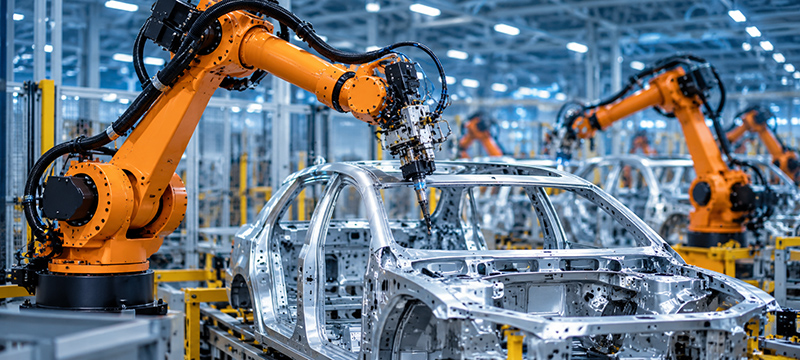
# The World’s Factory Floors Now Host Five Million Industrial Robots: What This Means for the Future of Manufacturing
The manufacturing sector has reached a historic milestone. Across factories in dozens of countries, the total number of industrial robots actively performing tasks has crossed the five-million mark. This figure, representing a 9% year-over-year increase, signals that automated machinery has become an indispensable spine of modern production lines.
But the story behind these numbers is not simply one of uniform growth. Regional disparities are stark, and the distribution of new robot deployments tells a complex tale about where the future of manufacturing is being written — and where it is lagging.
## A Defining Year for Global Automation
The year saw more than 600,000 new industrial robots placed into service, an 11% jump from the figures recorded the previous year. Over the past seven years, the cumulative operational stock has more than doubled. This rapid expansion reflects a broader trend: factories are not just adding individual machines but deploying interconnected fleets of automated systems that work alongside human operators, sensors, and digital production platforms.
What makes this moment particularly significant is how robot density is concentrating in specific regions while others struggle to keep pace. The global picture is one of divergence, not convergence.
## The Dominance of the Asian Manufacturing Powerhouse
A single country accounted for the majority of new robot installations worldwide, placing nearly 354,000 machines into factory operations during the year. That figure represents a 20% jump from the prior period and cements the nation’s role as the central engine driving worldwide automation growth.
Notably, domestic manufacturers in this country also supplied a majority of the units used within their own borders, reflecting a maturing robotics industry capable of producing competitive, cost-effective automation solutions.
The contrast with the rest of the world is dramatic. The second-largest market installed fewer than 40,000 units — less than one-eighth of the leading country’s volume. Other significant manufacturing economies contributed even less in absolute terms, highlighting how geographic concentration will shape investment strategies and supply chains for years to come.
## How the United States and Other Markets Are Faring
Several major economies are experiencing steady but comparatively modest growth in their industrial robot fleets. One North American nation overtook its long-standing rivals to become the world’s second-largest single market for new installations, with annual deployments rising 12% and reaching their third-best level on record.
However, even this growth is fragile when measured against the scale of leading economies. Meanwhile, in East Asia, a neighboring industrialized nation saw its installations drop by nearly one-fifth, a decline that raises questions about the sustainability of its current automation push. Southeast Asian competitors, though still small in absolute terms, are growing at annual rates exceeding 10%, suggesting that the geography of future manufacturing may shift further over the coming decade.
## Europe: A Cautious Trajectory
The European continent presents a more muted picture. While Germany continues to lead the region and holds a position among the top five global markets, even its deployments declined year over year. Southern and Western European markets saw similar contractions, with multiple countries recording double-digit percentage drops in new installations.
For industrial technology vendors and system integrators, this divergence is more than a statistical curiosity. It means that the same global trends in factory automation do not produce uniform opportunities across markets. Companies seeking to expand their presence in robotics, industrial networking, and connected infrastructure must navigate vastly different investment climates depending on where they operate.
## The Connected Factory: Why Robot Numbers Matter Beyond Robotics
An often-overlooked implication of the five-million-robot milestone is its impact on the broader industrial technology ecosystem. Today’s production robots are rarely standalone devices. They rely on machine vision systems, industrial sensors, networking infrastructure, and software platforms to function optimally.
As the robot population grows, so does the complexity of the environments in which they operate. Manufacturers are increasingly tasked with managing vast fleets of automated assets alongside conventional production equipment — tracking their condition, availability, and output data in real time. This reality makes the integration of robotic systems with overarching monitoring, analytics, and control platforms more critical than ever.
The implications extend into the domain of industrial connectivity and edge computing. A larger installed base of robots creates a larger ecosystem of data-generating assets that need to be connected, observed, and acted upon. Advances in artificial intelligence and sensing are further expanding the types of tasks that automated systems can handle, which in turn deepens the demand for robust, scalable industrial data architectures.
## Looking Ahead
Industry forecasts point to continued expansion over the next several years, with global annual installations expected to rise through the end of the decade. Factors cited include shifting manufacturing geographies, persistent labor shortages in developed economies, demographic pressures, and ongoing advances in automation capability itself.
For equipment manufacturers, technology providers, and factory operators, these trends underscore a central reality: the five-million-robot milestone is not merely a statistic about machines. It is a measure of the scale of physical equipment that next-generation industrial systems will need to connect, monitor, and orchestrate.
—
## Frequently Asked Questions (FAQ)
**Q1: What exactly is an industrial robot used for in manufacturing?**
Industrial robots are automated machines designed to perform repetitive, precise, or physically demanding tasks in production environments, such as welding, assembly, material handling, painting, and inspection. They are commonly deployed in automotive, electronics, food and beverage, pharmaceutical, and heavy equipment manufacturing.
**Q2: Why are robot installations so concentrated in certain regions?**
Concentration is driven by a combination of factors, including the scale of a country’s manufacturing sector, government incentives for automation, labor market dynamics, and the presence of a strong domestic robotics supply chain. Countries with large, rapidly growing manufacturing bases and supportive policy environments tend to attract more robot deployments.
**Q3: How does the growth of industrial robots relate to the Internet of Things (IoT)?**
Modern industrial robots increasingly function as nodes within larger connected factory ecosystems. They generate and consume data through sensors, machine vision systems, and industrial networks. As robot fleets grow, the need for integrated IoT platforms that can monitor, analyze, and control these assets becomes more pressing.
**Q4: What role does artificial intelligence play in industrial robotics?**
Artificial intelligence enhances robots’ capabilities in areas like object recognition, adaptive path planning, predictive maintenance, and quality inspection. AI-driven systems can respond to variability in their environment, making robots more versatile and reducing the need for rigid, pre-programmed operations.
**Q5: What are the main challenges manufacturers face when scaling robot deployment?**
Key challenges include the initial capital investment required, the need for skilled personnel to program and maintain robotic systems, integration with existing production software and infrastructure, and ensuring data security across increasingly connected factory environments.
**Q6: Are industrial robots replacing human workers entirely?**
While robots do take over certain repetitive or hazardous tasks, they often work alongside human operators in what is known as collaborative automation. The primary goal in most deployments is to augment human capabilities, improve safety, and increase throughput rather than fully replace the workforce.
**Q7: What can we expect from industrial robotics in the next decade?**
Forecasts point to continuing installation growth, deeper integration with AI and sensing technologies, and an increasingly interconnected factory landscape. The expansion of remote monitoring, predictive analytics, and real-time production optimization will likely define the next phase of industrial automation.
—
## Conclusion
The arrival of five million operational industrial robots marks a turning point in the story of global manufacturing. It reflects the ongoing transformation of factory floors into highly automated, data-rich environments where robotic systems and connected infrastructure operate as interdependent ecosystems. The regional disparities in deployment remind us that this transition is far from uniform, and the opportunities it creates will be shaped by local economic conditions, policy decisions, and technological readiness. As the installed base of robots continues to grow, so will the importance of the technologies — from IoT platforms to edge computing — that make it possible to manage and extract value from these increasingly complex production environments.
Thank you for reading
