



# Why Industrial IoT Programs Fail: The Cost of Measuring Everything
Industrial IoT has a paradox that most roadmaps refuse to acknowledge. The more sensors you install, the fewer machines you can actually cover. And the fewer machines you cover, the less value your program delivers.
For years, the dominant strategy has been to instrument machines exhaustively — pulling data directly from controllers, capturing high-resolution coordinates, error codes, and performance logs. It makes for compelling pilot projects and impressive slide decks. But when those projects leave the lab and enter the factory floor, they hit a wall that has nothing to do with technology.
## The Pilot Trap
Consider this scenario: a team of engineers walks into a facility and attaches a dozen sensors to a CNC machine. They capture every movement, every vibration, every thermal fluctuation. The data is rich, beautiful, and utterly useless — because the machine is one out of hundreds on the floor, and the project will never extend to the other two hundred.
The core problem is arithmetic. Each additional sensor adds installation time, integration complexity, and ongoing maintenance. Multiply that by dozens of machines and different manufacturers, and the economics collapse. A program that looks stellar across a handful of units quietly stalls around the point where the human cost of installation exceeds the value of the data being collected.
## A Deliberate Reduction in Ambition
The most successful industrial IoT deployments in recent years share an unexpected trait: they chose to measure less on purpose. Instead of connecting to machine controllers and extracting granular operational data, some teams turned to a surprisingly simple alternative — measuring electrical current draw.
A production machine consumes significantly more power when it is actively cutting material than when it is idle or paused. That single signal is coarse by any technical standard. It cannot tell you which tool is worn, what the feed rate was, or whether a dimensional tolerance was met. But it can answer the one question that plant managers actually care about: is this machine earning its floor space?
The elegance of this approach is that it works identically across every machine regardless of age, brand, country of origin, or technical sophistication. A multimillion-pound five-axis machining center and a basic benchtop drill look the same to a current sensor. The signal is universal, the installation takes minutes, and the barrier to scaling from one machine to one hundred drops dramatically.
## The Data Point No Sensor Can Capture
Here is the uncomfortable truth about industrial operations: even a perfectly instrumented machine cannot tell you why it stopped. When production halts, the reason is almost never mechanical. The operator stepped away to retrieve a tool. A shipment of raw material was late. The machine was being reconfigured between jobs — exactly as designed.
None of these explanations are available to a sensor. They exist only in the short-term memory of the person standing next to the machine.
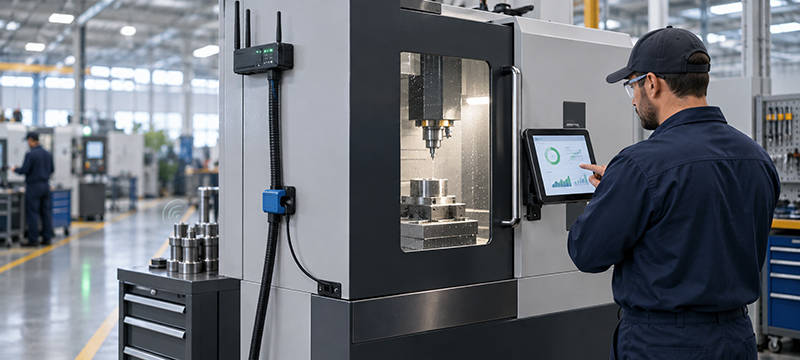
The solution does not require another sensor. It requires a different kind of input entirely. A simple interface — a tablet mounted at the workstation — allows operators to log a reason code every time the line goes quiet. The cost of this component is trivial compared to the price of a single sensor installation, yet it produces the single most valuable data point in the entire system. It transforms raw telemetry into actionable context.
This is a critical design insight for IoT product teams: the cheapest component in an architecture often generates the input that makes every other measurement meaningful.
## Friction, Not Technology, Is the Real Ceiling
If broad coverage is the goal, then friction is what stands between ambition and reality. And friction arrives in layers that most vendors never address.
**Integration friction** is the most visible and the least dangerous. Connecting to proprietary controllers, parsing vendor-specific protocols, and mapping data models — all of this is difficult but solvable with engineering effort and time.
**Installation friction** is the next layer, and it never shows up on a price quote. Every deployment that requires a site visit carries a per-location human cost. That cost does not scale gracefully. What begins as a software product with high margins slowly transforms into a services business where revenue is consumed by travel, configuration labor, and on-site troubleshooting.
**Network friction** is the layer almost nobody prices into a budget, yet it is where the greatest number of programs stall permanently.
Many industrial IoT deployments begin over corporate Wi-Fi. It is the path of least resistance — free infrastructure already in place. And it works. Until it does not. Enterprise IT departments enforce security policies that block certain network protocols. Some facilities in aerospace and defense will not permit third-party devices on their internal network at all. Other plants still run on paper-based workflows and have no wireless infrastructure whatsoever.
Worst of all is the failure mode where neither side is wrong. The customer’s IT team has exhausted their troubleshooting options. The hardware vendor has exhausted theirs. Both teams are honest, both are competent, and neither can prove the problem is on their side. Meanwhile, the customer watches two capable suppliers shrug at each other while their production floor remains unmonitored.
## Designing Around Security Policy
One of the most common ways industrial IoT programs die is not through technical failure or competitive pressure. They die when a new CISO joins the organization, or when a compliance certification introduces new requirements, or when a contract renewal clause quietly prohibits certain types of devices on the network.
The standard vendor response to this objection is to argue that operational telemetry is not sensitive data. A machine is either running or it is not. Why does that need a private, isolated network?
That argument is technically correct and strategically worthless. Corporate security policy is a blanket rule, not a threat model. The person enforcing it is not conducting a technical risk assessment of your data stream. They are enforcing a governance framework, and telling them their rules do not apply to your use case is a debate you will lose — not because you are wrong, but because it sounds like you are dismissing their authority in front of stakeholders who signed off on the policy.
The far more effective approach is to remove the debate entirely. If a device’s data traffic can be routed through a private network path without requiring any change to the customer’s infrastructure, then the objection evaporates before it ever reaches a procurement meeting. The technical mechanism for this exists today in cloud-native connectivity platforms, where software-defined network policies can isolate traffic from field devices and route it through encrypted tunnels into private cloud environments — no site visits, no hardware modifications, no network access required.
A security objection that can be resolved with a configuration change and a transparent monthly cost is simply a line item in a purchase order. One that cannot be resolved is a lost account.
## The Right Question to Ask
The industrial IoT industry spends an enormous amount of energy asking what else it could measure. This question wins planning meetings on enthusiasm alone. It generates feature requests, justifies budgets, and fills roadmaps with exciting-sounding capabilities.
But it is the wrong question.
The question that determines whether an IoT program survives its first real deployment is far more specific and far less glamorous:
*Can this system work on machine number four hundred, installed by a contractor we will never meet, in a facility we have never visited, on a network whose rules we were not told about, under a security policy that did not exist when we started designing?*
When the answer is yes, you have built something that scales. When the answer is no, you have built a pilot.
Simplicity is not a concession to low ambition. In industrial IoT, it is the entire strategy. Reducing complexity at every layer — the sensor, the installation process, the network requirements, and the security posture — is what separates programs that reach hundreds of machines from programs that reach four and quietly die.
The most valuable data is not the richest data. It is the data you can actually collect, at scale, without begging for network access or scheduling expensive site visits. That insight should reshape how every IoT product team thinks about its next deployment.
—
## FAQ: Industrial IoT Deployment and Scaling Challenges
**Q: Why do most industrial IoT pilot projects fail to scale?**
A: Pilots typically optimize for data richness rather than deployability. Rich sensor setups work well on a few machines in controlled environments, but the cumulative friction of installation, integration, and network access multiplies rapidly as you add machines, making large-scale deployment economically and operationally unsustainable.
**Q: Is lower-resolution data really useful in industrial settings?**
A: Yes, when it is the right data for the right question. A current draw signal cannot replace high-resolution machine telemetry for precision engineering tasks, but it directly answers the question most plant managers care about: is this machine producing value or sitting idle? Simple, universal signals often deliver more operational value than complex ones that only work on a subset of equipment.
**Q: What is the most overlooked cost in IoT deployments?**
A: Network friction. Corporate security policies, restricted network access, and the impossibility of modifying customer infrastructure quietly kill more IoT programs than any technical flaw. The cost of site visits, troubleshooting across vendor boundaries, and abandoned deployments rarely appears in initial project budgets but dominates the total cost of ownership.
**Q: How can IoT vendors address security objections without changing a customer’s network?**
A: By using software-defined connectivity that isolates device traffic through encrypted tunnels into private cloud environments. This allows fleet data to travel on a segregated path without requiring any hardware changes, network configuration, or site visits at the customer location. The objection shifts from a security debate to a procurement decision.
**Q: What is the single most valuable sensor in an industrial IoT deployment?**
A: Often, it is not a sensor at all. The most actionable data in many factories comes from operator input — a simple reason code entered when production stops. No physical sensor can capture context like material delays, tool changes, or reconfiguration events, yet these inputs drive the majority of operational decisions.
**Q: How should product teams think differently about IoT scalability?**
A: Shift from asking “what can we measure?” to “where can we measure?” The most important metric is not signal fidelity but deployability — how easily can the system be installed on any machine, by anyone, on any network, without requiring permission from IT or a visit from an engineer.
—
## Conclusion
The industrial IoT industry has spent decades optimizing for richer data while ignoring the far more consequential problem of reach. Programs that capture everything from a handful of machines deliver impressive demos but fail in real-world deployment because the cost of scaling the same approach becomes prohibitive.
The path to genuinely useful industrial IoT lies in intentional simplification — choosing lower-resolution signals that work universally, designing around network security policies rather than against them, and recognizing that operator input is sometimes more valuable than any sensor reading. These principles are not compromises. They are the architecture of programs that actually scale from a pilot to a fleet.
Technology evangelists and product teams would do well to remember that the goal is not to instrument every machine. The goal is to make every machine instrumented — and that requires a fundamentally different set of design priorities.
Thank you for reading
