



# A New Debate App Tries to Bridge the Trust Divide With Short-Form Video
A striking majority of the global population now refuses to trust anyone whose beliefs or sources of information differ from their own. That finding, from a large-scale survey spanning nearly three dozen countries, reveals how polarized public discourse has become. The same research shows that people now get most of their news from social and video platforms, yet they place very little confidence in what they find there.
Into this environment steps a new application that takes a novel approach. Rather than letting arguments spiral endlessly in comment threads, the platform pairs two opposing voices together and gives each a limited window to make their case. The result is a structured, split-screen debate — and it draws on ideas from both democratic traditions and decentralized technology.
## The Problem: Distrust and Short Attention Spans
The numbers paint a stark picture. Across age groups, income brackets, and nations at different stages of development, skepticism toward opposing viewpoints has become the norm. Social media has amplified this trend, serving as the primary gateway for online news while simultaneously eroding confidence in the information it delivers. Only a small fraction of users believe what they encounter on these platforms.
At the same time, short-form video has overtaken other formats as the dominant way people consume news. Clips under two minutes dominate engagement on major platforms, and weekly viewership for online video news has surged. The medium is no longer just entertainment — it is where public opinion is shaped.
## How the App Works
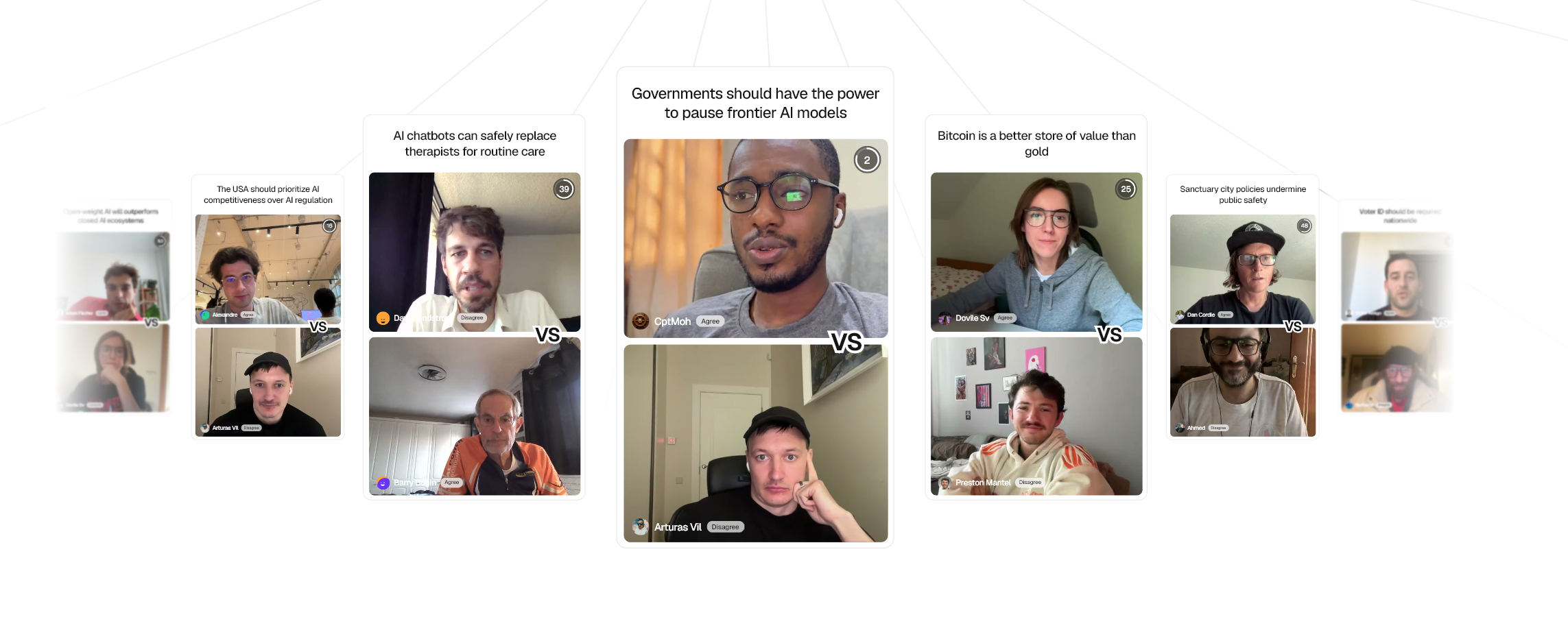
The debate application asks each user to declare a position on a specific claim before a match is made. It then pairs them with someone who has taken the opposite stance. Both participants record short video responses in timed, alternating turns. During one person’s speaking slot, the other’s microphone is muted, preventing interruptions or cross-talk.
After both sides have recorded their arguments, the app produces a subtitled split-screen video and publishes it to a public feed. Viewers can watch the exchange, examine the evidence behind each claim, and cast a vote on who presented the stronger case. Each claim is tagged as either factual or opinion, though the platform itself does not adjudicate which ones hold up.
## Grounding Claims in a Knowledge Graph
Once a debate concludes, the app extracts each speaker’s key claims and logs them under that individual’s profile. Other users can revisit any claim and challenge it in a follow-up discussion. The system is designed so that ideas are traceable and interconnected, forming something resembling a living knowledge network.
The architecture has roots in decentralized web infrastructure. The project’s founder has connections to a well-known protocol focused on indexing and organizing data on the internet. An earlier version of the application used standards tied to that protocol for storing and sharing knowledge. Whether the debate content itself is preserved in a decentralized way remains an open question.
## The Visionary Behind the Project
The creator traces the project’s origins to the misinformation that surrounded major political and public health events in recent years. He believes that democracy itself depends on the ability to engage honestly with opposing viewpoints, just as scientific progress relies on testing ideas against alternatives. His goal is to bring structured debate into the digital age.
“The internet has gotten very good at teaching us how to react to people we disagree with,” the creator posted, referencing a recent trend that named a word related to outrage as the year’s defining term. “We need better places to practice understanding them.”
## Does the Format Actually Work?
Evidence from academic research offers a mixed but cautiously optimistic picture. A controlled study paired voters from opposing parties for brief, unmoderated conversations. Participants became more sympathetic toward the other side only when they discovered common ground. Where disagreement remained pure, no shift occurred. However, the willingness to engage across lines deepened and persisted for weeks afterward.
Since the app intentionally matches only those who disagree, it enters the zone where the research found the hardest results. Yet even in that space, some positive engagement still emerged from similar formats.
## Challenges Ahead
There are real obstacles to the model gaining traction. First, it demands that two people be willing to appear on camera and argue in good faith — a significant hurdle given the anonymity and hostility that often characterize online spaces. Second, sustaining the quality of the knowledge graph requires a community of dedicated curators who add sources and context. Third, the voting system may reward charisma and confidence over actual accuracy, mirroring a dynamic already well documented in social media audiences that prefer entertaining creators over trustworthy ones.
A broader concern is that the short-form debate format, once published, can be clipped and shared outside the platform without its original context. The creator designed the system to let arguments outlive the feed, but containment is difficult in an era of screenshots and screen recordings.
## FAQ
**What is the debate app described in this article?**
It is a short-form video platform that pairs users with opposing views to debate specific claims in timed, alternating rounds. The final output is a subtitled split-screen clip published to a public feed where viewers can vote on the stronger argument.
**Who founded it and why?**
A technologist with background connections to a major decentralized data protocol created the app in response to rising misinformation and deepening distrust between people with different viewpoints.
**How does the app ensure fairness?**
It enforces strict turn-taking by muting one participant while the other speaks. However, it does not rule on the truthfulness of claims or moderate whether the arguments are factually accurate.
**Can users challenge claims after a debate ends?**
Yes. The app logs each speaker’s claims under their profile, allowing other users to pick them up and challenge them in follow-up exchanges.
**Is the content stored in a decentralized way?**
The platform has roots in web3 infrastructure and an earlier version used on-chain standards. Whether current debate content is written directly to a blockchain has not been confirmed.
**What does research say about debate formats like this?**
Studies show that structured conversations between opposing viewpoints can increase sympathy and willingness to engage, especially when common ground emerges. Pure disagreement without shared understanding tends not to shift opinions, but engagement itself can improve.
**What are the main risks of this model?**
Risks include charismatic speakers winning over well-evidenced ones, the need for willing participants on camera, the challenge of sustaining curatorial quality, and the potential for clips to be decontextualized when shared beyond the platform.
## Conclusion
The concept behind the debate application is compelling: take the format people already spend hours watching, add structure and accountability, and use it to force genuine engagement across ideological lines. Whether it can succeed where social media comment sections have failed remains to be seen. The platform’s emphasis on structured turns, traceable claims, and public voting represents a thoughtful experiment in digital discourse — but it faces real challenges in participant willingness, content quality, and the unpredictable dynamics of crowd judgment. As one of the platform’s own posts noted, the internet excels at teaching outrage; building spaces that cultivate curiosity and mutual understanding is a far harder task, but one that may be essential if online trust is to be rebuilt at all.
Thank you for reading
