



# The Yen’s Resurgence: USD/JPY Faces Critical Juncture Amid Diverging Central Bank Policies
The foreign exchange market is witnessing a dramatic shift in the dollar-yen dynamic as the Japanese currency gains significant ground against its U.S. counterpart. With the USD/JPY pair sliding toward the mid-155 region and breaching several key technical thresholds, traders and analysts are closely watching whether the pair can hold its ground or continue its descent into uncharted territory.
At the heart of this move is a fundamental reshaping of monetary policy across two of the world’s largest economies. The Japanese central bank is inching closer to a more orthodox policy stance, while the U.S. Federal Reserve appears poised to extend its own tightening cycle. This dual tightening environment has created a complex web of forces that are redefining the USD/JPY outlook for the months ahead.
## A Tightening Cycle Reshapes the Yen’s Trajectory
Japan’s central bank is widely expected to deliver another quarter-point increase in its policy rate, bringing it to approximately 1.25%. This would mark the latest step in a gradual tightening process that has fundamentally altered the interest-rate landscape that once made the yen the world’s lowest-yielding major currency.
What makes this moment particularly intriguing is that much of the rate increase has already been anticipated by market participants. As a result, the focus has shifted from the decision itself to the forward guidance that accompanies it. If policymakers signal that further rate increases are on the table — or that they are prepared to act more decisively when inflation warrants — the yen could see additional demand as investors reposition their portfolios accordingly.
Meanwhile, the U.S. Federal Reserve is moving in the opposite direction. Recent projections from the Fed suggest that a majority of its decision-makers anticipate at least one more rate hike before the end of the current year. This creates a tug-of-war in the currency markets, where both central banks are pulling in opposite directions, leaving the dollar-yen pair suspended between competing forces.
## Inflation Headwinds Add Layers of Uncertainty
Complicating the central bank calculus is a broader inflationary environment that shows no signs of abating. Commodity prices have been climbing steadily, with crude oil pushing past the $100 per barrel mark and global food costs reaching levels not seen in years. These pressures affect both economies in different but equally significant ways.
For Japan, which relies heavily on imported energy and food, rising commodity costs act as a double-edged sword. They threaten to erode consumer purchasing power and slow economic growth, yet they also stoke domestic inflationary pressures that could justify further monetary tightening. For the United States, persistent inflation reinforces the Fed’s hawkish stance and supports higher yields on dollar-denominated assets.
This inflation backdrop ensures that currency markets will remain volatile as policymakers attempt to balance growth concerns against price stability. The timing and magnitude of future rate decisions by both central banks will likely dictate the direction of USD/JPY more than any technical signal or speculative positioning.
## Technical Analysis: Key Levels Define the Path Forward
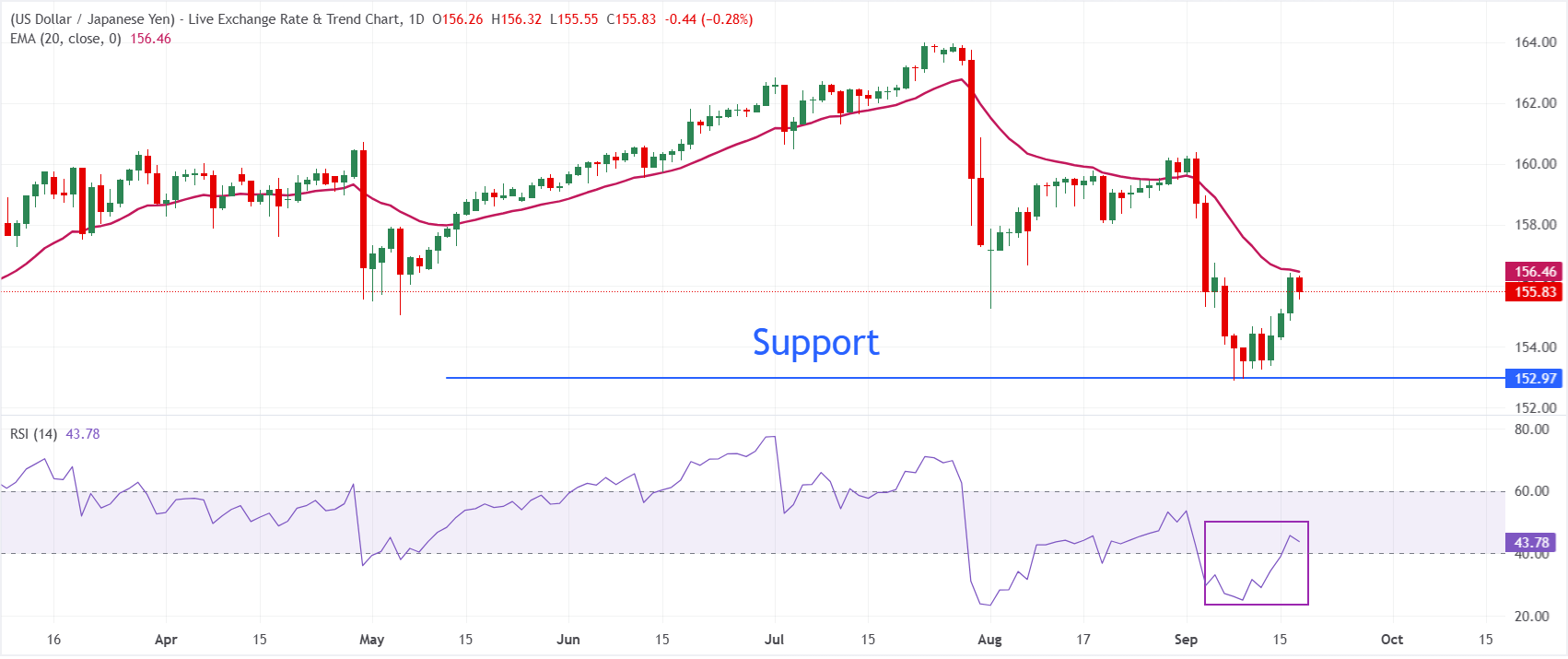
From a chart perspective, the USD/JPY pair is navigating a critical phase. The currency pair has slipped below its short-term trend signals and is now testing a support zone that many technical analysts consider pivotal. The region spanning 152 to 155 has emerged as a focal point, with the 152 level representing a particularly important floor.
Several technical indicators are telling a nuanced story. Momentum readings suggest that the pair is approaching historically oversold conditions, which could open the door to a sharp short-term recovery. A bullish divergence has started to form, hinting that selling pressure may be losing steam even as the overall trend remains downward.
However, the larger picture on higher timeframes paints a more cautious picture. The pair has broken through a multi-month uptrend and has passed through several Fibonacci retracement levels on its way down. Should the 152 support region give way, the next significant downside target sits around 149 — a level that coincides with a long-standing trendline and could serve as a major battleground for bears and bulls alike.
On the flip side, a recovery would need to overcome several resistance levels. The first hurdle lies around 155, followed by a cluster of resistance near 158 to 161. Reclaiming that zone would be necessary to invalidate the bearish thesis and suggest that the recent decline was a corrective move rather than the start of a more sustained downtrend.
## The Intervention Factor
Currency intervention has re-entered the conversation as Japanese authorities have demonstrated a willingness to defend the yen during periods of excessive weakness. The prospect of coordinated action involving both Japanese and U.S. financial authorities adds an unpredictable element to the trading environment, particularly for those holding large positions that bet against the yen.
Historically, intervention has produced sharp but often temporary moves in the currency markets. Previous episodes of direct yen buying have sparked sharp rallies before the pair eventually returned to its fundamental trajectory. However, the current environment is different in an important respect: the interest-rate differential that once drove carry trade demand for the yen is gradually narrowing as the Bank of Japan tightens its policy. This structural shift could make intervention more impactful in the long run, as speculative short-yen positions become less anchored to fundamental yield advantages.
## What Lies Ahead: A Bullish or Bearish Path?
Forecasting models and analyst projections generally point toward a stronger yen over the coming year. Several platforms tracking currency movements have projected that the dollar-yen exchange rate could decline from its current levels, with some estimates suggesting the pair might eventually reach the low-140s or even test the high-130s before the cycle concludes.
These projections envision a path that is not linear. Temporary recoveries are expected, particularly during late 2026 and into the middle of 2027, as oversold conditions trigger short-term bounces. But the broader direction points lower, reflecting the combined weight of tightening Japanese policy, a resilient dollar, and evolving market expectations around inflation and global growth.
Traders should prepare for a volatile ride. Key dates, data releases, and central bank communications will continue to move the pair sharply in either direction, and position management will be critical for anyone exposed to the dollar-yen market.
—
## Frequently Asked Questions (FAQ)
**Q: Why is the Japanese yen strengthening against the U.S. dollar?**
A: The yen is strengthening primarily due to the Bank of Japan’s ongoing tightening cycle, which is gradually closing the interest-rate gap between Japan and other major economies. As Japanese rates rise, the incentive to hold low-yielding yen positions diminishes, reducing demand for carry trades and supporting the currency’s value.
**Q: What is the significance of the 152 level for USD/JPY?**
A: The 152 level is widely regarded as a critical technical support zone. It aligns with a key Fibonacci retracement level, the lower boundary of a long-standing price channel, and the midpoint of a broader support region spanning 152 to 155. A break below 152 could accelerate selling and expose the pair to further downside.
**Q: Can currency intervention reverse the yen’s strengthening trend?**
A: Intervention can produce sharp short-term movements, but its long-term effectiveness depends on the underlying fundamentals. In the current environment, the narrowing interest-rate differential means that speculative short-yen positions are less supported by yield advantages, which could make intervention more lasting than in previous cycles.
**Q: How does the Federal Reserve’s policy affect USD/JPY?**
A: The Fed’s decisions directly impact dollar-denominated yields. Higher U.S. rates tend to support the dollar relative to the yen, as investors seek better returns. However, when the Fed and the Bank of Japan are both tightening, the effect on USD/JPY depends on which central bank is moving more aggressively and how markets interpret their forward guidance.
**Q: What role do oil prices play in the yen’s movements?**
A: Japan is a major energy importer, so rising oil prices increase its trade costs and can weigh on economic growth. At the same time, higher energy prices can stoke inflation, giving the Bank of Japan more justification to tighten policy. This creates a complex dynamic where oil moves can push the yen in opposing directions depending on which effect dominates at any given time.
**Q: Are USD/JPY price predictions reliable?**
A: Forecasting models provide useful directional guidance based on current data and assumptions, but currency markets are inherently unpredictable. Shocks, policy surprises, and changes in global economic conditions can invalidate even well-constructed projections. Traders should use forecasts as one input among many when forming their market views.
**Q: What would need to happen for USD/JPY to reverse its downtrend?**
A: A meaningful reversal would require the pair to reclaim and hold above 154.80, then push past the 20-day exponential moving average near 156.45. Sustained strength beyond 158 to 161 would be needed to confirm that the broader trend has shifted from bearish to bullish. Additionally, a significant shift in monetary policy expectations — such as the BoJ pausing or the Fed pivoting to cuts — would provide fundamental support for a recovery.
—
## Conclusion
The USD/JPY pair is navigating one of its most consequential periods in recent memory. The convergence of Bank of Japan tightening, Federal Reserve hawkishness, elevated global inflation, and the ever-present risk of currency intervention has created an environment where even small shifts in policy or data can trigger outsized moves.
For market participants, the key takeaway is that both technical and fundamental factors are aligning in a way that favors further yen strength, even as short-term bounces remain possible. The 152 support region stands as the defining level of the current setup, and how it holds — or fails — will likely set the tone for the next phase of the dollar-yen story.
As always, disciplined risk management and a clear understanding of both the technical structure and the macroeconomic backdrop will be essential for anyone navigating this rapidly evolving market.
Thank you for reading
