



# Nike Stock Faces Prolonged Struggle as Wall Street Weighs Recovery Potential
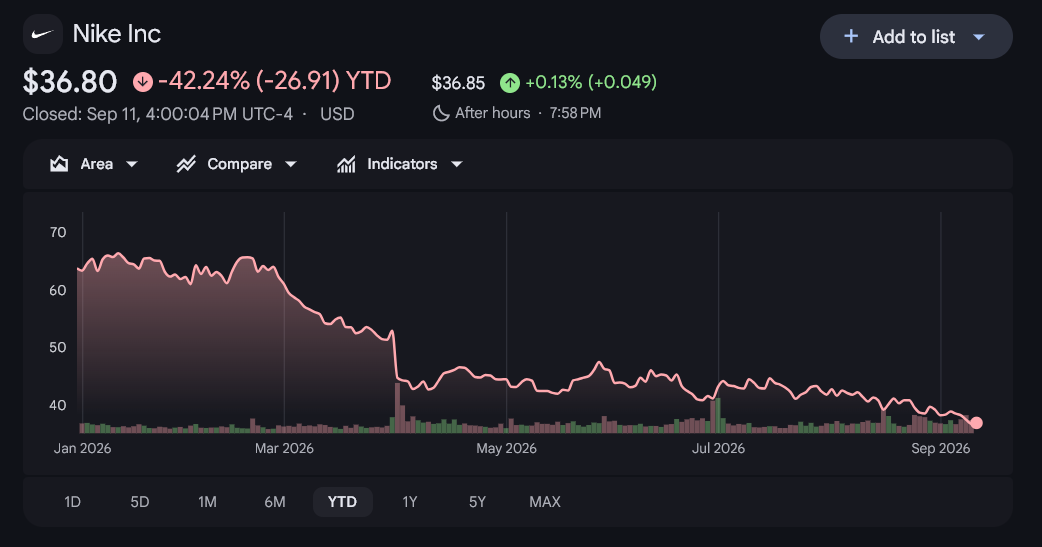
**Nike’s shares have experienced a dramatic deterioration in 2026, with the company becoming the weakest performer in the Dow Jones Industrial Average.** The stock has tumbled approximately 40% year-to-date, closing at $38.40 per share and pushing the sportswear giant’s market capitalization down to $56.97 billion—a steep decline from the roughly $264 billion it commanded at the end of 2021.
Wall Street’s collective 12-month price target hovers near $50.46, suggesting roughly 31% upside from current levels. However, this Neutral consensus masks a sharp divide among analysts, with some firms actively cutting their expectations as the company’s challenges deepen.
—
## Valuation May Look Attractive, But the Risks Remain
The selloff has brought Nike’s valuation metrics into strikingly low territory. The stock now trades at around 18 times trailing earnings, a significant contraction from approximately 31 times back in fiscal 2022. Its price-to-sales ratio has fallen even more dramatically, collapsing from roughly 4.0 to about 1.2.
By historical standards, these figures suggest the stock is trading at a deep discount. Yet a cheaper valuation does not automatically signal a bottom. Investors are wrestling with a critical question: how much further will earnings erode before Elliott Hill’s turnaround strategy begins delivering consistent, measurable growth?
—
## Major Banks Grow More Bearish on Nike
Recent analyst actions have added to the caution surrounding the stock. JPMorgan downgraded Nike to Underweight in August, slashing its price target to $40. The bank highlighted that the financial impact of Hill’s “Win Now” initiative could suppress earnings well into fiscal 2028, while the restructuring of the company’s Greater China operations is expected to create more than $1 billion in annual revenue headwinds.
Truist similarly reduced its rating and trimmed its price target to $42. Contributing to the pessimism, weaker footwear demand at Dick’s Sporting Goods has raised concerns that Nike’s recovery timeline may extend well beyond what the market currently anticipates.
The gap between the broad Wall Street average target of $50.46 and the more conservative individual forecasts underscores the uncertainty surrounding Nike’s trajectory. Without concrete proof of stabilizing sales and improving margins, assigning the stock a higher valuation multiple remains a difficult case to make.
—
## S&P 100 Removal Signals the Extent of the Decline
Nike’s slide is also reshaping its standing among America’s largest corporations. S&P Dow Jones Indices has announced that Nike will be removed from the S&P 100 on September 21, making way for technology names such as Dell, Palo Alto Networks, Arista Networks, and SanDisk.
While the index change does not directly affect Nike’s operations, it serves as a stark reminder of how much market value the company has lost. The stock sits roughly 78% below its November 2021 all-time high, and its current market cap represents only a shadow of its former peak.
—
## The Business Itself Is More Resilient Than the Stock Suggests
Fiscal 2026 revenue came in at $46.4 billion, essentially flat year over year on a reported basis. Beneath the surface, there are promising shifts in how Nike distributes its products. Wholesale revenue grew 6%, reflecting the company’s efforts to rebuild ties with retail partners after years of prioritizing direct-to-consumer channels.
At the same time, Nike Direct revenue dropped 6%, and digital sales fell 12%. This divergence paints a nuanced picture: the company is making progress repairing relationships with third-party retailers, yet demand within its own direct channels remains soft and uneven.
China remains one of the biggest obstacles. Ongoing weakness in the region has pressured results for some time, and JPMorgan’s estimate of more than $1 billion in annual revenue impact from the Greater China reset reinforces the headwinds ahead. Until that market shows signs of stabilization, strength in other regions may not be enough to drive a decisive earnings turnaround.
Nike is not alone in facing headwinds. Peer companies like Lululemon have also retreated sharply, with shares falling roughly 52% this year amid softer demand for core apparel categories and intensifying competition for market share.
—
## Short-Term Price Forecast Points to Limited Recovery
Algorithmic forecasting models paint a cautious near-term picture for Nike. Through the remainder of 2026, the stock may face continued pressure before any meaningful rebound takes hold. September carries an average projected price of roughly $32.51, while October is expected to be the weakest month, with an average forecast around $30.18 and a possible low near $28.85.
Conditions appear to improve modestly as the year progresses. November is forecast at an average of $35.19, and December edges higher to $37.14, though even the best-case December projection of $38.98 would leave the stock barely above its current level.
The outlook brightens somewhat in early 2027. January carries an average target of $41.78, with February reaching as high as $43.07. Throughout the spring months, average prices are expected to remain in the $40 range, indicating a temporary recovery that would still fall well short of Wall Street’s $50.46 average analyst target.
Momentum is expected to fade again in the second half of 2027. Average prices could decline from $39.06 in May to $36.35 in June and $36.01 in July, before slipping to $34.99 in August. By September of that year, the forecast drops to $31.80 on average, with potential lows around $29.76.
Overall, the algorithmic guidance points to a modest and short-lived recovery rather than a sustained reversal—a notable divergence from the more optimistic tone of the broader analyst consensus.
—
## Frequently Asked Questions
**Why has Nike stock fallen so sharply in 2026?**
Nike’s decline has been driven by a combination of weaker direct-to-consumer sales, softening demand in China, and skepticism about how quickly CEO Elliott Hill’s turnaround strategy will produce results. Downgrades from major banks like JPMorgan and Truist have further weighed on sentiment.
**Is Nike stock a good buy at current levels?**
While the stock trades at historically low valuation multiples, a cheap price does not guarantee a bottom. Investors should weigh the attractive valuation against the risk that earnings could face further pressure before any sustained recovery materializes.
**What is the significance of Nike leaving the S&P 100?**
The removal reflects the scale of Nike’s market value loss rather than any change in its underlying business. It signals to investors that the company has fallen significantly from its former position among America’s largest and most influential corporations.
**How does the China market affect Nike’s outlook?**
China remains a critical market for Nike, and the company’s ongoing restructuring there is expected to create more than $1 billion in annual revenue pressure. Stabilization in the Chinese consumer market will likely be a key prerequisite for any meaningful earnings recovery.
**Do algorithmic price forecasts align with Wall Street analyst targets?**
Not entirely. While analysts on average see roughly 31% upside to a $50.46 target, algorithmic models suggest a more limited early-2027 recovery that would only partially close the gap, followed by renewed weakness later in the year.
—
## Conclusion
Nike finds itself at a pivotal crossroads. The stock’s steep decline has made it one of the cheapest names in the Dow by many valuation measures, but the company faces real and persistent challenges. China weakness, a turbulent direct-to-consumer transition, and skepticism from major analysts all suggest that a turnaround will not happen overnight.
For investors, the situation presents a classic dilemma: the valuation is compelling, but the fundamental evidence needed to justify a sustained recovery has yet to materialize. A temporary bounce in early 2027 is possible, but anyone considering a position in Nike should be prepared for continued volatility and the prospect of further downside before any meaningful reversal takes hold.
Thank you for reading
