



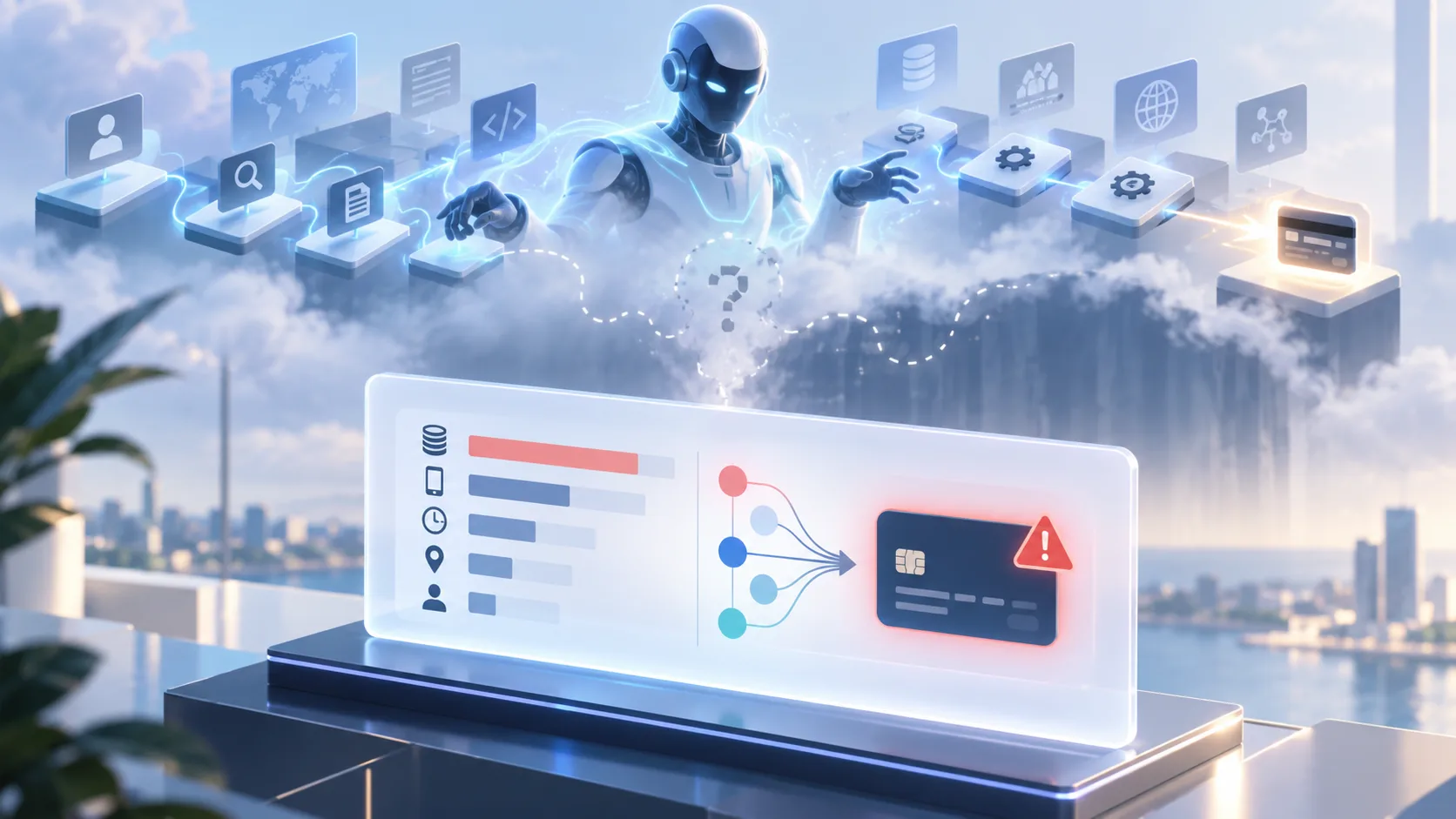
# When Machines Start Shopping for Themselves: The New Frontier of Financial Fraud
## The Rise of Non-Human Transaction Actors
Fraud has undergone a quiet but profound transformation in recent years. While most fraudulent activity still involves a person manually attempting to move funds that don’t belong to them, a growing category of fraud now operates without any human at the keyboard at the moment of the transaction. Autonomous AI agents — software systems capable of browsing, shopping, and executing financial actions on behalf of users — have become a significant vector for financial crime.
Industry forecasters have begun labeling this phenomenon “machine-to-machine mayhem,” a term that captures the core difficulty: there is no longer always a human being on the other end of a transaction log. A legitimate autonomous shopping agent and a malicious bot can produce transaction records that look nearly identical. At this point, the industry has not yet identified a reliable signal that distinguishes one from the other.
## The Human Fingerprint Assumption
For over a decade, fraud detection systems across every tier — from emerging fintech startups to global banking institutions — have rested on a foundational belief: that a human being is present at the point of transaction, and that humans are predictable creatures who leave behavioral traces.
These traces include how someone types, the rhythm of their interactions, the timing of their actions across devices, and behavioral cues like hesitation or urgency. Every fraud model, whether its creators acknowledge it or not, has been trained to detect when a human stops behaving in a way consistent with their established patterns.
This worked well because it leveraged something fundamentally human: consistency. People develop routines, spending habits, and behavioral rhythms. Deviations from those rhythms — a sudden large purchase from an unusual location, a rapid sequence of transactions — serve as reliable red flags. The entire architecture of modern fraud detection was built on this premise.
But that premise begins to crumble when the actor behind the transaction isn’t human at all.
## Why Explainability Became Essential
Even before autonomous agents entered the picture, black-box fraud models carried an inherent trust problem. The models that deliver the highest predictive performance — deep ensembles, gradient-boosted decision trees — are notoriously difficult to interpret. When a compliance officer encounters a flagged transaction but cannot understand why it was flagged, one of two outcomes inevitably follows: either every transaction gets rubber-stamped, or the model gets ignored entirely. Neither outcome represents what the system was designed to achieve.
This is where explainability techniques earned their place in fraud infrastructure. Tools that rank and display the specific factors driving a particular prediction — showing, for example, that a flagged transaction was primarily driven by an unusually high dollar amount combined with a recently created account and a merchant with prior risk flags — transform an opaque number into something actionable.
A risk score without reasoning attached becomes nearly useless the moment a real person must make a decision based on it. Explainability bridges the gap between statistical output and human judgment, giving analysts the confidence to act on model recommendations.
## When Behavioral Baselines Disappear
The features fraud detection models rely on — transaction amount, timing, device fingerprint, velocity of activity — all derive their usefulness from a single underlying assumption: that there is a stable human behavioral baseline to deviate from.
Anomaly detection works because a university student’s account suddenly moving six-figure sums represents a departure from an established pattern. The system catches the shift because it knows what “normal” looks like for that account.
An AI agent has no such baseline in any meaningful sense. It does not experience fatigue at odd hours. It does not accidentally mistype a recipient or panic-transfer funds to the wrong account in a moment of anxiety. It can sustain transaction speeds and consistencies that no human could maintain for even a short period. Every action it takes falls within its programmed parameters, meaning nothing about its behavior registers as anomalous under a system designed to spot human deviation.
The signals that fraud defenses were originally constructed around are themselves changing. A survey of over 1,400 fraud and risk professionals across 25 countries found that a significant majority believe AI-mediated banking will weaken the effectiveness of traditional fraud defenses within the next year. This points to something more fundamental than criminals simply acquiring better tools — the very behavioral signals those defenses rely on are beginning to erode.
## Regulatory Signals
Regulatory bodies have started responding to this shift, though the industry itself has yet to fully catch up. In early 2026, a major national standards organization launched an initiative specifically addressing autonomous AI agents. The initiative frames agents as identifiable non-human principals requiring their own credential management and audit trail requirements, on the basis that existing authentication frameworks were designed exclusively for human users and do not extend to autonomous software entities.
In parallel, legislative efforts have emerged. A proposed federal bill would establish a public registry of verified autonomous agents and mandate that these systems operate transparently in their user’s interest when interacting with major platforms. While the legislative fate of any particular bill remains uncertain, the broader direction is clear: lawmakers have identified identity verification and accountability as the foundational questions that must be answered before the industry can build robust defenses against agent-driven fraud.
The challenge, however, is significant. The industry has not yet converged on a standard way to log an agent’s decision-making process in a manner that a human auditor could later review and understand.
## What Still Works — and What Doesn’t
It would be a mistake to declare traditional fraud detection methods obsolete. Feature-level explanations and transaction-based anomaly detection remain highly effective for the vast majority of fraud scenarios involving actual human actors. Humans are still responsible for the majority of fraudulent transactions, and behavioral analysis still catches the kinds of deviations that human fraudsters introduce.
What traditional methods struggle with is a fundamentally different question. Current explainability tools answer “why does this transaction look suspicious?” but agentic fraud demands an additional layer of inquiry: “why did this actor take this action at all?”
The second question requires tracing an agent’s decision trajectory — the sequence of tools it invoked, the permissions it held, whether its eventual action fell within the scope of what it was originally delegated to do. This is less like scoring a single data point and more like auditing a complete path of decision-making. A system designed to explain a classification model’s output about a dollar amount has essentially nothing to say about whether the agent that ultimately triggered that transaction diverged from its intended behavior upstream.
## A Path Forward
The most promising direction likely involves borrowing from fields that already grapple with autonomous system behavior — areas focused on trajectory monitoring and agent evaluation — and integrating those methods with the explainability traditions already established in fraud detection. Rather than refining existing tools to handle a problem they were never designed for, the solution may require building something new from the ground up: a system capable of not only explaining a decision but reconstructing the full chain of reasoning behind it.
It is also worth acknowledging that this problem remains genuinely unsolved. The academic and industry literature contains proposals that gesture toward solutions but have not yet delivered fully closed frameworks. Whether this reflects a gap in search efforts or a genuinely open research challenge remains an open question.
For anyone involved in building or evaluating fraud detection systems, the question worth sitting with is no longer simply whether the model is accurate. It is whether the explanations the system provides still hold meaning when the entity on the other side of the transaction stops being a person.
—
## Frequently Asked Questions
**Q: What is “machine-to-machine mayhem” in the context of fraud?**
A: It refers to fraud carried out by autonomous AI agents acting on behalf of users — or maliciously — without direct human involvement at the moment of the transaction. These agents can browse, authorize purchases, and execute transfers, producing transaction records that are difficult to distinguish from legitimate human-initiated activity.
**Q: Why do traditional fraud detection systems struggle with AI agents?**
A: Traditional systems are built around detecting deviations from expected human behavior. They rely on features like transaction timing, device switching, spending velocity, and behavioral anomalies. Since AI agents operate at consistent speeds without fatigue or hesitation, their behavior does not trigger the deviation-based signals these systems were designed to catch.
**Q: Is SHAP still relevant for fraud detection?**
A: Yes. SHAP and similar explainability methods remain valuable for understanding why specific transactions are flagged, particularly in cases involving human actors. The limitation is not with SHAP itself but with the scope of what it can explain — it addresses transaction-level reasoning rather than reconstructing an agent’s full decision trajectory.
**Q: What kind of regulatory responses are emerging?**
A: Regulatory bodies in several countries have begun treating autonomous agents as distinct entities requiring their own identity frameworks, credential lifecycles, and audit trails. Proposed legislation in some jurisdictions includes requirements for agent registries and mandates for transparent operation in the user’s interest.
**Q: What does the future of fraud explainability look like?**
A: The likely direction involves combining traditional transaction-level explainability with trajectory-based auditing — tracking not just what decision was made but the full sequence of actions and reasoning that led to it. This represents a shift from scoring individual data points to reconstructing complete decision paths.
**Q: Are human-driven fraud and agent-driven fraud the same problem?**
A: No. They require different detection strategies. Human-driven fraud exploits behavioral anomalies, while agent-driven fraud exploits the absence of a stable behavioral baseline. Effective defense systems will likely need to address both categories simultaneously.
—
## Conclusion
The landscape of financial fraud is evolving at a pace that demands attention from both technologists and regulators. The emergence of autonomous agents as transaction actors introduces a class of fraud that does not neatly fit into the detection paradigms built over the past decade. These systems exploit the very assumptions — human consistency, behavioral baselines, deviation as a signal — that modern fraud detection relies upon.
The response cannot simply be better models or more sensitive thresholds. It requires a fundamental rethinking of what it means to explain a fraud decision when the decision-maker is not human. This means moving beyond transaction-level explanations and toward full trajectory reconstruction, audit trails for autonomous actors, and frameworks that treat agent identity as a first-class concern.
The gap between explaining a score and explaining an actor is real, and closing it will require collaboration across fraud detection, AI safety, and regulatory design. Those who begin addressing this gap now will be better positioned to defend financial systems in a world where the line between human and machine transaction is no longer clear.
Thank you for reading
