



# Abacus AI Reviewed: A Broad Platform That Tries to Do Everything — and What That Means for Your Workflow
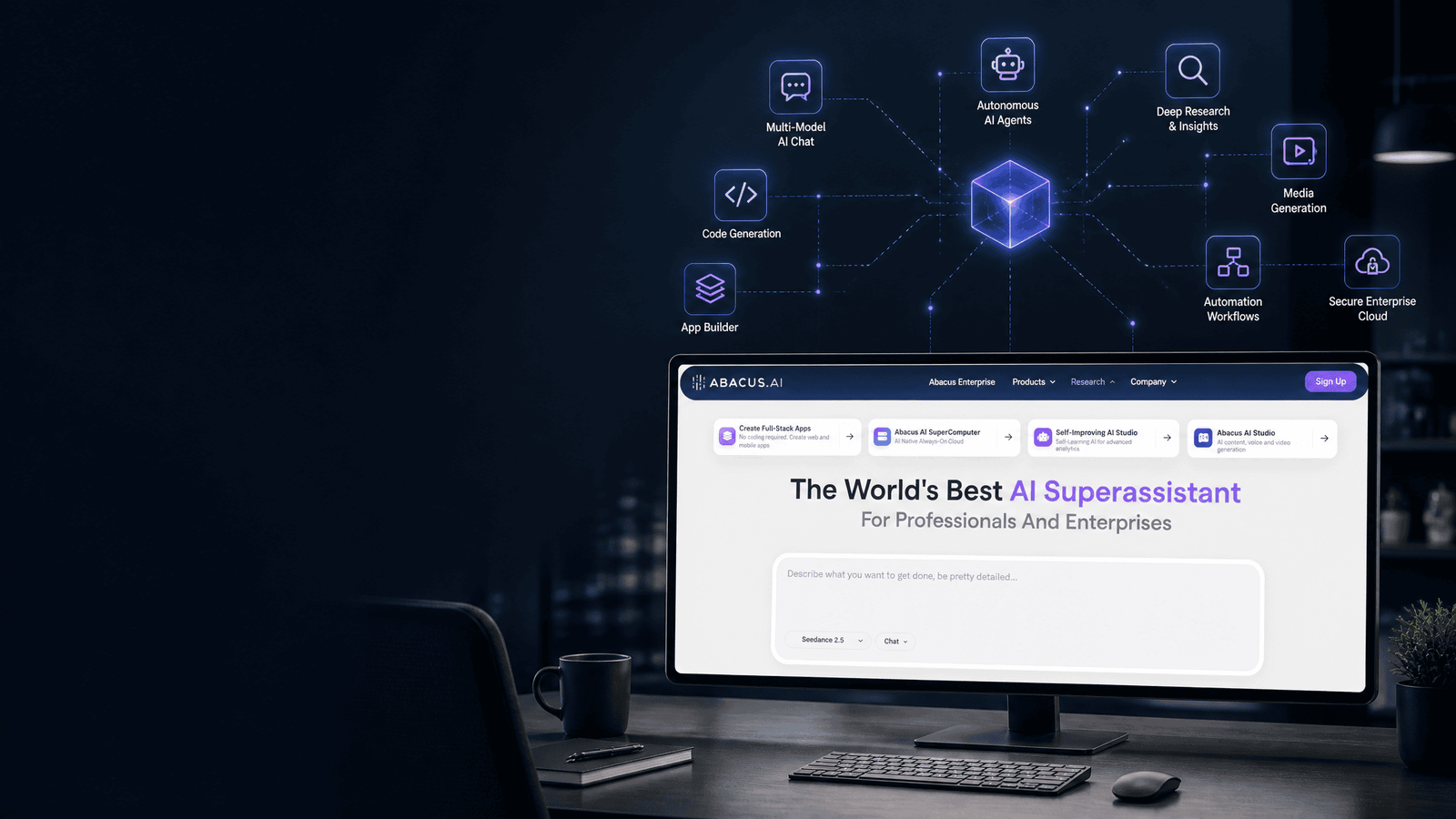
The AI subscription market has become crowded, expensive, and increasingly siloed. Many professionals today juggle separate tools for chat, coding, research, image generation, automation, and app deployment — each carrying its own monthly fee and its own learning curve. Against this backdrop, Abacus AI positions itself as a unified alternative: a single platform that bundles multi-model chat, intelligent agents, creative tools, app builders, personal assistants, API routing, cloud infrastructure, and an enterprise-grade machine-learning environment under one roof.
But consolidation at a low price tag does not automatically mean better value. The real questions are whether the breadth of Abacus AI translates into practical daily usefulness, whether its credit system makes costs predictable, and whether its reliability matches the promise its features suggest. This review examines the platform from the standpoint of an individual professional or small team deciding whether it is worth adding to — or replacing — their existing AI subscriptions.
—
## What Exactly Is Abacus AI?
Abacus AI is a multi-purpose artificial intelligence platform that was founded around 2019 by researchers with backgrounds at Google Brain and related institutions. The company originally built its reputation as an enterprise machine-learning platform before evolving into the broader consumer and professional assistant space.
The self-serve product that most individuals encounter centers on a conversational interface called ChatLLM. ChatLLM is essentially a model-agnostic chat window that connects to language, image, and video models from OpenAI, Anthropic, Google, xAI, DeepSeek, Moonshot, and a growing roster of other providers. The catalog spans over 100 models at the time of this writing, though that number is fluid — providers rotate, versions update, and availability shifts without warning.
Beyond ChatLLM, the platform extends into several distinct but interconnected tools:
– **Abacus AI Agent** (formerly branded as DeepAgent) is a general-purpose agent capable of carrying out multi-step tasks such as compiling research reports, building presentations, writing and deploying code, processing invoices, and automating browser workflows. It can browse the web, create files, and interact with external services.
– **Desktop** is a local workstation that combines a coding agent, a command-line interface, a VS Code extension, and a meeting transcription listener. It processes local files without requiring cloud uploads, which is a notable privacy advantage.
– **Studio** is a creative workspace offering access to more than 50 image, video, and audio generation models in a single interface.
– **AppLLM** is a browser-based builder for creating, running, and deploying full-stack applications from natural-language prompts.
– **Personal Agents** (including Claw and Hermes) are persistent assistants with memory that can be connected to messaging platforms like Telegram, Discord, or WhatsApp for scheduled check-ins and ongoing context.
– **RouteLLM** provides a single API endpoint that covers more than 160 models, offering automatic routing, failover, and prompt caching for developers.
– **SuperComputer** is a persistent cloud environment for hosting applications, APIs, databases, and agents that need to stay online beyond a browser session.
– **Abacus AI Enterprise** is a separately scoped organizational product designed for companies that need private deployment, SSO, role-based permissions, dedicated GPU clusters, and connections to internal data sources.
It is important to understand that the consumer-facing subscription and the enterprise platform are separate products with different capabilities, pricing, and support commitments. Confusing the two leads to incorrect expectations on either side.
—
## Key Strengths: Where Abacus AI Delivers
### Genuine Breadth in a Single Interface
Few competing products offer this combination of chat, coding, creative generation, app deployment, persistent agents, API routing, and cloud hosting in one subscription. For a professional who regularly switches between writing, document analysis, coding, research, automation, prototyping, and media generation, the reduction in context-switching and account management is tangible.
### Model Comparison Without Account-Hopping
One of the most practical advantages of ChatLLM is the ability to run the same document, prompt, or analysis through models from different providers without re-uploading or managing separate logins. If your workflow benefits from seeing how GPT-4o, Claude Sonnet, and Gemini each interpret the same material, having them in one workspace saves significant time.
### Competitive Pricing at the Entry Level
At a published introductory rate of $7 for the first month and $10 monthly thereafter for the Basic tier, the platform undercuts the cost of holding individual subscriptions to ChatGPT Plus ($20), Claude Pro ($20), and similar services. When you factor in that Pro at $20 per month unlocks broader model access, unrestricted agent conversations, personal assistants, and SuperComputer access, the consolidation math becomes compelling for users who actively employ multiple components.
### Coherent Developer Tooling
Desktop and AppLLM form a surprisingly complete prototyping stack. Local file context, terminal integration, VS Code extension, browser automation, one-click deployment, built-in databases, authentication flows, and rollback capabilities are features that most developers would otherwise assemble from separate tools. For founders and technical teams validating ideas quickly, this stack has real practical value.
### RouteLLM as Infrastructure
For developers building applications that need to integrate with multiple model providers, having one OpenAI-compatible endpoint with failover and caching eliminates significant integration overhead. It is a more substantive offering than a simple model-selection menu.
—
## Key Weaknesses: Where the Platform Falls Short
### Credits Make Real Costs Hard to Forecast
The headline subscription price tells you almost nothing about how much productive work you can complete. Abacus AI uses a credit system where different activities consume credits at vastly different rates. Simple text chat is cheap; complex agent runs, large file analysis, video generation, and persistent cloud computation are expensive. Exact per-model and per-task costs are not consistently published, and the credit draw can vary significantly depending on the model chosen, the task complexity, and the current state of the platform’s infrastructure.
Users across multiple independent review platforms have reported rapid credit depletion, restrictions appearing before the end of the billing cycle, credits consumed during failed agent runs, and confusion around promotional pricing. While individual reports are not verified findings, their consistency across sources and time periods is a signal that deserves attention.
### Agent Reliability Is Inconsistent
The vendor’s demonstration gallery shows sophisticated, polished outcomes — self-fixing code, investor-grade research reports, personalized outreach at scale. Everyday user experience is more uneven. Some users receive usable, well-structured outputs; others encounter looping agents, incomplete tasks, context loss mid-run, and credits consumed during failures. Agents are useful tools that require active oversight, not autonomous systems you can set and forget — especially not for high-stakes work.
### Basic Tier Severely Limits the Platform’s Differentiating Features
Agent task limits, restricted Desktop capabilities, and a smaller credit allocation mean the features that most distinguish Abacus AI from a standard chatbot are effectively gated behind the Pro tier at $20 per month. The $10 Basic plan is a reasonable way to sample the platform and test whether the model access alone justifies the cost, but it should not be mistaken for the full experience the marketing pages imply.
### Support Quality Is a Repeated Complaint
Delayed responses, unresolved billing issues, cancellation friction, and difficulty obtaining credit refunds for failed agent runs appear consistently across independent feedback. At the price point of the subscription, responsive support is a baseline expectation. Based on available evidence, it is not consistently delivered.
### Product Clarity Is Poor
The platform has separate landing pages for ChatLLM, Agent, Desktop, Studio, AppLLM, personal agents, RouteLLM, Roleplay, and SuperComputer — many of which advertise the same introductory price while describing different access levels. A prospective customer should not have to cross-reference multiple product pages to answer the fundamental question of what a single subscription includes.
—
## How Abacus AI Compares to ChatGPT, Claude, and Gemini
| Dimension | Abacus AI | ChatGPT | Claude | Gemini |
|—|—|—|—|—|
| **Primary appeal** | Multi-model workspace with agents, coding, apps, media, and routing | Direct OpenAI product experience | Direct Anthropic access with coding tools | Google ecosystem integration |
| **Entry price** | $7 first month, $10 Basic, $20 Pro | Free tier available; Plus is $20 | Free tier available; Pro is $20 | Free tier available; Advanced from ~$20 |
| **Model variety** | 100+ in ChatLLM; 160+ through RouteLLM | OpenAI models only | Anthropic models only | Google models |
| **App deployment** | Built-in via AppLLM and Agent | No equivalent hosted builder | No equivalent hosted builder | No equivalent hosted builder |
| **Creative tools** | 50+ models across image, video, and audio in Studio | Plan-dependent image features | Not the central focus | Google-native media tools |
| **Coding environment** | Desktop with local files, CLI, VS Code, browser automation | Codex integration (tier-dependent) | Claude Code and Cowork on Pro | Not established |
| **Main drawback** | Complexity, credit opacity, agent inconsistency | Single provider’s model family | Single provider’s model family | Less relevant if Google tools are not central |
**When to choose Abacus AI:** You routinely compare model families, need app deployment alongside chat, want agent and automation tools in one account, or find that separate subscriptions for coding, research, and media creation create real operational friction. Its value increases with the number of components you actually use.
**When to choose a first-party tool:** You prefer a cleaner, simpler experience with direct access to one provider’s ecosystem. ChatGPT, Claude, and Gemini each offer polished, focused experiences without the orchestration overhead of a multi-model platform.
—
## Safety and Privacy: What You Should Know
Abacus AI publishes a security posture that includes AES-256 encryption at rest, TLS 1.2 or higher for data in transit, AWS KMS for key management, logical data separation, least-privilege access, multi-factor authentication for production systems, vulnerability scanning, and penetration testing. The vendor states SOC 2 Type II and ISO/IEC 27001:2022 compliance and supports HIPAA, GDPR, and CCPA requirements. Enterprise options include SSO, SAML, permission hierarchies, dedicated infrastructure, and in-VPC deployments.
The vendor also states that customers retain ownership of their data, that prompts are not used to train generalized models, that customer data is not sold, and that deletion occurs within 15 days after a qualifying request or service termination.
These are meaningful controls, but they are vendor statements, not independently verified conclusions. The risk profile shifts significantly when you grant a desktop agent screen access, connect email or messaging integrations, expose a public application endpoint, accumulate long-term personal-agent memory, or allow an agent to operate a browser autonomously.
Before placing sensitive data on the platform, confirm which security and retention terms apply to your specific plan, restrict integrations to the minimum permissions each task requires, avoid placing API keys or credentials in prompts or source files, and require human approval before agents take irreversible actions.
The Roleplay product specifically advertises no data retention and anonymous use, but those terms apply only to that product — do not assume they extend to the rest of the platform.
—
## Who Should Use It — and Who Should Not
### Strong Fit:
– **Developers and technical founders** who want one environment for model comparison, coding, repository work, app generation, deployment, API access, and persistent cloud services.
– **Analysts and researchers** who regularly work with documents, spreadsheets, web research, and long-form output and benefit from testing different models against the same material.
– **Agencies and marketing teams** that need research, copy, imagery, video, and presentations in one system and want to iterate across creative models without managing separate accounts.
– **Operations teams** exploring scheduled briefings, document extraction, browser automation, CRM updates, and monitoring agents — workflows that benefit from staged testing and checkpoints.
### Look Elsewhere If:
– You want the simplest possible chatbot experience and do not want to manage credits, routing, or product selection overhead.
– You need strictly predictable monthly usage. Credit variability makes precise budgeting genuinely difficult, and unexpected depletion is a recurring user complaint.
– You are considering unattended automation involving money, legal commitments, trading, external communications, or security changes. Agent errors and hallucinations are real, and the current reliability record does not justify unmonitored high-stakes automation.
– You are subscribing primarily because a specific model version is listed in the catalog. The catalog is a snapshot, not a guarantee.
—
## A Sensible Buying Strategy
If you are considering Abacus AI, approach it as a trial rather than a commitment. The introductory month is inexpensive enough to make this practical. Follow these steps:
1. **Start with the introductory month** and record the exact credit balance and renewal price before it auto-renews.
2. **Test the three or four features most relevant to your workflow** — do not try to evaluate everything at once.
3. **Measure credit consumption** on your actual tasks and note any failure rates or unexpected interruptions.
4. **Contact support with a real question** before you hit any problems, to gauge response time and quality firsthand.
5. **Export important outputs and keep local copies** — do not rely on the platform as your sole repository.
6. **Upgrade to Pro only after confirming** that a Basic limitation is genuinely blocking your work, not before.
—
## Frequently Asked Questions
### What is Abacus AI actually used for in practice?
The platform serves a wide range of use cases: multi-model AI chat, document and spreadsheet analysis, web-based research, coding and repository work, application building and deployment, image and video generation, scheduled automation, custom chatbots, personal assistants, API routing, and enterprise machine-learning workloads. Which of these a given user engages with depends entirely on their profession and daily needs.
### How much does Abacus AI cost at its core?
The published entry price is $7 for the first month, then $10 per month for the Basic tier. The Pro tier costs $20 per month and includes more monthly credits, broader model access, and unrestricted access to agents, personal assistants, Desktop, and SuperComputer. Enterprise pricing reportedly starts at $5,000 per month and requires direct commercial negotiation. Always verify current pricing at checkout before committing.
### Is there a free plan available?
Based on the pricing documentation reviewed for this analysis, there is no standing free plan for ChatLLM. Several product pages promote a discounted first month as the primary entry point. Availability of promotional terms changes, so check the live checkout page for the most current options.
### What is the difference between ChatLLM and Abacus AI Agent?
ChatLLM is the conversational workspace used for chat, file analysis, document and spreadsheet work, media generation, and model comparison. Abacus AI Agent is the execution layer for multi-step, autonomous tasks such as compiling research, building applications, running browser workflows, and creating presentations. They are separate tools within the same subscription, not the same product with different names.
### Can Abacus AI actually build and host an application?
Yes. AppLLM and Abacus AI Agent are documented as capable of building full-stack applications from text prompts, with built-in databases, authentication, hosted deployment, custom domains, and rollback capabilities. However, any application produced this way should be code-reviewed and security-tested before real users interact with it. A prompt-built prototype is a starting point, not a finished product.
### Does the platform include models from GPT-4, Claude, and Gemini?
The current catalog advertises models from OpenAI, Anthropic, Google, xAI, DeepSeek, and other providers. Specific versions and access levels are subject to change at any time. If a particular model version is critical to your workflow, confirm its current availability before subscribing.
### What are Abacus AI credits, and how do they work?
Credits measure platform resource consumption. They are not equivalent to language-model tokens. Simple text chat consumes far fewer credits than video generation, complex agent tasks, or persistent cloud computation. Exact per-model and per-task costs are not publicly fixed because the catalog and underlying provider economics change regularly. A billing dashboard reportedly provides real-time monitoring, but predicting costs upfront remains difficult.
### Is the platform safe for work data?
The vendor documents AES-256 encryption at rest, TLS encryption in transit, access controls, SOC 2 Type II and ISO 27001 certifications, and a policy against training generalized models on customer data. For regulated, confidential, or legally sensitive data, verify which controls apply to your specific plan, request relevant audit documentation, and review retention and subprocessor terms before proceeding.
### How does Abacus AI compare to using ChatGPT or Claude directly?
It is wider but more complex. Abacus AI provides access to models from both providers and many others, alongside app deployment, coding tools, creative generation, and persistent agents that first-party products do not bundle together. ChatGPT and Claude offer cleaner, more focused experiences with direct model access and first-party features. The right choice depends on whether you need several of Abacus AI’s components enough to justify the added orchestration layer and credit management.
—
## Final Verdict
Abacus AI earns a strong recommendation for the right user. Its breadth is genuine — no other self-serve subscription offers this combination of chat, coding, creative generation, app deployment, persistent agents, API routing, and cloud infrastructure in a single account. At $10 per month for Basic and $20 per month for Pro, the consolidation value is real for professionals who actively use multiple components.
The score is tempered by pricing opacity, inconsistent agent reliability, a support experience that does not consistently match the price point, and a Basic tier that gates the platform’s most distinguishing features behind a higher subscription. These are not dealbreakers for everyone, but they should not be ignored.
**Bottom line:** Abacus AI is worth trying — especially if you find yourself paying for multiple separate AI subscriptions and using enough of its components to make consolidation worthwhile. Start with the introductory month, test the features that matter to your workflow, measure actual credit consumption, and only upgrade when you have clear evidence that the platform solves a real problem in your daily work. If you are not sure whether you will use three or more of its components in a typical month, the low cost of the trial month makes experimentation almost risk-free.
Thank you for reading
