



# LandingAI’s ADE Gen2: A Complete Guide to the New Document Intelligence Stack
## Introduction
A new generation of document extraction technology has arrived. LandingAI’s Agentic Document Extraction Gen2 represents a fundamental reimagining of how machines read, interpret, and return structured information from documents. The platform, built on a new model family called DPT-3, moves far beyond the flat, chunk-based approach that dominated the previous generation of document AI systems. Instead, it introduces a hierarchical tree structure, character-based pricing, and a capability called atomic grounding that traces every extracted piece of data back to its exact visual origin on a page.
This article covers the architecture, pricing model, deployment options, and practical implications of ADE Gen2 for developers and enterprise teams.
## From Flat Chunks to Hierarchical Trees
The most significant architectural shift in ADE Gen2 is how documents are represented. The previous generation treated every document as a flat list of interchangeable chunks, making it difficult to preserve context about where a piece of content lived within the page hierarchy. Gen2 replaces this with a three-level tree: document root, child pages, and child blocks.
Each block carries a semantic identifier in the format of `type-index`, which remains stable within a single response. Block types now span a wide range of visual elements, including text paragraphs, tables, individual table cells, figures, marginal annotations, attestations, logos, cards, and scanned barcode or QR code regions. Every block also contains a grounding object that records the page number, a character range within the rendered markdown string, and a normalized bounding box that maps directly back to coordinates on the source page.
This tree structure unlocks capabilities that were impractical before. Because the system understands that a table cell belongs to a specific table on a specific page, downstream consumers can build more reliable pipelines for data interpretation and validation.
## The Two-Parsing-Model Approach
Rather than relying on a single monolithic model, ADE Gen2 splits the parsing workload across two specialized models. This separation gives teams a direct lever to balance accuracy against cost depending on their document mix.
**DPT-3 Verity** handles the high-volume, high-throughput side of document processing. It deterministically transcribes digitally native documents and returns a bounding box alongside a confidence score for every individual word. It excels at clean text, structured tables, and simple form fields, making it well-suited for documents that were born digital and do not require complex layout reasoning.
**DPT-3 Pro** takes a fundamentally different approach. It reads the page layout before processing individual words, detecting block types across tables, figures, marginal annotations, and handwritten signatures. It handles scanned pages, handwritten content, non-Latin scripts, and LaTeX mathematical notation. Because it operates at a higher level of document understanding, Pro commands a higher credit cost.
LandingAI’s published guidance indicates that DPT-3 Verity costs roughly 40 percent of what DPT-3 Pro costs in credits. Automated routing between the two models is expected to become available in the fall of 2026, which could further simplify integration for teams that currently need to inspect documents manually before choosing a model.
## Understanding the New Pricing Model
The pricing overhaul is arguably the most impactful change for production teams. Under the prior model, every page cost a flat rate regardless of how much content it contained or how much output the extraction produced. ADE Gen2 replaces this with a two-component formula: a per-page component plus an output-character component.
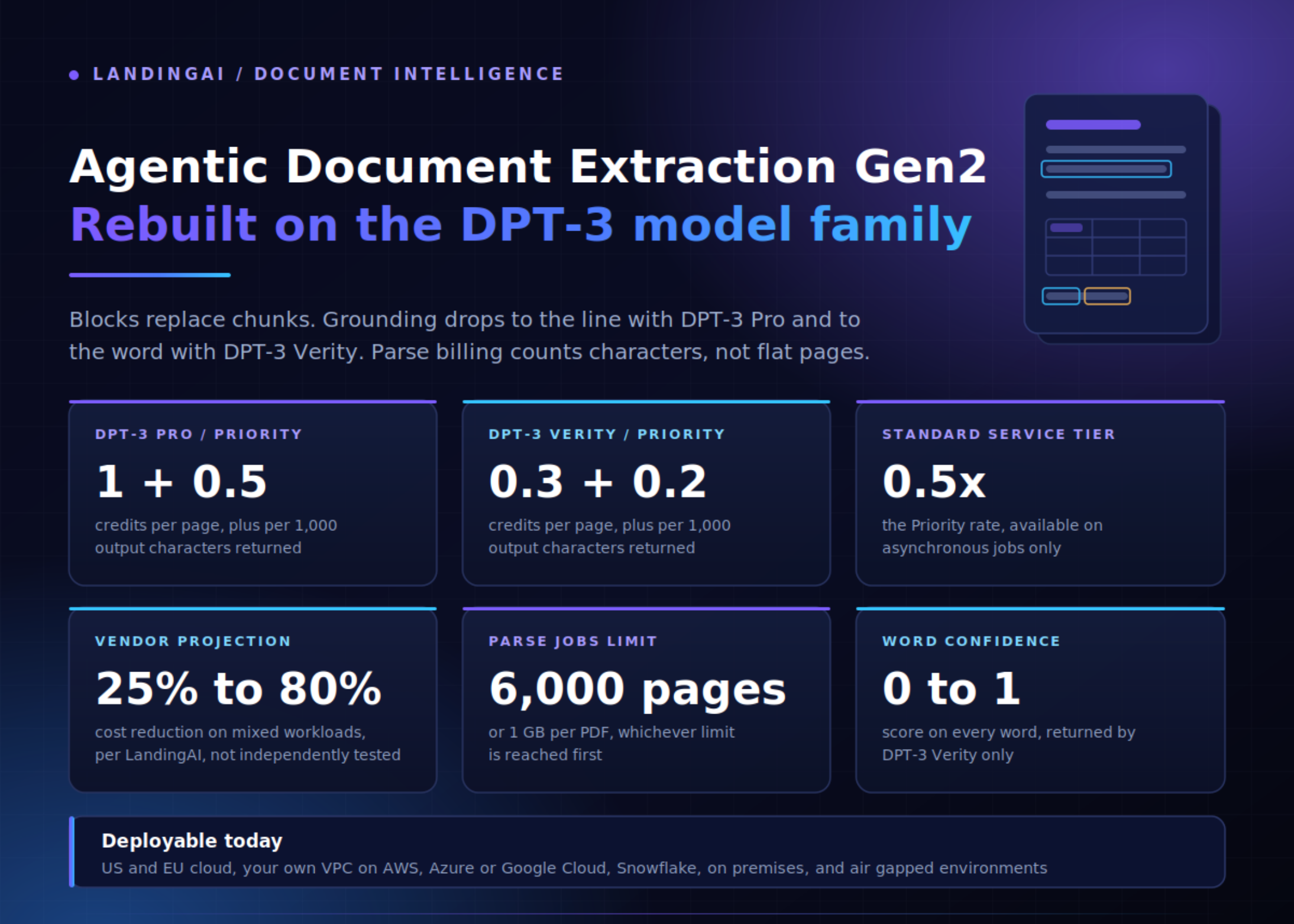
On the **priority tier**, DPT-3 Pro bills one credit per page plus 0.5 credits for every 1,000 output characters. DPT-3 Verity bills 0.3 credits per page plus 0.2 credits for every 1,000 output characters. The **standard tier** halves both rates, making it the right choice for asynchronous pipelines that can tolerate processing times of minutes to hours.
It is important to note that synchronous API calls always bill at the priority rate, and the interactive playground itself runs on priority pricing. Teams should plan their integration patterns accordingly.
A worked example helps clarify the math. A 12-page document parsed with DPT-3 Pro that returns 48,120 output characters would cost 36.1 credits on the priority tier. The same job on the standard tier would cost roughly half that amount. Totals are rounded up to the nearest 0.1 credit, and the response metadata includes a full breakdown of every input used in the calculation, so there is no ambiguity about what drives a given bill.
LandingAI projects that mixed workloads could see cost reductions of 25 to 80 percent compared to prior pricing, and Verity on the standard tier can process pages for under one cent each. These figures should be treated as estimates until benchmarked against a team’s own document characteristics, since the character component means a dense, text-heavy page can cost more than a sparse page did under the old model.
## Atomic Grounding and What It Enables
Atomic grounding is arguably the most consequential capability introduced in this release. Each leaf block in the parse tree carries an `atomic_grounding` array. DPT-3 Pro produces one entry per visual line, while DPT-3 Verity produces one entry per word.
This granularity has direct practical consequences. Verity attaches a confidence value between 0 and 1 to every word, computed as the lowest per-character score within that word. This gives teams a clear signal for routing uncertain transcriptions to human review, without having to guess which parts of a document might contain errors.
Table cells also receive their own bounding boxes under this model, though Pro leaves cell-level atomic grounding empty for the time being. The Extract V2 endpoint draws its citations directly from this grounding data, meaning every extracted field traces back to a specific word on a specific page. That traceability makes PII redaction by coordinate, document diffing, and reviewer-facing user interfaces buildable with precision rather than approximation.
## Standardized Markdown Outputs
Gen2 standardizes the format of its markdown output in ways that make it significantly easier for downstream agents and pipelines to consume. Figures now use `
Attestations emit stacked labels in a predictable format, such as `[STAMPED][SIGNED]`, with `[ILLEGIBLE_SIGNATURE]` and `[ILLEGIBLE_TEXT]` as fixed literal values that can be used as branching conditions in automation logic.
Tables ship as HTML by default, which preserves merged cells naturally. Teams can switch to markdown output for pipe syntax if needed, with merged cells expanding into neighboring empty fields in that format.
Scan code blocks emit a bracketed code type followed by the decoded value, providing structured access to barcode and QR data directly from document images.
## Deployment Flexibility
ADE Gen2 is generally available today. Developers can start for free in the interactive playground, which serves as both a testing environment and a learning tool. Enterprise teams have access to a broad deployment footprint.
The platform supports US and EU cloud regions, dedicated virtual private clouds on AWS, Azure, and Google Cloud, Snowflake integration, and fully on-premises deployment including air-gapped environments that require no outbound network connectivity. This flexibility allows regulated industries to adopt the technology without compromising their perimeter security requirements.
Teams migrating from Gen1 should be aware that Gen1 code does not run against Gen2 Parse and Extract endpoints, representing a breaking change at the API level. However, extraction schemas built on the first generation carry over to Gen2, and the Ground API consumes zero credits, making it a cost-effective way to align existing workflows with the new system. Asynchronous parse jobs accept up to 6,000 pages or 1 gigabyte per PDF, with webhook notifications for job completion.
## FAQ
**What is the difference between ADE Gen1 and ADE Gen2?**
Gen1 treated documents as a flat list of chunks, billed by the page, and provided approximate grounding. Gen2 uses a hierarchical tree structure, bills by characters returned in addition to pages, and provides atomic grounding that traces every answer back to a specific line or word on the source page.
**Is there a free tier available?**
Yes. Developers can use the ADE playground at no cost. The Ground API also consumes zero credits across all tiers.
**Can I run ADE Gen2 in my own infrastructure?**
Yes. Enterprise customers can deploy in their own VPC on AWS, Azure, or Google Cloud, on Snowflake, or on fully on-premises hardware including air-gapped environments.
**What document types does DPT-3 Pro handle that DPT-3 Verity does not?**
DPT-3 Pro handles scanned pages, handwritten content, non-Latin scripts, LaTeX math, and complex page layouts with figures, marginalia, and signatures. DPT-3 Verity targets digitally created documents with high-volume text, tables, and simple form fields.
**How does the confidence scoring work in DPT-3 Verity?**
Verity assigns a confidence value from 0 to 1 to every word, computed as the lowest per-character score within that word. This provides a conservative signal that helps teams identify which transcriptions may need human review.
**Will my existing extraction schemas work with Gen2?**
Yes. Schemas built on Gen1 carry over to Gen2 Extract V2. However, the Parse and Extract endpoints themselves have changed, so integration code will need to be updated.
**What happens to the standard tier pricing for synchronous requests?**
Synchronous calls always bill at the priority rate regardless of which service tier is selected. Standard pricing applies only to asynchronous jobs.
**What is the maximum document size for async jobs?**
Parse jobs accept up to 6,000 pages or 1 gigabyte per PDF, with webhook-based notification on completion.
**When will automated model routing be available?**
Automated routing between DPT-3 Verity and DPT-3 Pro is planned for fall 2026.
## Conclusion
LandingAI’s ADE Gen2 represents a meaningful step forward in document intelligence. The combination of a tree-based document representation, a flexible two-model architecture, character-conscious pricing, and atomic grounding creates a platform that is significantly more transparent, controllable, and cost-effective than its predecessor. The standardized output formats and broad deployment options make it suitable for both experimentation and production at scale.
For teams building agentic workflows that depend on structured document data, the traceability that atomic grounding provides is a game-changing capability. Knowing exactly which line or word on which page every extracted claim originated from removes the ambiguity that has historically plagued document AI systems and makes it possible to build trustworthy, auditable pipelines.
Teams evaluating the platform should take advantage of the free playground to benchmark their own document mix against the published pricing model, since real-world costs will vary based on document density and the chosen model and tier combination.
Thank you for reading
