



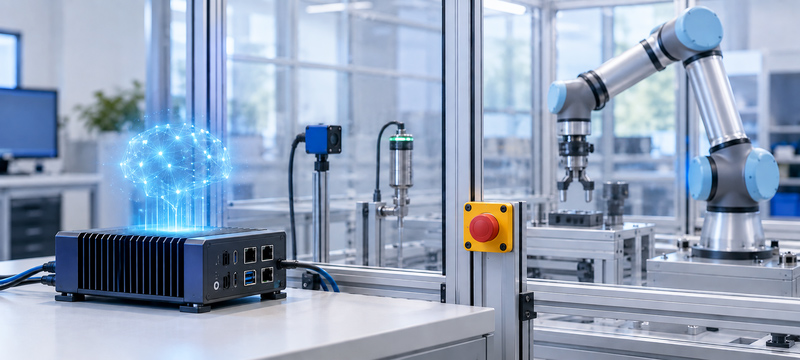
# When AI Agents Start Controlling Physical Hardware: What the New Industry Standard Means for IoT
The line between software and machinery is blurring. As artificial intelligence systems gain the ability to plan, execute, and adapt sequences of actions autonomously, a critical question emerges: what happens when these intelligent systems are given direct control over real-world equipment? A recently introduced technical specification aims to answer this by creating a universal language between AI agents and programmable devices, but it also raises pressing concerns about safety, security, and accountability.
## The Shift from Passive Monitoring to Active Operation
Traditional Internet of Things deployments have followed a well-understood pattern. Sensors gather environmental or operational data, software platforms process and analyze that information, and rule-based logic determines whether corrective commands should be issued to connected equipment. Throughout this chain, human operators retain meaningful oversight of every action.
Agentic AI disrupts this model in a fundamental way. Unlike conventional analytics tools, an AI agent can set its own sub-goals, orchestrate multi-step workflows, observe outcomes in real time, and adjust its strategy mid-task without waiting for human direction. Give such an agent access to industrial or laboratory hardware, and it ceases to be a passive observer. It becomes a participant in physical processes, issuing commands that move actuators, adjust settings, and interact with the material world.
This capability unlocks enormous potential. It promises adaptive manufacturing, autonomous experimentation, and intelligent infrastructure management. But it also introduces a layer of control that is probabilistic by nature—something that sits in tension with the deterministic, fail-safe principles that industrial operations have relied on for decades.
## A Universal Interface for Machines and Models
The specification in question, introduced in late August 2026 under the working name Model Hardware Standard, is designed to give AI agents a consistent way to discover and operate a wide range of programmable equipment. The target devices span scientific instruments like microscopes and liquid handlers, robotic arms, sensors, and other controllable hardware found in laboratories and advanced manufacturing environments.
At its core, the standard proposes a set of shared drivers that describe each device’s capabilities. These drivers specify what measurements a device can take, which parameters can be adjusted, and what operating boundaries should never be crossed. They also expose basic functions such as reading sensor values or writing configuration parameters.
Once a device is described and connected through this standard, it becomes discoverable and controllable through APIs, command-line utilities, and interoperability protocols designed for AI integration. An agent can pull data from multiple instruments, sequence operations across different machines, and dynamically respond to changing conditions—all without requiring custom integration code for each individual device or manufacturer.
The ambition is to build a model-agnostic abstraction layer that sits above any hardware ecosystem. This would mean that the same agent platform could interact with equipment from different vendors, using a single consistent interface rather than dozens of proprietary connections. The implications for integration cost and deployment speed in IoT environments are significant.
## Interoperability Is Not Safety
While the promise of standardization is compelling, it is important to separate the technical benefit of compatibility from the far more difficult challenge of ensuring safe behavior.
A well-defined interface can document what commands a device accepts and declare hard limits on operating ranges. However, it cannot guarantee that an AI agent will choose the correct action in a given situation, correctly interpret ambiguous sensor readings, or fully anticipate the combined effects of issuing multiple permitted commands in sequence.
Published demonstrations of the standard highlight this gap. In one laboratory exercise involving a liquid-handling system, an agent encountered unexpected bubbles in a container and responded by retrying the operation in the same vessel. The repetition worsened the physical problem because the model had not grasped the underlying cause of the failure. Only direct human intervention allowed the system to learn from the mistake. In other trials, robotic arms and lab instruments were coordinated successfully, and safety interlocks prevented movement during deliberately introduced fault scenarios. These results are encouraging but remain confined to controlled settings managed by the organizations behind the effort.
Real-world industrial environments present a far more complex picture. Equipment diversity is greater, environmental conditions are less predictable, and errors carry consequences that extend well beyond a failed experiment. A command that is perfectly valid in software terms can become physically dangerous if a workspace is cluttered, a sensor has drifted out of calibration, or a parallel process has altered the state of a machine in ways the agent did not anticipate.
## Why Deterministic Safeguards Must Stay in Place
The most prudent approach to deploying agent-controlled hardware is to never allow the AI agent to serve as the sole authority over physical actions.
Hard limits should continue to be enforced by deterministic systems—equipment controllers, safety PLCs, or dedicated protection circuits—that operate independently of any model’s reasoning. An agent might propose that a robotic arm reposition itself, for example, but a separate verification layer would need to confirm acceptable speed, precise position, payload weight, access authorization, and collision-free pathways before the motion is permitted.
Not all actions carry the same risk profile. Reading a temperature sensor is inherently low-risk, whereas adjusting a chemical valve or commanding a heavy payload to move demands far greater scrutiny. Access permissions therefore need to be granular, reflecting the specific device, the nature of the command, the current operating state, and the potential physical impact—not simply a binary determination of whether the agent is “connected” to the network.
For certain categories of action, human approval should remain a mandatory gate. Critical or irreversible operations should require explicit confirmation, while routine, low-risk tasks might be authorized to proceed automatically according to predefined policies. This tiered approach reflects a fundamental architectural truth: language models are built to navigate ambiguity, but industrial safety systems are designed to remove it.
## Security, Identity, and the Audit Trail
Connecting a broad range of physical devices through a single agent platform also creates a concentrated attack surface. If an adversary compromises the agent itself, its authentication credentials, or one trusted integration point, the potential exists to reach and manipulate numerous physical systems through that single entry point.
Robust identity management is therefore essential. Agents, human users, and individual devices must all be authenticated with strong credentials, and permissions should be scoped as narrowly as possible. No single set of access tokens should grant unrestricted control over every machine connected to the platform.
Equally critical is the ability to reconstruct what happened after the fact. Comprehensive audit trails should capture which agent and which model version initiated each action, what goals, instructions, and sensor data influenced the decision, which commands were requested, approved, rejected, or modified, what state the equipment reported before and after execution, and whether a human or another safety system intervened at any point.
Model and driver versioning introduces additional complexity. Updating an AI model, a device driver, a prompt configuration, or an equipment description can all change system behavior even when the physical hardware remains untouched. Organizations will need to treat the full agent-to-device configuration as a managed, version-controlled artifact rather than viewing the AI model as an isolated software component.
## What Still Needs to Be Proven
The standard addresses a genuine and costly problem in the IoT landscape—the friction of integrating heterogeneous machines into coherent workflows. A common interface has the potential to dramatically reduce development time and open the door to more flexible, responsive automation.
However, several things have yet to be demonstrated at scale. The current evidence comes from a limited number of controlled environments, and the reported performance gains have not been independently verified through external benchmarking. True production readiness would require broader hardware compatibility, independent safety testing, well-defined certification procedures, and sustained deployments that run reliably over extended periods. Equipment manufacturers would also need to decide whether to adopt the standard natively or rely on third-party middleware to bridge their systems.
The underlying trend is unmistakable, though. IoT infrastructure has spent years providing software with increasingly detailed visibility into physical processes. The next phase is already beginning—giving software not just observation but genuine authority over the physical world.
A universal interface may accelerate that transition technically. Whether the industry can maintain a safety boundary that is more dependable than the intelligence operating above it will determine whether this vision fulfills its promise or introduces new and serious risks.
—
## Frequently Asked Questions
**What is the Model Hardware Standard?**
It is a proposed technical specification designed to provide AI agents with a standardized way to discover, describe, and control programmable hardware devices. It aims to replace the need for custom, device-specific integrations with a common interface that any compatible device can expose.
**Who is developing this standard?**
The specification was introduced by Anthropic as an open research initiative. It is currently being tested with selected scientific laboratories and advanced manufacturing partners, with plans to develop safety evaluations and eventually release it as open source.
**What kinds of devices does it support?**
The standard targets programmable equipment including sensors, laboratory instruments such as microscopes and liquid handlers, robotic arms, and other controllable hardware. The long-term vision extends to manufacturing systems, building management equipment, test facilities, logistics automation, and remote infrastructure.
**Why is this different from traditional IoT integration?**
Traditional IoT systems rely on predefined rules and individual custom integrations for each piece of equipment. The Model Hardware Standard creates a shared abstraction layer that allows an AI agent to interact with heterogeneous devices through a single, consistent interface, dynamically adapting to changing conditions without manual reconfiguration.
**Can AI agents operate equipment safely under this standard?**
The standard provides a mechanism for describing device capabilities and enforcing basic operating limits. However, interoperability does not automatically equal safety. The agent’s decision-making is probabilistic, and it cannot guarantee correct interpretation of physical situations. Deterministic safety systems and human oversight remain essential.
**What security concerns does this approach raise?**
A shared hardware interface concentrates access to many physical systems in a single platform. If that platform or an agent’s credentials are compromised, attackers could potentially reach multiple devices. Strong authentication, narrowly scoped permissions, and comprehensive audit trails are critical mitigations.
**Will human operators still be needed?**
Yes. Human approval is expected to remain necessary for exceptional, irreversible, or safety-critical actions. The standard envisions a tiered authority model where routine low-risk operations may proceed autonomously while higher-risk actions require human confirmation or oversight.
**Is this standard ready for production use?**
Not yet. The current demonstrations cover controlled laboratory and pilot environments. Broader hardware support, independent testing, formal certification processes, and long-running operational deployments are needed before the standard can be considered production-ready.
—
## Conclusion
The introduction of a shared hardware interface for AI agents represents a meaningful step forward for IoT integration, offering the potential to reduce complexity and accelerate the adoption of agent-driven automation across scientific and industrial settings. However, the fundamental tension between probabilistic AI reasoning and deterministic industrial safety cannot be solved by a specification alone. It demands a deliberate architectural commitment to layered safeguards, granular access control, comprehensive auditing, and ongoing human oversight. The technology is moving quickly, but the evidence base for safe, reliable, and secure deployment at scale has yet to catch up. The industry’s task now is to move beyond promising demonstrations and build the rigorous validation, certification, and operational frameworks that will determine whether this new control plane earns the trust it needs to succeed.
Thank you for reading
