



# OpenTelemetry Reaches CNCF Graduated Status: A New Era for Observability Standards
**Written by the OpenTelemetry Community**
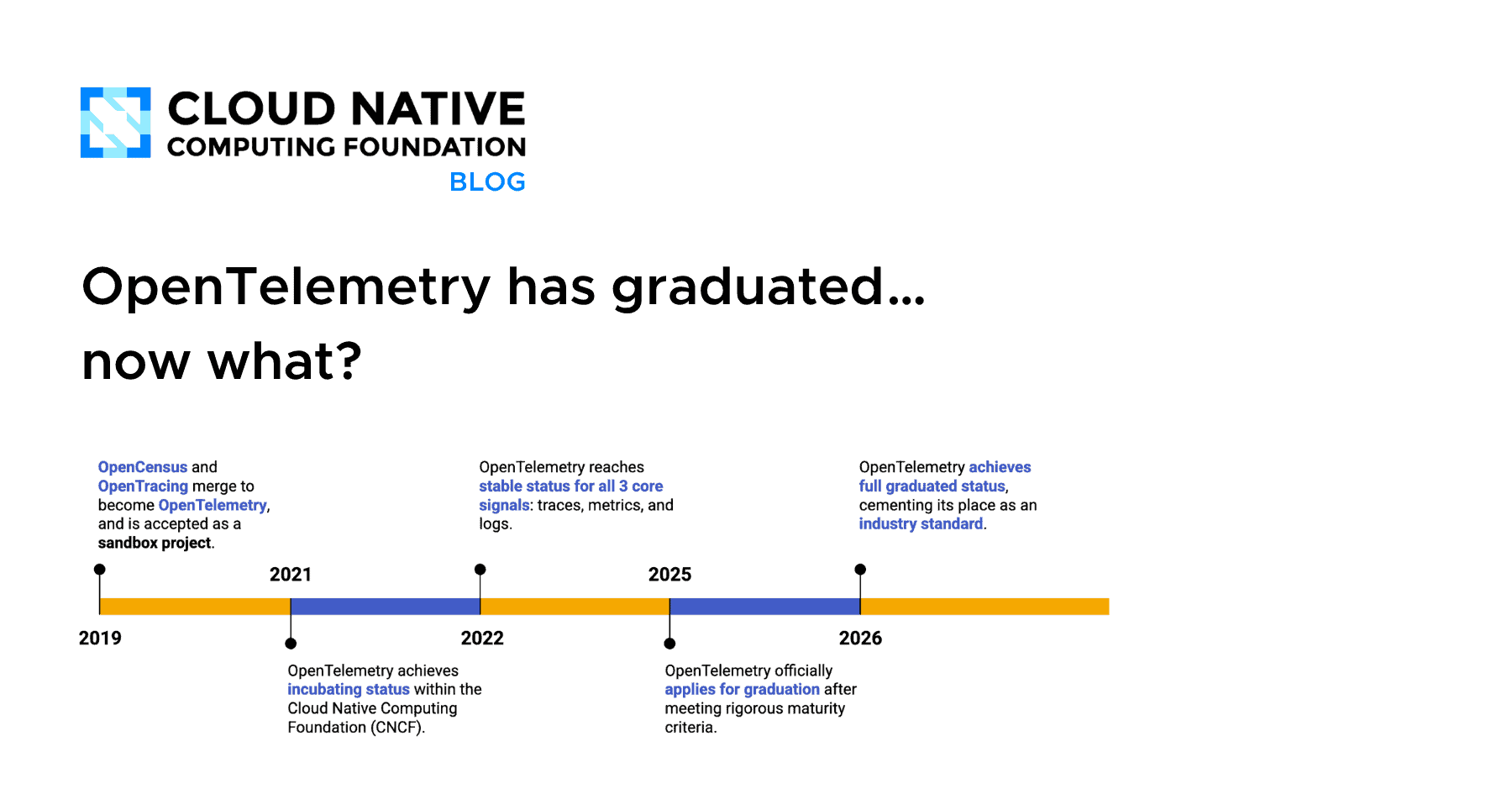
The OpenTelemetry project has officially reached a major milestone — it has been elevated to graduated status within the Cloud Native Computing Foundation (CNCF). This achievement places it alongside other prominent graduated projects like Kubernetes and Prometheus, signaling that the open-source observability framework is now a mature, enterprise-grade standard.
But what does this mean for the broader software engineering community? And how did we get here? Let’s take a closer look at the journey, the significance, and what comes next.
—
## The Problem That Started It All
For years, software teams faced a fragmented telemetry landscape. Every observability vendor built its own instrumentation libraries, meaning that switching providers required ripping out one set of code and replacing it with another. This vendor lock-in made modernization costly and slow.
On top of that, the three pillars of observability — distributed traces, structured logs, and numerical metrics — existed in silos. Correlating a spike in error logs with a slow trace or an unusual metric wasn’t straightforward, leaving gaps in the monitoring story that teams relied on to keep their systems healthy.
Early standardization efforts like OpenTracing and OpenCensus laid the groundwork, but they were separate initiatives with overlapping goals and a divided community.
## A Unified Vision
In May 2019, OpenTracing and OpenCensus were merged to create OpenTelemetry. The goal was bold: build a single, vendor-neutral framework for generating, collecting, and exporting telemetry data across all major programming languages.
The new project combined the tracing expertise of OpenTracing with the metrics and instrumentation strengths of OpenCensus, while also introducing support for logs as a first-class signal. It shipped with standardized APIs, SDK implementations in multiple languages, and a powerful data collection pipeline known as the OpenTelemetry Collector.
Former projects like OpenTracing and OpenCensus have since been archived, as the community consolidated around the unified OpenTelemetry specification.
## Rapid Growth in a Short Timeframe
In just over seven years, OpenTelemetry has become one of the most actively contributed projects in the CNCF ecosystem — second only to Kubernetes in development velocity. The project boasts contributions from more than 2,800 organizations and hundreds of dedicated maintainers working across language-specific Special Interest Groups.
Key milestones along the way include:
– General availability for traces, logs, and metrics signals
– The addition of profiling as a new telemetry signal
– Significant expansion of the Collector with new processing components
– Growth of the OTel ecosystem with tools like OpAMP, the OTel Operator, Weaver, and OTel Arrow
– An ever-expanding reference demo application that showcases end-to-end instrumentation
## What It Takes to Graduate
Reaching graduated status at the CNCF is not a simple formality. Projects must demonstrate that they meet rigorous criteria across multiple dimensions:
1. **Production adoption** — Real organizations, from startups to large enterprises, must be running the project in live production environments. Major names across the industry already use OpenTelemetry in their critical systems.
2. **Governance maturity** — The project needs a transparent, well-documented governance model with clear processes for leadership elections, role transitions, and decision-making.
3. **Community vitality** — A healthy contributor base with multiple organizations represented, responsive code review practices, and a clear path for new contributors to get involved.
4. **Security posture** — At least one independent security audit must be completed, with all critical findings properly addressed and resolved.
5. **API stability** — Public interfaces must be versioned, stable, and committed to backward compatibility so that downstream users are not disrupted by breaking changes.
6. **Comprehensive documentation** — Architectural overviews, user guides, operator documentation, and contribution guidelines must all be maintained and up to date.
7. **Formal review** — The project must submit a graduation application to the CNCF Technical Oversight Committee for thorough evaluation and approval.
The graduation effort was driven by a broad coalition of maintainers, end users, governance volunteers, and TOC members. Special recognition goes to the leadership of Austin Parker, a former Community Manager and current Governance Committee member, who spearheaded the application process.
## What This Means for Practitioners
For teams evaluating observability tools, OpenTelemetry’s graduation sends a clear message: this is no longer an experimental or emerging technology. It has been vetted for production readiness at scale, and its governance, security, and quality standards meet the expectations of enterprises of any size.
If an organization has been hesitant to adopt OpenTelemetry — perhaps waiting for more maturity or broader industry support — there is now little reason to delay. The framework is production-ready, fully open, and backed by a thriving contributor community.
## Looking Ahead
Graduation is not the finish line; it’s a launching pad. The OpenTelemetry project continues to evolve across multiple fronts:
– **New workload types** — Emerging areas like agentic AI workflows are already being addressed through new semantic conventions focused on generative AI observability.
– **Broader platform coverage** — Browser and mobile observability are gaining more attention, bringing OTel instrumentation to environments that were previously underserved.
– **Operational guidance at scale** — Tools like Weaver help teams define, enforce, and govern telemetry schemas across large organizations.
– **Easier onboarding** — Packaging improvements and zero-code instrumentation options (such as the OpenTelemetry Injector) are lowering the barrier to entry for teams that want to get started quickly without extensive manual configuration.
The future of OpenTelemetry is bright, and its continued success depends on the partnership between maintainers, contributors, and the organizations that depend on it every day.
—
## Frequently Asked Questions
**What is OpenTelemetry?**
OpenTelemetry is an open-source observability framework that provides standardized APIs, SDKs, and tooling for generating, collecting, and exporting telemetry data — including traces, logs, metrics, and profiling data — across applications and infrastructure.
**What does CNCF graduated status signify?**
Graduated status is the highest maturity level in the CNCF project lifecycle. It indicates that a project has demonstrated widespread production adoption, robust governance, strong community health, verified security practices, stable APIs, and comprehensive documentation.
**Why was OpenTelemetry created?**
It was created by merging OpenTracing and OpenCensus to eliminate vendor lock-in, standardize telemetry formats across the industry, and provide a unified way to capture and correlate traces, logs, and metrics.
**Which organizations use OpenTelemetry?**
OpenTelemetry is used in production by a diverse range of organizations, including major technology companies and enterprises across various industries. The project’s contributors come from over 2,800 companies worldwide.
**Is OpenTelemetry free to use?**
Yes. OpenTelemetry is fully open-source and free to use. It is licensed under the Apache 2.0 license, and there are no commercial requirements or licensing fees associated with its use.
**What’s the difference between traces, logs, metrics, and profiling?**
– *Traces* track the path of a request through distributed systems.
– *Logs* are discrete, timestamped events that record what happened in an application.
– *Metrics* are numerical measurements aggregated over time, such as request counts or latency.
– *Profiling* captures CPU and memory usage patterns to help optimize application performance.
**How can my team get started with OpenTelemetry?**
Getting started typically involves instrumenting your application code using OTel SDKs in your language of choice, deploying the OTel Collector to receive and route telemetry data, and configuring exporters to send data to your preferred observability backend.
—
## Conclusion
OpenTelemetry’s journey to CNCF graduated status represents a significant achievement for the open-source observability community. It reflects years of collaborative work, a commitment to standards, and a growing ecosystem of tools and integrations that make modern monitoring more accessible and effective.
For teams evaluating their observability strategies, graduation is a strong signal of maturity and reliability. The framework is ready for enterprise adoption, and its trajectory points toward even broader capabilities in the years ahead.
As OpenTelemetry continues to expand into new domains like AI observability, edge computing, and mobile platforms, it will remain anchored by the same principles that guided its creation: openness, standardization, and community-driven innovation.
Thank you for reading
