



# Breaking Through the Edge AI Wall: Why Embodied AI Needs a New Mathematical Framework
The dream of intelligent machines that walk, drive, and navigate our physical world has moved from science fiction to active engineering. Yet, as robots and autonomous systems grow more capable, developers are confronting a wall that no amount of hardware scaling can easily fix — a fundamental convergence of physics and computational complexity that threatens to stall the entire embodied AI revolution.
## When Smart Algorithms Meet a Stupid World
Autonomous mobile robots, self-driving vehicles, and humanoid assistants all share a common trait: they must make decisions in real time while operating under strict physical constraints. Unlike cloud-based AI systems that can borrow virtually unlimited processing power from a data center, a physical machine sits on a battery, generates heat, and has a finite window of milliseconds to react to a changing environment.
Early research into autonomous navigation revealed a surprising insight. Even when every sensor, actuator, and software module functions perfectly, a robot’s behavior can degrade simply because its planning system is overwhelmed by too many possible future paths. The machine isn’t broken — it’s drowning in choices.
This insight, once considered a narrow navigation problem, has taken on broader significance with the explosive progress of artificial intelligence. As large language models and multimodal systems push toward physical embodiment, the same instability that plagues a single robot now appears to be a systemic limitation across the entire class of physical AI systems.
## The Two Walls of Edge AI
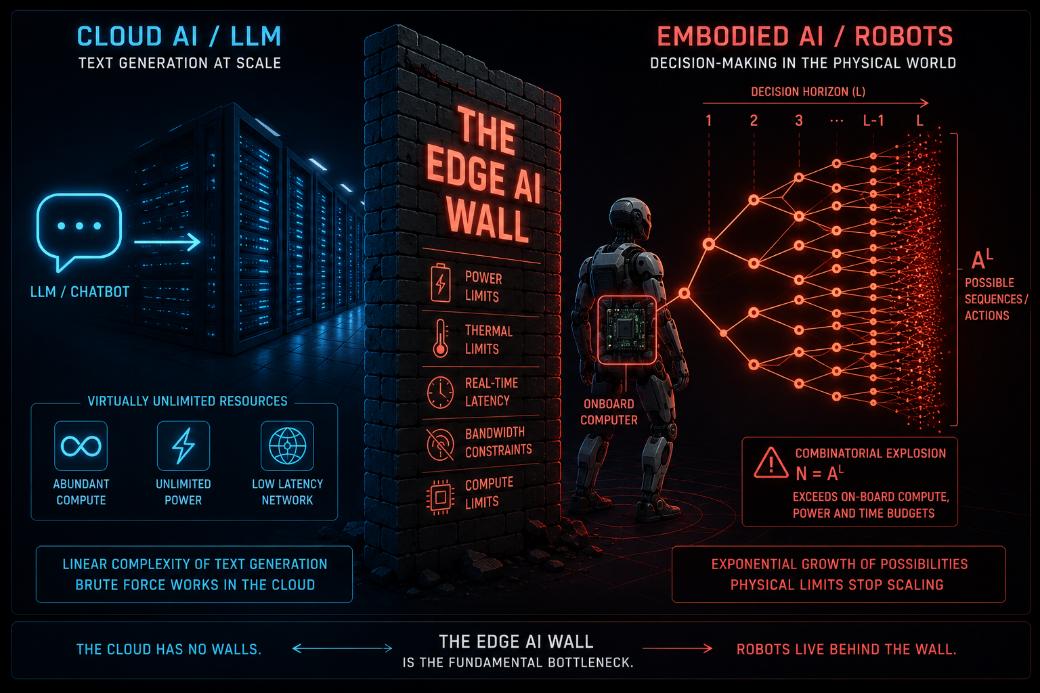
The challenge facing embodied AI is doubly constrained, forming what researchers have termed the “edge AI wall.” The first wall is physical. A mobile robot cannot plug into a wall outlet, so every watt of computation comes at a direct cost in battery life, weight, and heat dissipation. Mounting increasingly powerful processors on a mobile platform creates a vicious cycle: more compute demands more energy, which demands more battery mass, which demands more compute to move. At some point, each additional unit of processing power becomes prohibitively expensive in terms of platform design and operational uptime.
The second wall is mathematical and far more stubborn. When a robot navigates a dynamic environment filled with moving objects, people, and unpredictable events, the number of possible futures grows exponentially with every step of planning. In technical terms, the search space follows a power law: N equals A to the power of L, where A represents the number of alternative actions at each decision point and L represents the planning depth — how many steps ahead the system looks.
Under modest assumptions, the numbers quickly become staggering. With just 10 alternatives per step, a one-step decision involves 10 options, a five-step local avoidance problem involves 100,000 scenarios, a warehouse navigation task at 10 steps expands to 10 billion possibilities, and multi-agent collision avoidance at 20 steps reaches 10^20 — a number so vast that no brute-force search algorithm can traverse it in real time. Real-world environments involve continuous action spaces with joint angles, velocity vectors, and accelerations, making the effective number of alternatives orders of magnitude larger than the simplified example suggests.
Hardware scaling can only move through this tree faster. It cannot stop the tree from growing. Classical brute-force computation remains powerless against exponential explosion, forcing developers into painful trade-offs between planning depth, reaction speed, and energy consumption.
## Why Offloading to the Cloud Fails
One intuitive response to onboard computational limits is to shift the heavy thinking to remote servers — the so-called “remote brain” or cloud robotics approach. Streaming sensor data to powerful cloud infrastructure and receiving processed commands back seems like an elegant solution on paper.
In practice, this architecture collapses under the demands of real-world physical interaction. Control loop latency is the first killer. A text-based chatbot can tolerate a half-second delay without the user noticing, but a bipedal robot or a vehicle approaching an intersection cannot survive a 50-millisecond lag. During that delay, the robot’s body has already moved due to inertia, and the cloud-generated command arrives to act on a state of the world that no longer exists.
The second killer is wireless reliability. Urban canyons, industrial facilities, and high-density environments introduce signal attenuation, interference, and dead zones. Any packet loss or momentary connection drop in a cloud-dependent control loop instantly transforms a guided machine into an unguided projectile weighing hundreds of kilograms. A safe embodied system must think for itself, which means edge computing remains the only viable architecture. The solution to exponential complexity must therefore be found onboard.
## Compressing the Decision Space Instead of Expanding Hardware
Faced with these constraints, a radically different approach is emerging — one that does not try to traverse the decision tree faster, but instead shrinks the tree itself before valuable compute cycles are wasted.
The core idea centers on a concept called the Combinatorial Compression Engine, an algorithmic framework designed to prune redundant or destructive branches of the planning tree in real time. Rather than optimizing the AI model through techniques like pruning, quantization, or distillation, this approach targets the structure of the problem space directly, stripping away computationally expensive but functionally irrelevant search paths before they are ever evaluated.
The theoretical backbone for this work draws from a framework known as Duality-Nonequilibrium theory. Within this model, the state of a system is described by a parameter called structural complexity, which differs fundamentally from classical entropy. Where entropy measures disorder, structural complexity measures how effectively a system organizes its internal resources to resist external disturbances. The rate at which this complexity changes reflects the system’s capacity to adapt in real time.
In computational experiments, the compression engine demonstrated the ability to reduce the search space by a factor of eight to eleven while preserving the quality and correctness of the decisions made. This suggested that significant computational savings were possible without sacrificing the intelligence of the system.
## The ΔN-ΔD Regulator: Learning from Chaos and Conflict
Building on the compression framework, researchers developed a behavior regulator governed by two dynamic parameters drawn from the DN model. The system tracks external nonequilibrium — the raw intensity and chaos of environmental changes — alongside internal duality — the level of conflict within the planner when it faces equivalent or competing alternative paths.
By mapping the robot’s state onto a coordinate space defined by these two variables, the regulator dynamically adjusts its behavioral mode. It can narrow the planner’s bandwidth, reduce velocity, or prioritize safety when external chaos intensifies. When internal conflict arises from symmetrical or ambiguous path choices, it suppresses the oscillations that plague traditional trajectory planners.
Simulation testing across two critical edge scenarios yielded striking results. Under intense random chaos, the regulator activated a safety-priority mode that reduced dangerous near-collision events by over 90 percent compared to a baseline planner, though it did so by intentionally slowing the robot to ensure survival. In scenarios marked by symmetrical ambiguity, where conventional planners would freeze, twitch, or oscillate before obstacles, the new regulator eliminated oscillations entirely across every test run while preserving core navigation efficiency.
These results emerged from a two-dimensional simulation environment, and the transition to physical hardware on real robots remains a significant engineering challenge. The mathematical model has yet to be validated on actual edge devices, and doing so will require substantial computational research and development investment.
## A Paradigm Shift from Brute Force to Structural Intelligence
For decades, the AI industry advanced along a path of extensional scaling — bigger models, more data, denser chips. This approach delivered remarkable results in cloud environments where computational resources could expand elastically. Embodied AI, however, exposes the limits of that paradigm in unforgiving ways. The laws of physics dictate that a mobile machine cannot scale its compute infrastructure the way a data center can.
The emerging alternative paradigm focuses on managing the structure of the solution space itself rather than racing to enumerate it faster. By actively compressing combinatorial complexity at the algorithmic level, the goal is to make physical AI systems that are not merely powerful, but elegantly efficient — avoiding unnecessary computational overhead instead of simply processing massive datasets more quickly.
If this direction holds, complexity management could become as foundational to robotics as memory management, network allocation, and power optimization became to general computing. The long arc of engineering progress has consistently favored internal organizational efficiency over brute force, and embodied AI may be the next chapter in that story.
## Frequently Asked Questions
**What is the edge AI wall?**
The edge AI wall is a systemic bottleneck that limits the performance of physical AI systems, such as autonomous robots and self-driving vehicles. It arises from the convergence of two constraints: the physical limits of onboard hardware (battery, weight, heat) and the mathematical reality of combinatorial explosion in real-time decision-making. Together, these constraints mean that simply adding more compute to a mobile platform is neither physically practical nor mathematically sufficient.
**Why can’t robots just use cloud computing instead?**
Cloud robotics faces two critical barriers for real-time physical systems: latency and reliability. Wireless communication delays of even a few tens of milliseconds can cause a robot to react to an outdated state of the world, leading to instability or accidents. Additionally, wireless signals are prone to interference, attenuation, and dropouts in real environments, making cloud-dependent control loops unsafe for safety-critical applications.
**What is combinatorial explosion?**
Combinatorial explosion describes how the number of possible futures a robot must consider grows exponentially with planning depth. If a system evaluates A alternatives at each step and plans L steps ahead, the total search space equals A raised to the power of L. Even modest values of A and L produce astronomically large numbers, making exhaustive search infeasible in real time.
**What does the Combinatorial Compression Engine do?**
The Combinatorial Compression Engine is an algorithmic approach that prunes redundant or irrelevant branches from the planning tree before computational resources are spent evaluating them. Rather than shrinking the AI model itself, it shrinks the decision space the model must navigate, achieving substantial reductions in computational workload while preserving decision quality.
**What is Duality-Nonequilibrium theory?**
Duality-Nonequilibrium theory provides the mathematical framework for modeling how physical AI systems respond to both external chaos and internal conflicts. It introduces the concept of structural complexity — a measure of how effectively a system organizes itself to handle disturbances — and defines a regulator that adjusts system behavior based on the interplay between external nonequilibrium and internal duality.
**Have these approaches been tested on real robots?**
The simulation results demonstrating the effectiveness of the ΔN-ΔD regulator and the combinatorial compression engine have been validated in controlled virtual environments. Translation to physical robotic platforms has not yet been completed, and real-world hardware testing represents a critical next phase requiring further research and development.
**How is this different from existing robot optimization techniques?**
Traditional optimization methods like neural network pruning, quantization, and distillation aim to make the AI model smaller and faster. The approaches discussed here target the problem from the other direction — compressing the dynamic search space that the robot must navigate in real time, addressing the root cause of computational overload rather than its symptoms.
## Conclusion
The pursuit of intelligent machines that operate autonomously in the physical world is one of the defining engineering challenges of our era. Yet the path forward cannot simply mirror the success of cloud AI through ever-larger hardware and datasets. The rigid constraints of energy, weight, heat, and real-time latency demand a fundamentally different kind of intelligence — one that is structurally efficient rather than computationally brute.
The edge AI wall reminds us that physics and mathematics impose hard boundaries on what raw compute can achieve. Breaking through that wall will require innovations in algorithmic thinking, new theoretical frameworks for understanding complexity, and a willingness to redesign the way autonomous systems plan and decide. The shift from expanding hardware to managing the structure of the solution space itself may well define the next generation of embodied AI, unlocking machines that are safer, more stable, and more capable than the brute-force approach could ever deliver.
Thank you for reading
