



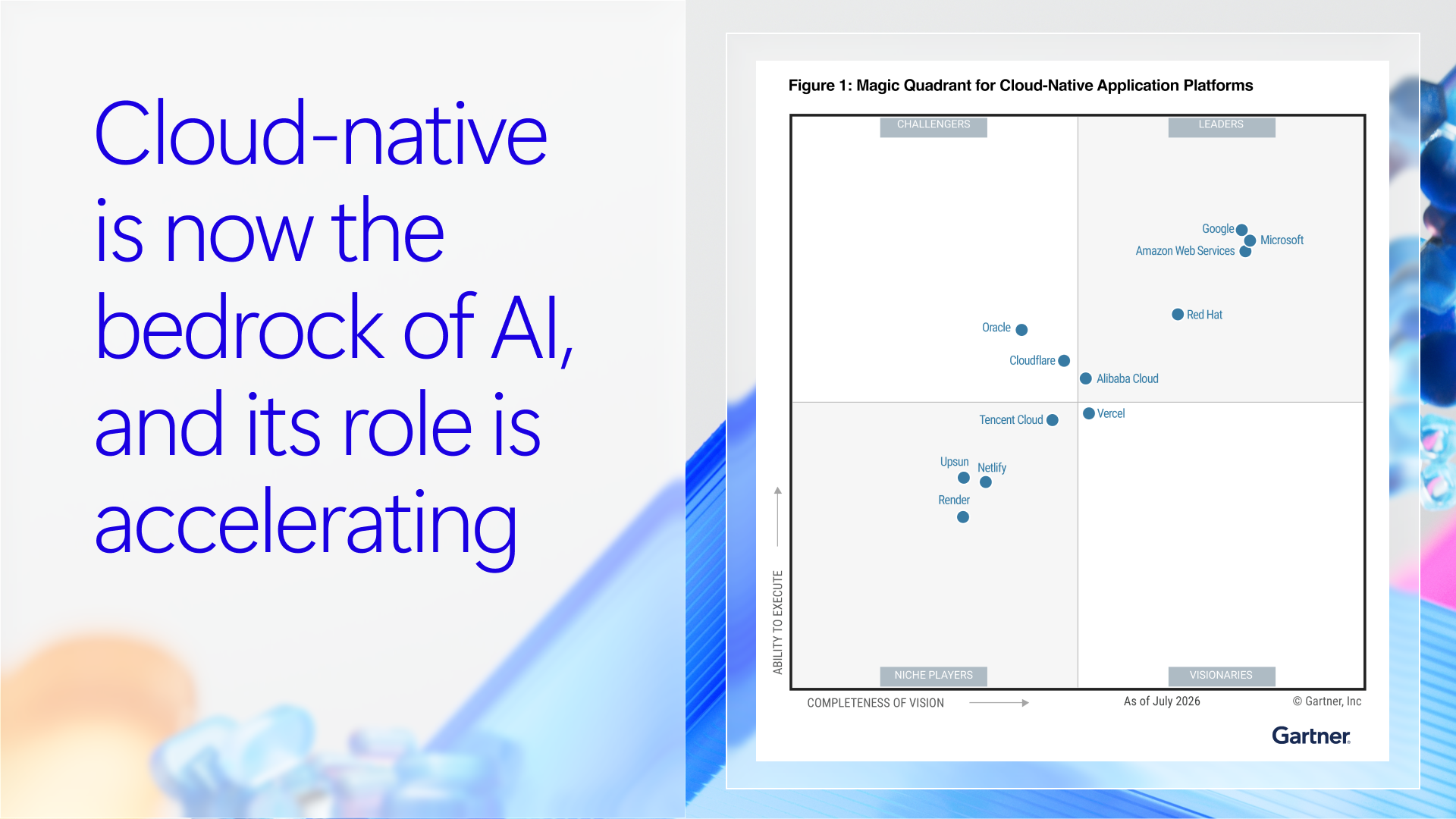
**Microsoft Recognized as a Leader in the 2026 Gartner® Magic Quadrant™ for Cloud-Native Application Platforms**
Microsoft has once again been named a Leader in the 2026 Gartner® Magic Quadrant™ for Cloud-Native Application Platforms, marking its third consecutive year in this position. This recognition highlights the critical role cloud-native platforms play in enabling organizations to build, deploy, and operate applications at scale. More importantly, it signals a broader shift: cloud-native platforms are evolving from mere application development environments into the foundational layer for AI transformation.
—
### **The AI Transformation Imperative**
Organizations today are not short of AI ideas—they struggle with turning those ideas into production-ready systems. The challenge lies in connecting AI capabilities to existing applications and data, ensuring reliability at global scale, and meeting strict security and governance standards. Addressing these demands requires more than isolated application services; it requires a unified platform that integrates application modernization, AI innovation, operations, and security.
Microsoft’s cloud-native application platform is built with this reality in mind. Key components such as **Azure App Service**, **Container Apps**, **Azure Functions**, and **API Management** work together with **Microsoft Foundry**, **GitHub Copilot**, and the shared Azure foundation for identity, networking, observability, and security. This integration provides organizations with a single platform for both their current workloads and future AI-driven initiatives.
—
### **Building AI Apps and Agents Faster**
Microsoft is bringing the application runtime and AI toolchain closer together, allowing developers to use their preferred models, frameworks, and architectures. Microsoft Foundry offers the necessary AI models, agent tooling, evaluation, and safety features for production deployment. GitHub Copilot accelerates development across the lifecycle, while Azure’s application platform delivers managed runtime, event-driven execution, integration, and API capabilities.
With Azure Container Apps Express, developers can deploy containers directly to production. Azure Functions enables the exposure of business logic through the Model Context Protocol, and over 1,400 connectors allow agents to interact with enterprise systems without rebuilding integration logic from scratch. Azure Container Apps Sandboxes provide isolated, hardware-level compute environments for agent platforms, forming the backbone of Foundry Agent Service and supporting custom agent platforms on Azure.
—
### **Modernizing Applications Regardless of Architecture**
AI transformation begins with the existing application estate, not from scratch. Azure enables organizations to modernize at their own pace—whether through fully managed Platform-as-a-Service (PaaS), containerization, event-driven patterns, or extending legacy business logic. App Service Managed Instance supports complex Windows and .NET migrations without rewrites, while GitHub Copilot app modernization speeds up assessment and remediation.
This flexibility allows organizations to protect existing investments while building a foundation for continuous innovation. Modernized applications can seamlessly connect to AI services, APIs, identity controls, and operational practices, unifying old and new initiatives within a single strategy.
—
### **Securing, Governing, and Simplifying Operations**
AI applications raise the bar for operations. Agents can call APIs, execute generated code, and interact with sensitive systems at unprecedented speed and volume, requiring security, governance, and observability to be embedded in the platform from the start.
Azure delivers shared identity, networking, policy, and security controls across the application estate. Azure API Management extends consistency to APIs, MCP servers, and model endpoints, with AI gateway capabilities for authentication, token limits, quota enforcement, semantic caching, and usage monitoring. Azure Container Apps Sandboxes offer hardware-level isolation for untrusted code, while confidential computing and Microsoft Defender enhance protection for sensitive workloads.
Operational scalability is ensured through global reach, managed scaling, load balancing, zone redundancy, deployment controls, and integrated observability. Azure Monitor and Application Insights provide end-to-end visibility, while Azure SRE Agent supports agentic operations—enabling incident investigation, root cause analysis, and auditable remediation aligned with GitHub Copilot.
—
### **Customer Momentum Across Industries**
Organizations across banking, retail, healthcare, manufacturing, and IT are running critical applications and new AI workloads on the same Azure foundation.
> *“A clean cloud architecture is a prerequisite for AI. You can’t build on top of a weak foundation.”*
> — Mike Gibson, Chief Technology Officer, Planet DDS
Planet DDS, Replit, Morgan Sindall, Commerzbank, Ghassan Aboud Group, and Levi Strauss & Co. are just a few examples of organizations leveraging Azure to modernize, run AI in production, and scale agentic workflows. These are not experimental projects—they are core business systems.
This demonstrates a single platform managing existing applications, production AI and agentic workloads, and providing a consistent foundation for both.
—
### **Looking Ahead**
Microsoft’s third consecutive Leader positioning in the Gartner® Magic Quadrant™ reinforces its commitment to offering a secure, scalable platform for modernizing current systems and building what comes next. The next generation of applications will be cloud-native, AI-powered, and deeply integrated with existing systems.
—
### **Get Started**
No matter where you are in your journey, there is a starting point:
– **Building AI apps and agents**: Begin with Azure Container Apps for secure, scalable agentic development.
– **Modernizing existing applications**: Use App Service Managed Instance and GitHub Copilot modernization.
– **Running event-driven and API-centric workloads**: Build with Azure Functions and manage APIs through Azure API Management.
– **Operating with confidence**: Add Azure SRE Agent and Azure Monitor for agentic operations and full observability.
—
## FAQ
**What is a cloud-native application platform?**
A cloud-native application platform is a managed environment designed to help organizations build, deploy, and operate applications at scale using cloud-native technologies such as containers, microservices, serverless computing, and APIs.
**Why was Microsoft named a Leader in the Gartner® Magic Quadrant™?**
Microsoft was recognized for its comprehensive cloud-native application platform, its third consecutive year as a Leader, and its role in helping organizations modernize applications and integrate AI into production systems at scale.
**How does Microsoft’s platform support AI transformation?**
Microsoft’s platform integrates AI tools like GitHub Copilot and Microsoft Foundry with application runtime environments such as Azure Container Apps and Azure Functions. This enables developers to build, deploy, and govern AI-powered applications and agents within a unified, secure, and scalable platform.
**What industries are using Microsoft’s cloud-native platform?**
Organizations in banking, retail, healthcare, manufacturing, IT, and other sectors are using the platform for both existing applications and new AI and agentic workloads.
**What security features does the platform offer?**
The platform includes shared identity, networking, policy, and security controls; API Management with AI gateway capabilities; Azure Container Apps Sandboxes with hardware-level isolation; confidential computing; and Microsoft Defender for workload protection.
**How can organizations get started with the platform?**
Organizations can begin by leveraging Azure App Service for modernization, Azure Container Apps for agentic applications, Azure Functions for event-driven workloads, and Azure API Management for API governance, supported by Azure Monitor and Azure SRE Agent for operational excellence.
—
## Conclusion
Microsoft’s third consecutive Leader recognition in the Gartner® Magic Quadrant™ for Cloud-Native Application Platforms highlights the maturity and strategic value of its platform. By unifying application modernization, AI innovation, operations, and security, Microsoft provides organizations with a single, scalable foundation for today’s workloads and tomorrow’s AI-driven future. As customer adoption continues to grow across industries, this platform demonstrates its ability to carry existing systems forward while powering the next generation of intelligent, cloud-native applications.
