



**The 1920s: How The Decade’s Innovation Reshaped The Assembly Line**
The 1920s was a decade defined by roaring change. It was an era of jazz, flappers, and unprecedented economic growth that sparked a revolution in entertainment, fashion, music, and transportation. This period wasn’t just culturally transformative; it was also the birthplace of modern industrial automation. As factories shed their reliance on stationary steam engines and complex belt systems, manufacturers adopted individual electric motors and advanced electromechanical controls, paving the way for a new era of production flexibility and power.
Nowhere was this shift more evident than in the automotive industry. To satisfy the insatiable consumer demand for cars during the Jazz Age, companies raced to develop automated systems that could mass-produce vehicles faster, cheaper, and with higher quality. Here is a look at the key milestones that made the 1920s the defining decade for manufacturing innovation.
### **A.O. Smith and the Birth of Automated Framing**
The decade kicked off with a bang from an unlikely source: A.O. Smith Corp. In 1920, the Milwaukee-based company unveiled its “mechanical marvel”—an automated frame factory that could produce one automobile frame every 8 seconds, churning out 10,000 units per day. This high-speed facility utilized punch presses, riveting machines, and welding robots, setting a new benchmark for production efficiency.
### **Ford’s River Rouge: The Temple of Vertical Integration**
Ford Motor Co. further pushed the boundaries with the completion of its River Rouge Complex in Dearborn, Michigan. This architectural behemoth was a masterclass in continuous flow and mechanization. The sprawling facility relied on an intricate network of belts, buckets, moving platforms, and overhead cranes to transport parts and components without human intervention, embodying the ideal of vertical integration.
### **Chrysler’s Production Palace**
Not to be outdone, Chrysler Corp. made headlines in early 1929 when it opened a state-of-the-art factory in Detroit. At the time, it was the largest automobile assembly building in the world, boasting the two longest production lines in the industry. This massive structure signaled Chrysler’s arrival as a major force in the auto market.
### **General Motors and the Unified Assembly Line**
While Ford and Chrysler dominated the headlines, engineers at General Motors were hard at work on a breakthrough of their own in Flint, Michigan. Their creation, the “Unified Assembly Line,” would redefine manufacturing logistics.
—
### **The Buick Unified Assembly Line: A Marvel of Modern Manufacturing**
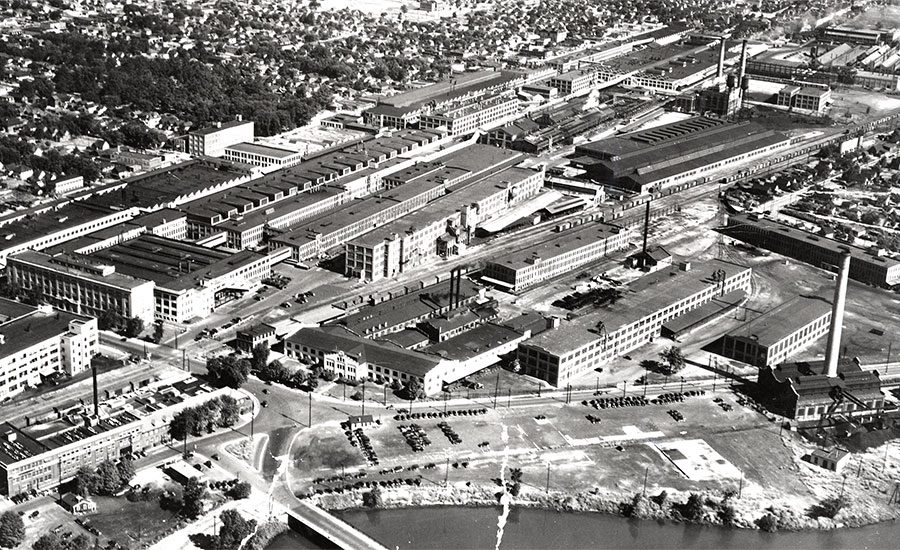
Often considered the crown jewel of 1920s automation, the Unified Assembly Line debuted at Buick’s factory in Flint in 1926. This wasn’t just a new production line; it was a complete rethinking of workflow. The system consolidated all final assembly tasks into a single, massive building, replacing the traditional setup where different processes were scattered across multiple disconnected buildings.
**The Concept:**
Engineers, led by Vice President Cady Durham, designed the line to solve a critical problem: Buick couldn’t keep up with surging consumer demand. In 1922, the company made 105,000 vehicles; by 1923, sales had skyrocketed to 180,000. Durham’s solution was to funnel every final assembly task into one central location, with all parts delivered via an automated conveyor system.
**The Workflow:**
The line operated like a well-oiled machine. Bare iron frames entered one end, while workers and materials flowed through a complex network of elevated bridges and mezzanines. These bridges were the key innovation. They allowed workers to install components—such as axles, springs, and power plants—without the frames ever having to stop moving.
> “The first impression I received on entering this building was one of noise and confusion… But I soon became accustomed to the surroundings and saw that the confusion was only seeming, and that in reality every motion is carefully planned.”
> — *The Trip I Took Through the Factory of the Buick Motor Company*
Because the three assembly lines were contained within a single, climate-controlled building, Buick drastically reduced the floor space needed per vehicle. Mezzanines acted as subassembly stations where parts were sorted and delivered precisely when needed, eliminating wasted motion and downtime.
**Results and Recognition:**
The results were staggering. By 1926, Buick was producing 266,000 vehicles annually, making it General Motors’ most profitable division and allowing the company to leapfrog competitors like Dodge and Hudson to claim third place in the market. An article in *Automotive Industries* praised the line, noting that 850 men were producing a completed car every 60 seconds in a space just 64 feet wide.
—
### **Supporting Innovations: Conveyors and Material Flow**
The success of the unified line depended on groundbreaking material handling technology.
* **The World’s Longest Conveyor:** To feed the line, GM engineers developed the longest conveyor belt in the world to transport engines. Stretching 3,600 feet, this overhead system rose from the engine test room, crossed streets, and traversed roofs before delivering motors directly to the assembly floor. This replaced the old method of loading engines onto railroad cars and moving them between buildings three separate times.
* **Reduced Waste and Inventory:** The unified system slashed inventory “float” by more than 50%. A master scheduling system planned production 12 hours in advance, ensuring parts arrived just-in-time.
* **The Human Element:** The design was also meant to help the workers. Durham believed the old system “wore out” men through physical strain. The new system brought the work to the worker, simplifying the job and allowing them to focus on a single task. Consequently, the department was paid a fixed price per completed car, incentivizing speed and quality.
—
### **FAQ: The 1920s and the Rise of Factory Automation**
**Q1: What was the primary driver for automation adoption in the 1920s?**
The primary driver was the explosion in consumer demand, particularly for automobiles. Companies like Ford, GM, and Chrysler needed to produce unprecedented volumes of vehicles quickly and affordably, which necessitated moving away from manual labor and toward mechanized production.
**Q2: What technology defined the era’s manufacturing?**
The defining technologies were the moving assembly line, electric motors, and relay logic controls. These innovations replaced the old infrastructure of stationary steam engines and complex overhead shaft systems, offering factories greater power and flexibility.
**Q3: Why was the Buick Unified Assembly Line considered a “marvel”?**
It was considered a marvel because it consolidated all assembly steps into a single building. By using elevated conveyor bridges to deliver parts directly to the line, it eliminated wasted movement, reduced factory floor space by 50%, and increased production output dramatically, all while maintaining order in a seemingly chaotic environment.
**Q4: How did material handling technology change?**
Material handling shifted from rail cars and manual labor to sophisticated conveyor systems. GM’s engine conveyor, for example, moved six-cylinder engines effortlessly across a half-mile of elevated track, reducing transport labor and ensuring a smooth, continuous flow of parts to the assembly line.
**Q5: What impact did the 1920s have on the modern factory?**
The 1920s established the foundational principles of modern manufacturing: standardized parts, sequential workflows, and the integration of automation to scale production. The decade proved that high-volume, low-cost manufacturing was possible, a model that continues to influence industry today.
—
### **Conclusion**
The 1920s were far more than a cultural revolution; they were an industrial one. The decade’s embrace of automation transformed factories from collections of machines into synchronized production ecosystems. The innovations born in the assembly plants of Detroit and Milwaukee—from Ford’s River Rouge to GM’s Unified Line—set the stage for the modern manufacturing world. By prioritizing efficiency, flow, and integration, engineers of the Jazz Age didn’t just build cars; they built the blueprint for how we build things, an influence that continues to resonate in every factory floor today.
