



**MSCI Revives Index Threat That Deepened October’s Bitcoin Crash**
The cryptocurrency market is once again facing uncertainty as MSCI (Morgan Stanley Capital International) has revived a framework that could lead to the removal of major companies like Strategy (formerly MicroStrategy) from its benchmarks. This move has raised concerns about potential market disruptions reminiscent of the events that contributed to Bitcoin’s crash in October 2025. While the framework avoids explicitly naming digital assets, the companies affected appear all too familiar.
—
### What Happened During October’s Crash?
In October 2025, MSCI proposed treating firms with digital-asset holdings exceeding 50% of their total assets more like investment funds than operating businesses. Strategy, the world’s largest corporate Bitcoin holder, was immediately targeted. Analysts estimated potential passive outflows of $2.8 billion from MSCI trackers alone, with broader adoption risking sales up to $8.8 billion.
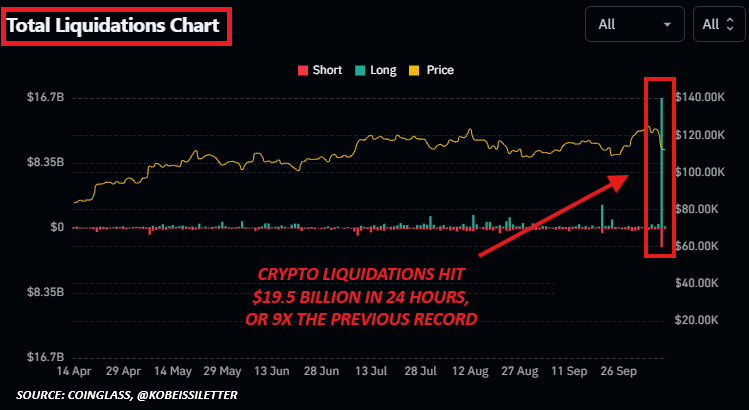
The timing worsened the situation, with $19 billion in leveraged liquidations occurring simultaneously, driving Bitcoin’s price down by over $15,000 from its peak of nearly $126,000 a month earlier. MSCI eventually retreated in January 2026 following significant industry pushback, including Strategy’s argument that it operates more as a software business than a passive fund.
—
### How the New Framework Works
MSCI has reopened the issue with a consultation in August 2026, applying a quantitative screening process to determine the eligibility of non-operating companies. The framework first identifies firms where operating assets fall below 50% of total assets. It then evaluates additional ratios, including operating intensity, expense intensity, cash flow, fair-value exposure, and capital dependence. Companies failing four of these measures face potential removal.
Simulations using May 2026 data flagged Strategy, Japan’s Metaplanet, and Yellow Cake as vulnerable to deletion. However, existing constituents have some protection—they must fail the criteria across two consecutive periods before removal.
Strategy responded assertively on X, stating, “Index providers should measure markets, not decide which assets companies are allowed to own. Bitcoin doesn’t need MSCI. Neither does Strategy.”
—
### Why Bitcoin Would Feel This Only Indirectly
Though Strategy has shifted toward active liquidity management, including selling some Bitcoin to build cash reserves, the impact on Bitcoin would be indirect. The forced sale of MSTR shares by passive funds does not necessarily mean Strategy will dump its Bitcoin holdings.
However, the broader implications are significant. A compressed stock premium relative to Bitcoin holdings could make future capital raises less efficient, undermining the model that has driven demand. With Bitcoin trading around $62,849—roughly 50% below its October 2025 high—the stakes remain high.
—
### FAQ
**Q1: Why is MSCI considering this move now?**
MSCI is responding to regulatory and market pressures regarding how companies with significant digital asset holdings are classified. The new framework aims to standardize eligibility criteria across non-operating entities.
**Q2: Which companies are most at risk?**
Strategy, Metaplanet, and Yellow Cake are prominently mentioned in simulations, but any firm failing the quantitative thresholds could be affected.
**Q3: What happens if a company is removed?**
Removal from MSCI benchmarks could lead to passive fund outflows, reduced liquidity, and a potential decline in stock premiums, particularly for Bitcoin-heavy firms.
**Q4: Could this impact Bitcoin’s price?**
Yes. Indirect effects include reduced efficiency in capital raises for Bitcoin-focused companies, potentially dampening demand and contributing to price volatility.
—
### Conclusion
MSCI’s revived framework highlights the ongoing intersection between traditional finance and cryptocurrency markets. While the immediate impact may be indirect, the potential removal of major corporate Bitcoin holders like Strategy could disrupt market dynamics and amplify volatility. As the consultation progresses, all eyes will be on how regulators, investors, and index providers navigate this critical juncture. The evolving relationship between corporate Bitcoin adoption and financial benchmarks remains a defining theme for the crypto market’s future stability.
