



For most of the last decade, the promise of IoT in industrial operations was visibility. Connect the assets, stream the data, put it on a dashboard and let operators see what was happening across a site in real time. The question now is what comes after visibility, and the answer reshaping oil and gas operations is autonomy: systems that move past detection into action, taking operational decisions without waiting for a human to read the alert.
That trajectory is visible across two editions of the Oil and Gas Automation and Digitalisation Congress (AUTOMA). At AUTOMA 2025, a roundtable on IoT and remote monitoring brought together operators and technology providers building the connectivity, edge and analytics foundations for digital field operations. At AUTOMA 2026, in Amsterdam on 5-6 October, the dedicated roundtable has moved one step further, to autonomous IoT and the future of smart operations. The gap between those two titles, between monitoring and autonomy, is the most consequential shift happening in heavy industry right now, and the work presented at both sessions maps it closely.
The foundation: connectivity, edge and the digital oilfield
The case for digitalisation in oil and gas is not in dispute, and the numbers explain why. As Giovanni Auciello of SES set out at the AUTOMA 2025 roundtable, digital transformation has the potential to lower the cost per barrel of oil equivalent by up to 25% and unlock USD 250 billion in value for upstream operations by 2030. His central point was a precondition that the industry often skips past: none of that value is reachable without secure, reliable, high-performance connectivity, and that is precisely what is missing in the world’s most remote energy locations. SES’s answer, a multi-orbit satellite architecture combining medium and low earth orbit systems with intelligent traffic management, exists to give remote sites the guaranteed availability and predictable latency that mission-critical processes such as drilling optimisation, predictive maintenance and real-time environmental monitoring depend on.
If connectivity is the precondition, edge computing is what turns a connected asset into a responsive one. Karan Bhatia of SLB, presenting the ZEDEDA-enabled Edge AI platform, described operators in remote and complex environments achieving double-digit gains in production by moving compute closer to where data is generated. The significance is in the verb: the shift he described was from reactive to proactive operations, with measurable improvements in uptime and event detection. The same presentation was candid about what usually blocks this in the field, namely unreliable connectivity, cyber security risk, scarce onsite IT resources and the sheer difficulty of scaling edge devices across a site. Predictive maintenance is where the foundation has scaled furthest. Shubham Rajvanshi of L&T Technology Services presented a real-time monitoring solution deployed across more than 70 petrochemical plants, converging IT, OT and engineering data streams on critical assets to cut unplanned downtime significantly. That convergence of previously separate data domains is the unglamorous engineering work that everything more autonomous is built on.
The shift: from monitoring to acting
The move from a system that informs a human to one that acts on its own is already underway, and the AUTOMA 2025 session showed it from two directions.
Ryosuke Amezawa of JGC Corporation presented Automatics Operation, a layer that sits above the distributed control system and executes complex sequences that were previously manual. In an LNG plant, JGC Corporation automated the cool-down of the Main Cryogenic Heat Exchanger, one of the most complex manual operations in the entire facility, validated it in a virtual plant environment, and used it for a successful first start-up without interruption. In a power plant with carbon capture, more than 1,000 procedural steps for start-up and shutdown were automated. This is the machine running the procedure, not flagging it for someone else to act on.
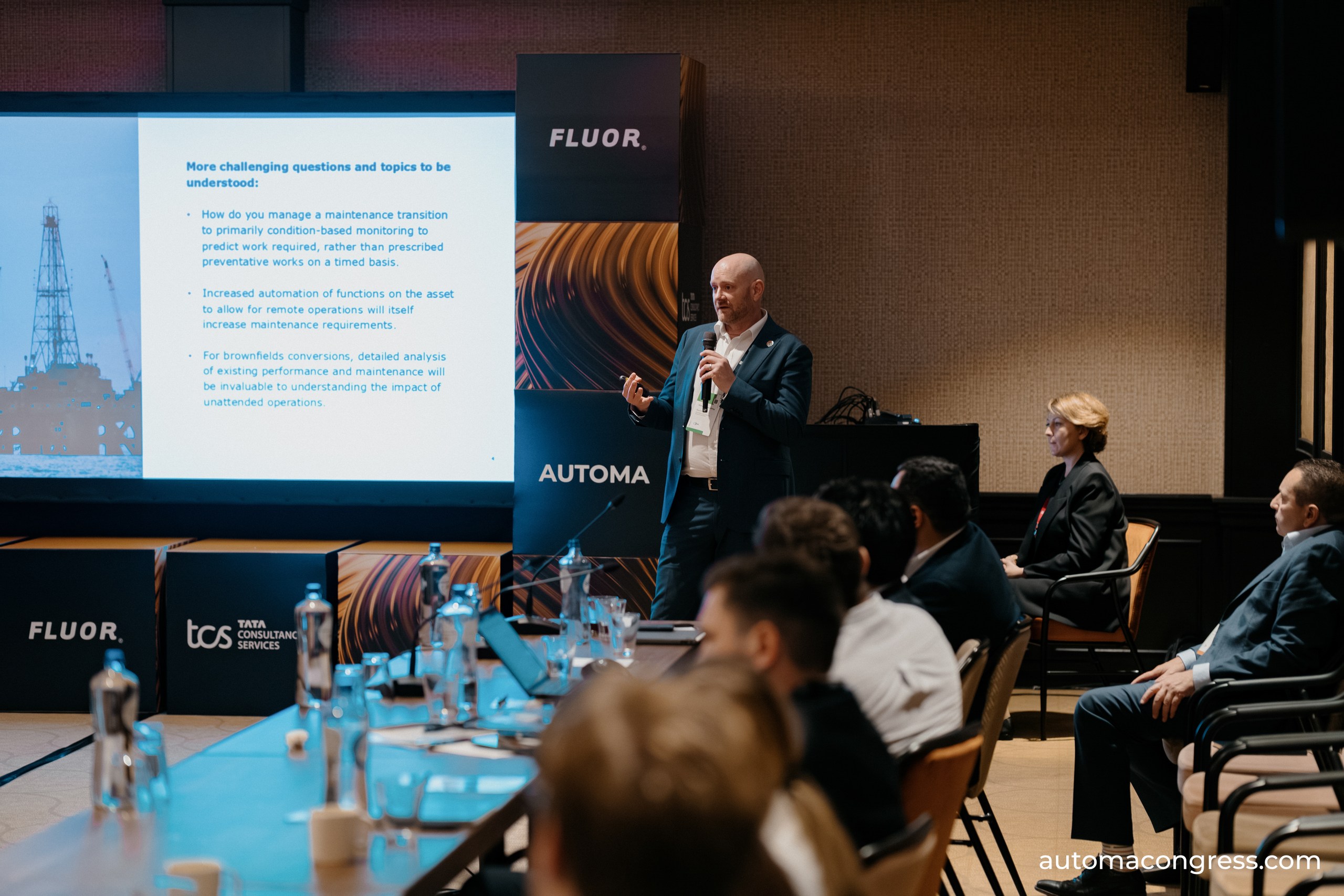
Brad Derada of Worley Consulting took the hardest version of the question: how to convert existing brownfield facilities, not just new greenfield projects, to unattended autonomous operations. His argument is one the industry needs to hear, because it cuts against the assumption that autonomy is mainly a technology problem. Setting a facility up for remote operations, he noted, is the comparatively easy part. Shifting the culture of operations and maintenance is much harder. He was also clear about a counterintuitive cost: more automation increases maintenance demand, because every additional IIoT sensor is one more thing to maintain. Autonomy relocates complexity rather than removing it – from running the process to governing the system that runs it.
The broader industry now has proof points that this progression reaches full autonomy. ADNOC, whose early predictive maintenance platform was a classic visibility play, has since moved to systems that act: its Neuron 5 platform has been credited with cutting unplanned shutdowns by half, and its autonomous well control technology initiates corrective steps rather than only recommending them. The progression from decision support to autonomous operation is in production at one of the largest operators in the world.
Safety is becoming autonomous too
The same shift is visible in worker safety, where IoT is moving from a person watching a screen to a system that detects and responds on its own. Malcolm James of DEKI presented an AI vision system that interfaces with existing CCTV, processes everything locally at the edge so no data is lost when connectivity drops, and detects whether drivers are wearing the correct PPE during LNG refuelling. The problem it addresses is stark: more than 80% of drivers do not follow PPE requirements, a behaviour that leads directly to gas leaks and equipment damage. By processing at the edge and pixelating faces to protect privacy, the system also resolves the bandwidth and data-protection constraints that usually defeat camera-based monitoring on remote sites.
This is the thread that runs into the AUTOMA 2026 programme. At the Autonomous IoT roundtable, Jacopo Moretti, HSE R&D Engineer at Saipem, is presenting a study on smart wearable IoT devices, where autonomous hazard detection has immediate human consequences. Jesus Gonzalez Lopez, Operational Technology Head at Moeve, is examining the move from data visibility to autonomous decision-making directly, drawing on a strategy that commits the company to building its new plants as digital-native from the design phase. And Abdalla Alnaqbi, Asset Management Engineer at ADNOC, is presenting on autonomous reliability-centred maintenance, the operational reality behind those headline figures.
Where it still breaks down
The honest version of this story includes where it stalls, and three constraints recur across every presentation.
The first is trust calibration. An autonomous system that acts without sign-off has to be right often enough, and fail safely enough, that operators will take their hands off the controls. In a refinery or offshore platform, where a wrong autonomous decision is measured in safety rather than cost, that bar is extremely high. The staged, virtual-plant validation approach JGC Corporation described is one practical answer: prove the sequence in a digital environment before it touches a live asset.
The second is connectivity dependence. Autonomous decisions at the edge rely on reliable local inference, which is exactly why SES’s multi-orbit connectivity and SLB’s edge architecture are prerequisites rather than enhancements. An autonomous system is only as dependable as the network and compute beneath it.
The third grows in direct proportion to autonomy: security. Every device that can sense is an entry point, and every system that can act on its own can be made to act wrongly by someone who compromises it. This is why roundtable pairs the autonomy discussion with industrial cyber security directly, in a joint presentation from Dr Al Graziano, CEO of CYBER RANGES, and Ali Bozorgmir, Global Director of OT Security Solutions at OTIFYD, on building operators’ capability to defend oil and gas environments. The security conversation and the autonomy conversation cannot be separated.

The conversation continues in Amsterdam
What makes the roundtable format useful for this topic is that the hard questions are not technical in isolation. They are about where a human stays in the loop and where they step out, how much autonomy a given process can justify on its safety profile, and what has to be true about connectivity and security before any of it is defensible. Those are questions that benefit from operators, technology providers and integrators working through them in the same room.
For anyone building the connectivity, platform or analytics layers that autonomous operations depend on, the value is in seeing exactly where the technology meets the operational and safety constraints that decide what gets deployed. The infrastructure is largely built. What the industry is working out now, and what the roundtable at AUTOMA 2026 is built around, is how much it is prepared to let that infrastructure decide.
“Roundtable 2. Autonomous IoT and the Future of Smart Operations” is part of the programme in Amsterdam, 5-6 October. Details of the full agenda are available on request.
Comment on this article via X: @IoTNow_ and visit our homepage IoT Now
