



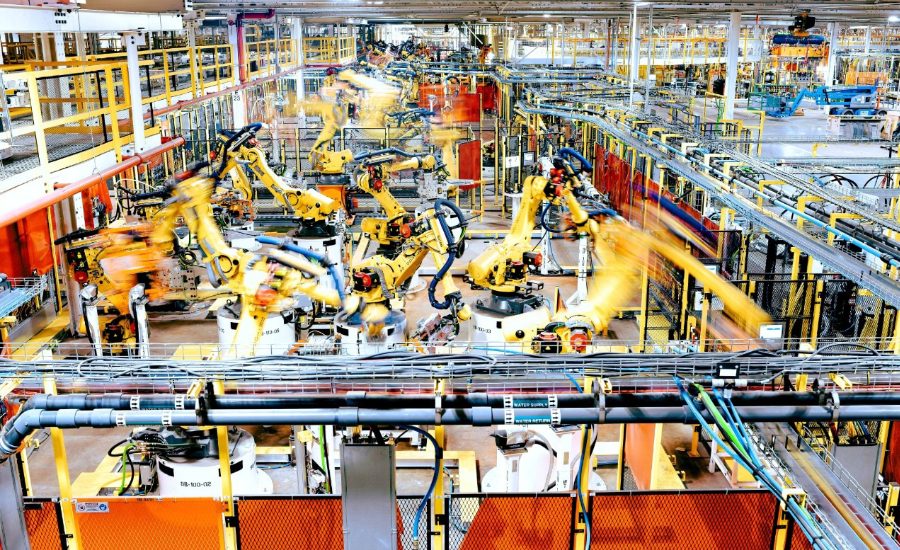
**Ford Revamps Louisville Plant with Revolutionary “Assembly Tree” EV Production System**
*By [Your Name/Source]*
In a major strategic shift towards electric vehicle (EV) manufacturing, Ford Motor Company is undertaking a massive transformation of its Louisville Assembly Plant in Kentucky. The centerpiece of this overhaul is the implementation of a groundbreaking production process centered on its new “Universal EV Production System,” which abandons the traditional assembly line for a more efficient, parallel “assembly tree” model. This ambitious $2 billion investment aims to position the plant for the production of the Ford Fathom midsize electric truck, with prototype builds set to begin in early 2027 and customer production to follow later in the year.
### The “Assembly Tree”: A Radical Departure from Tradition
At the heart of this innovation is a complete rethinking of the assembly line. Instead of vehicles moving down a single, linear track where each component is added step-by-step, Ford’s new system divides the vehicle into three major subassemblies that are built simultaneously and then joined together.
These three core sections are:
1. The **front section**, which includes the front clip.
2. The **rear section**, which includes the rear clip.
3. A **structural battery assembly**, which serves as the vehicle’s floor and includes seats, consoles, and carpeting.
This architecture is made possible by using large aluminum unicastings for the front and rear sections. These massive castings replace dozens of individual stamped and welded parts, providing the necessary structural integrity to allow these sections to be fully assembled before they are ever joined. The battery pack itself acts as the structural foundation, with interior components installed on top of it before the entire battery module is secured into the vehicle from below.
Once the three subassemblies are complete, they are brought together and joined using a combination of bolts and adhesives, forming the final vehicle.
### Key Benefits and Innovations
Ford claims that this “assembly tree” system will enable it to assemble the Fathom 40% faster than current vehicles produced at the Louisville plant. The company also reports that after reinvesting time into automation and quality improvements, this will result in a net assembly-time improvement of 15%.
The transformation of the plant has been extensive. To make way for the new system, crews removed nearly 25,000 gross tons of scrap metal and poured approximately 230,000 square feet of new concrete for final assembly equipment. The revamped facility now features approximately 17,000 feet of conveyor and what Ford says is the highest level of final assembly automation among its global manufacturing plants.
A significant focus of the overhaul has been enhancing worker ergonomics and safety. The new system is designed to give workers greater access to components, eliminating the need to work in cramped, contorted positions inside a vehicle frame. For example, installing a seat no longer requires operators to squeeze through the vehicle’s structure. Instead, they can work comfortably from the side, significantly reducing twisting, turning, and bending. Ford reports an 84% reduction in “reaching over the fender” and has created wiring harnesses that are thousands of feet shorter and lighter than in previous models.
### Digital Transformation and Connectivity
The overhaul also includes a massive expansion of the plant’s digital infrastructure. With Wi-Fi access points increasing from 385 to 1,080, the plant now supports high-bandwidth, low-latency connectivity across the production floor. This enhanced connectivity facilitates additional in-process quality checks and enables new capabilities, such as a software module flash station. For the first time in a Ford assembly plant, software modules will be updated before a vehicle is fully assembled, streamlining a process that previously could take up to 10 minutes per vehicle. Private 5G connectivity will also allow for quality tests to be conducted while vehicles are still moving through production.
### **Frequently Asked Questions (FAQ)**
**Q: What is the Universal EV Production System?**
A: The Universal EV Production System is Ford’s new manufacturing process for electric vehicles. It replaces the traditional single-file assembly line with a parallel “assembly tree” model. The vehicle is divided into three major subassemblies—the front, the rear, and a structural battery—which are built at the same time and then joined together.
**Q: Why is Ford investing $2 billion in the Louisville plant?**
A: This investment is part of Ford’s broader $5 billion manufacturing program for the Ford Fathom. It is designed to transition the plant from producing gasoline-powered vehicles to assembling cutting-edge electric trucks using the new Universal EV Production System.
**Q: When will the Ford Fathom be available?**
A: Prototype builds using production-qualified parts are scheduled to begin in the first quarter of 2027, with customer production expected to start later in 2027.
**Q: How will this new system make assembly more efficient?**
A: By allowing major sections to be assembled in parallel rather than sequentially, the process is estimated to be 40% faster. Subsequent automation and quality improvements add another 15% net gain in assembly time.
**Q: How is this change improving worker safety and ergonomics?**
A: The new system is designed to eliminate uncomfortable and strenuous tasks. Workers now have better access to components, can stand facing forward for tasks like installing the dashboard, and no longer need to squeeze into tight spaces, leading to an 84% reduction in reaching over the fender.
### **Conclusion**
Ford’s transformation of its Louisville Assembly Plant represents a significant leap forward in electric vehicle manufacturing. By adopting a modular, parallel “assembly tree” system, the automaker is not only aiming to drastically reduce production time for its new Fathom truck but also to create a more efficient, ergonomic, and technologically advanced workplace. This bold initiative underscores Ford’s commitment to securing its future in the EV revolution and sets a new standard for how complex electric vehicles can be built.
