



### Celona Launches Orion: A Unified Agentic Wireless Platform Built for Physical AI and Robotics
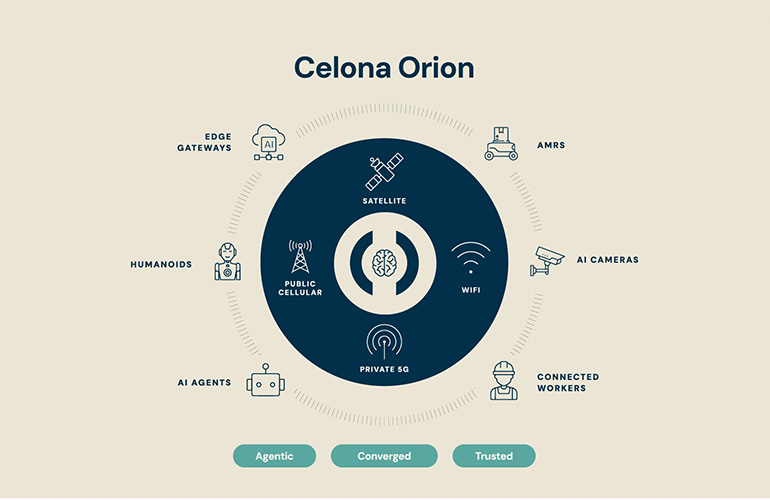
Celona, a private wireless provider based in Campbell, California, has announced the launch of **Celona Orion**, a groundbreaking unified agentic converged wireless platform designed to merge private 5G, Wi-Fi, public cellular, and satellite connectivity into a single, deterministic network fabric. The platform is specifically engineered to support the connectivity demands of **physical AI**, including autonomous vehicles (AVs), autonomous mobile robots (AMRs), computer vision systems, and edge software agents. Orion represents a significant shift from legacy, device-centric networks to an intelligent, multi-network architecture built for automated enterprise operations.
One of the key features of Celona Orion is its ability to simplify infrastructure management. The platform offers private 5G and Wi-Fi 7 access points under a single subscription model, along with an open-source agent for robotics manufacturers. This allows factory and warehouse customers to deploy Celona private 5G access points alongside Celona Wi-Fi access points to create overlapping network canopies. The entire network can then be managed through a “single pane of glass” via the Orion Orchestrator, providing unified control and visibility.
Enterprises operating across multiple environments—such as tile manufacturer Del Conca USA—often rely on various wireless technologies, each serving different purposes. With the expansion of automation, the number of connected devices, systems, and workflows continues to grow. Celona Orion brings these disparate networks together under a common platform, simplifying operations while maintaining the security, reliability, and control required by modern businesses.
**What’s New with Celona Orion?**
Beyond unified network fabric, Celona Orion introduces an **agentic operations platform** for converged wireless. Celona Wi-Fi 7 access points are included at no additional cost. The platform enables a single SIM identity on robots and autonomous vehicles, allowing seamless authentication across both Celona Wi-Fi and Celona private 5G while maintaining identity during network transitions. This is particularly useful for AVs and AMRs that may switch between private 5G during normal operations and Wi-Fi for high-speed data downloads at the end of a shift.
Security is embedded into the architecture through SIM-based identity, micro-segmentation for operational technology, and IT/OT separation—all delivered via an in-house software stack and a trusted supply chain. Importantly, Celona Orion is not just a proprietary solution; it is designed to work with other vendors’ Wi-Fi or private 5G networks, making it a flexible, ecosystem-driven platform.
**Open-Source Agent and Satellite Integration**
Celona has also launched **Celona AerConnect**, an open-source agent for robotics OEMs. This non-proprietary agent is aware of all available wireless interfaces and can handle visibility, monitoring, and traffic steering among them. It enables robotic systems to intelligently select the best network based on quality thresholds and switch when performance or reliability issues arise.
Orion further extends connectivity to remote and previously unconnected locations by integrating **Starlink satellite connectivity** with private 5G and Wi-Fi. From a single platform, enterprises can bring up private 5G, Wi-Fi, and satellite-backed connectivity wherever operations require it. New sites can be deployed in hours rather than weeks or months, using the same operating model across all locations.
IDC’s Brandon Butler notes that as AI workloads and edge computing reshape operational networks, enterprises increasingly need Wi-Fi and private 5G not as separate silos, but as a unified, intelligently managed system. Celona Orion represents the emerging category of enterprise wireless platforms designed to simplify management and orchestration while leveraging the strengths of each technology.
**AI-Driven Troubleshooting and Agentic Network Operations**
Celona is also moving toward agentic network operations, where AI agents act like virtual members of the IT/OT team. Troubleshooting is informed by network infrastructure data from Celona Orchestrator, kept local and accessible via the Model Context Protocol (MCP) and large language models (LLMs).
**Celona Brain**, a model trained on the company’s internal documents and code, functions as a digital twin of a Celona engineer, helping bridge the connectivity skill gap for roboticists who are not wireless experts and improving the scalability of physical AI deployments. Orchestrator AI exposes network capabilities through open, standards-based interfaces and an extensible library of skills and agents built by Celona. These agents can integrate with an enterprise’s preferred LLM platform and collaborate across AI-native systems.
According to Lane Wooldridge from INS, most deployments involve both Wi-Fi and private cellular, each matched to the applications they support best—Wi-Fi for IT use cases and private cellular for OT. As IT and OT converge, environments grow more complex, but Celona’s Orchestrator AI agents can help network teams simplify operations while maintaining visibility and performance.
—
### FAQ
**What is Celona Orion?**
Celona Orion is a unified agentic converged wireless platform that combines private 5G, Wi-Fi, public cellular, and satellite connectivity into a single deterministic network fabric. It is designed for physical AI applications such as autonomous vehicles, AMRs, computer vision systems, and edge agents.
**What problem does Orion solve?**
Orion addresses the complexity of managing multiple wireless technologies by unifying them into one intelligent, automated system. It enables seamless network transitions for mobile robots and vehicles, improves security through embedded identity and segmentation, and simplifies operations with a single management interface.
**How does Orion support robotics and autonomous systems?**
Orion provides a single SIM identity that works across Wi-Fi and private 5G, allowing autonomous machines to move seamlessly between networks. It also includes an open-source agent (AerConnect) that enables robotic systems to intelligently choose and switch between wireless interfaces based on performance and reliability.
**What is Celona AerConnect?**
AerConnect is an open-source agent developed by Celona for robotics OEMs. It allows robotic systems to monitor, visualize, and steer traffic across multiple wireless interfaces, making intelligent decisions about network selection in real time.
**Does Orion work with other vendors’ networks?**
Yes, Celona Orion is designed to be interoperable with other vendors’ Wi‑Fi and private 5G networks, making it a flexible, ecosystem‑oriented solution for enterprises.
**What role does AI play in Orion?**
AI is embedded throughout Orion, from AI-driven orchestration and troubleshooting to the Celona Brain digital twin, which helps non‑expert roboticists manage connectivity. AI agents work alongside IT/OT teams to automate operations and improve scalability.
**When will Celona Orion be available?**
Celona Orion will be available beginning in the fourth quarter of 2026, with key capabilities introduced on a phased basis.
—
### Conclusion
Celona Orion represents a major step forward in enterprise wireless infrastructure, particularly for organizations deploying physical AI and autonomous systems. By converging private 5G, Wi-Fi, public cellular, and satellite connectivity into a single, intelligently managed platform, Orion simplifies operations, enhances security, and future-proofs network deployments. With its agentic architecture, open-source tools, and AI-driven operations, Orion is well-positioned to become the foundational wireless platform for the next generation of automated, AI-powered enterprises.
