



**The Quiet Winner of Elon Musk’s $16.8 Billion Terafab Bet Is a US Chipmaker Stock**
Elon Musk’s Terafab chip project is suddenly real, and it has dragged one US stock back into focus. Months ago Musk tied the giant plant to Intel (INTC) and its most advanced technology, and now that Terafab is funded, that endorsement matters again.
—
### What Elon Musk Said About Intel and Terafab
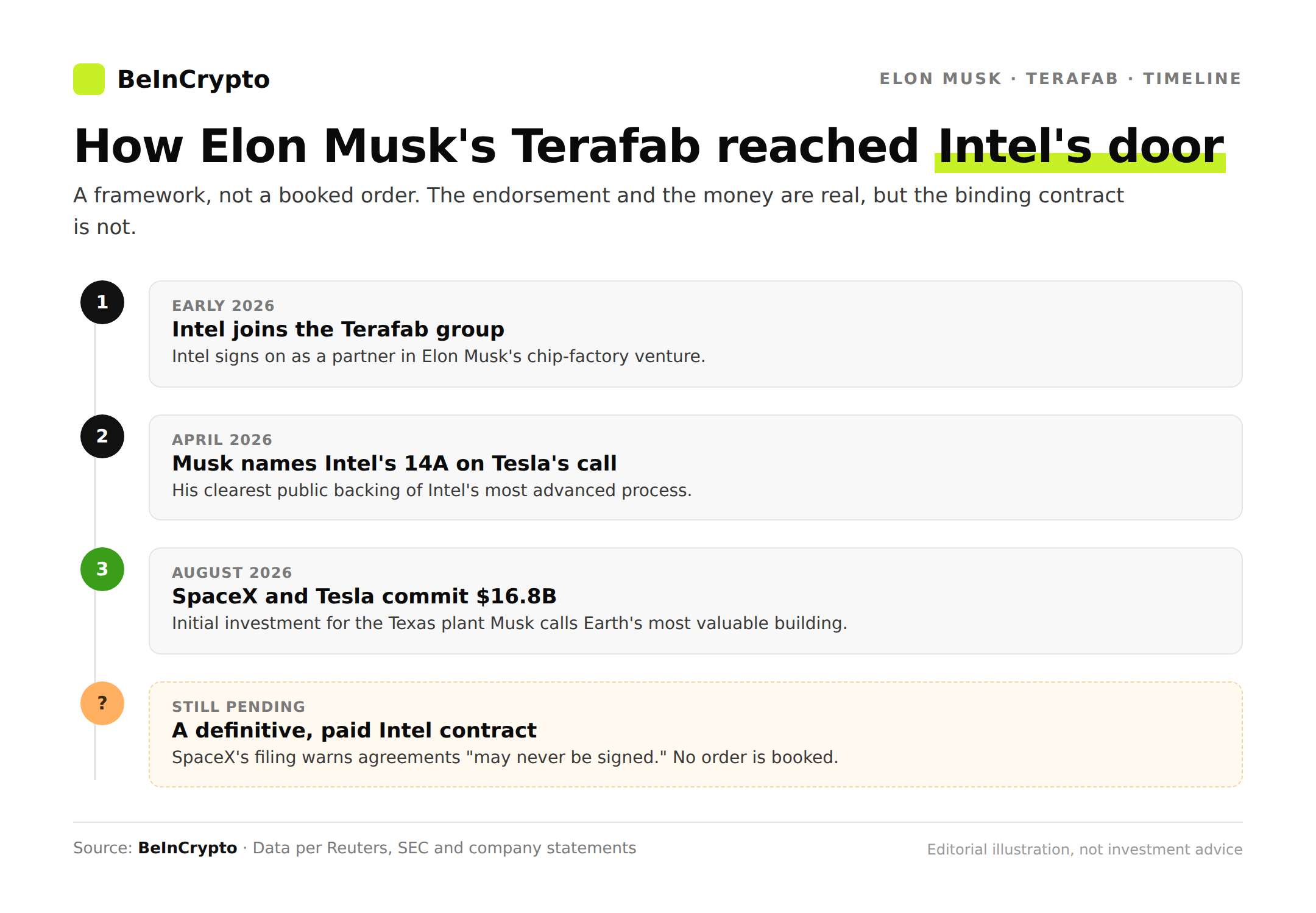
Terafab is Elon Musk’s plan to build one of Earth’s largest chip factories, the plant he calls the world’s most valuable building. He first named Intel’s 14A process on Tesla’s first-quarter call in April, its next-generation recipe for the smallest, fastest transistors. That would make Terafab the first major customer for 14A, a process Intel has not even finished building.
Then it went quiet. By the next quarter, Musk’s chip spotlight had swung to NVIDIA’s newest processor, and Intel slipped from the story. It roared back this month, once SpaceX and Tesla funded Terafab.
Intel had joined Elon Musk’s Terafab group in April, and the warmth runs both ways. Intel posted that it was “proud to join” the project alongside SpaceX, xAI, and Tesla, and CEO Lip-Bu Tan praised Musk’s “proven track record of reimagining entire industries.”
Musk’s word carries weight, too. His record personal fortune was built on bets exactly like this, so naming Intel is no idle comment.
The money is serious. In August, SpaceX and Tesla committed $16.8 billion to build the Texas plant.
The catch is the contract. SpaceX’s filing warns that the Terafab partners, Intel among them, are not obligated to stay and that definitive agreements may never be signed. So Musk’s 14A endorsement is a framework, not a booked Intel order.
That gap is why the endorsement matters more as validation than as revenue.
—
### Why It Means Validation, Not Revenue Yet
Intel has told regulators it may pause or discontinue 14A without a major outside customer. A name like Elon Musk is exactly the vote of confidence it needs.
But it is not near-term money. The 14A process reaches high-volume manufacturing in 2028, the point of full commercial scale. External foundry revenue was just $293 million last quarter, against a $2.1 billion foundry loss.
Wall Street is just as split. On July 28, the two biggest banks landed on opposite calls the same day—JPMorgan a sell at $85 and Bank of America a buy at $160. No major analyst has moved a rating since, even as Terafab won its funding (August 6) and Intel launched a $15 billion share sale, the sale of new stock that dilutes existing holders and drove the August 10 dip.
The wider business is healthier. Q2 revenue rose 25% to $16.1 billion. Investors are still pricing a broad turnaround, including bets like Trump’s Intel stake, not a Terafab order book.
That optimism is already priced in. Intel has soared this year despite a recent pullback.
—
### Intel Stock Price Levels to Watch
The chart is where the bull case lives. Since mid-July, Intel has traced an inverse head-and-shoulders, a bullish reversal shape, a dip, a deeper dip, then a shallower dip, that hints sellers are losing their grip. However, the seller-side volume seems to be rising near the right shoulder.
But the conviction behind it looks thin. Since Intel’s July 23 earnings, options traders have leaned bearish, buying more puts, bets the stock falls, and fewer calls, bets it rises. The put/call volume ratio has climbed to 0.79 and open interest to 1.01, a less bullish tilt just as the pattern needs buyers.
The left shoulder of the bullish pattern sits near $89, the head near $81, the right shoulder near $96, under a neckline around $104.
The price action is the tie-breaker. A close above the $104 neckline, roughly 7% away, confirms the breakout and opens $109, $113, and $118, near the average analyst target near $119. A confirmed move points to $126 and then $132. Below $96, the $89 left shoulder is first support, the $81 head the last line.
So Elon Musk’s Terafab hands Intel stock a real option on 14A validation, bullish in shape but short on conviction. It becomes a breakout only above $104 on rising volume (which isn’t there now), and a bankable Terafab story only when a paid deal appears.
—
## FAQ
**What is the Terafab chip project?**
Terafab is Elon Musk’s plan to build one of the world’s largest semiconductor factories, aimed at producing advanced chips in-house for his companies, including Tesla, SpaceX, and xAI.
**Which company is involved in Terafab?**
Intel has publicly joined the Terafab project alongside SpaceX, xAI, and Tesla. Intel’s 14A process technology is designated for use in the facility.
**Why does Elon Musk’s endorsement of Intel matter?**
Musk’s mention of Intel’s 14A process on Tesla’s earnings call gives Intel a crucial validation as a potential major customer, which Intel needs to justify continued investment in the cutting-edge process.
**Is Intel guaranteed to get orders from Terafab?**
No. Legal filings indicate that no binding contracts have been signed, and the partnership is not obligated to proceed.
**How much money has been committed to Terafab?**
SpaceX and Tesla have committed $16.8 billion to fund the construction of the Texas-based chip plant.
**What impact does this have on Intel’s stock?**
While the endorsement is positive for Intel’s long-term prospects, the stock remains influenced by broader market sentiment, recent share sales, and a lack of near-term revenue guarantees from Terafab.
—
## Conclusion
Elon Musk’s Terafab project has brought Intel back into the spotlight, offering the chipmaker a crucial validation of its 14A technology as a potential cornerstone customer. However, with no binding agreements in place and the factory only reaching full production in 2028, the impact on Intel’s near-term financials remains uncertain. For investors, the situation represents a long-term opportunity that is more about strategic validation than immediate revenue, making Intel a stock to watch as the Terafab story continues to evolve.
