



**Japan’s Exit from Ultra-Low Rates Exposes Hidden Financial Risks**
Japan’s decision to move away from decades of ultra-low interest rates is revealing previously hidden vulnerabilities within its financial structure. A stark indicator of this shift is the reported $96 billion in unrealized losses held by the nation’s four largest life insurance companies on Japanese government bonds (JGBs). This situation underscores the complex challenges the Bank of Japan (BOJ) faces as it attempts to normalize monetary policy.
### Japan’s Return to Higher Rates Comes at a Cost
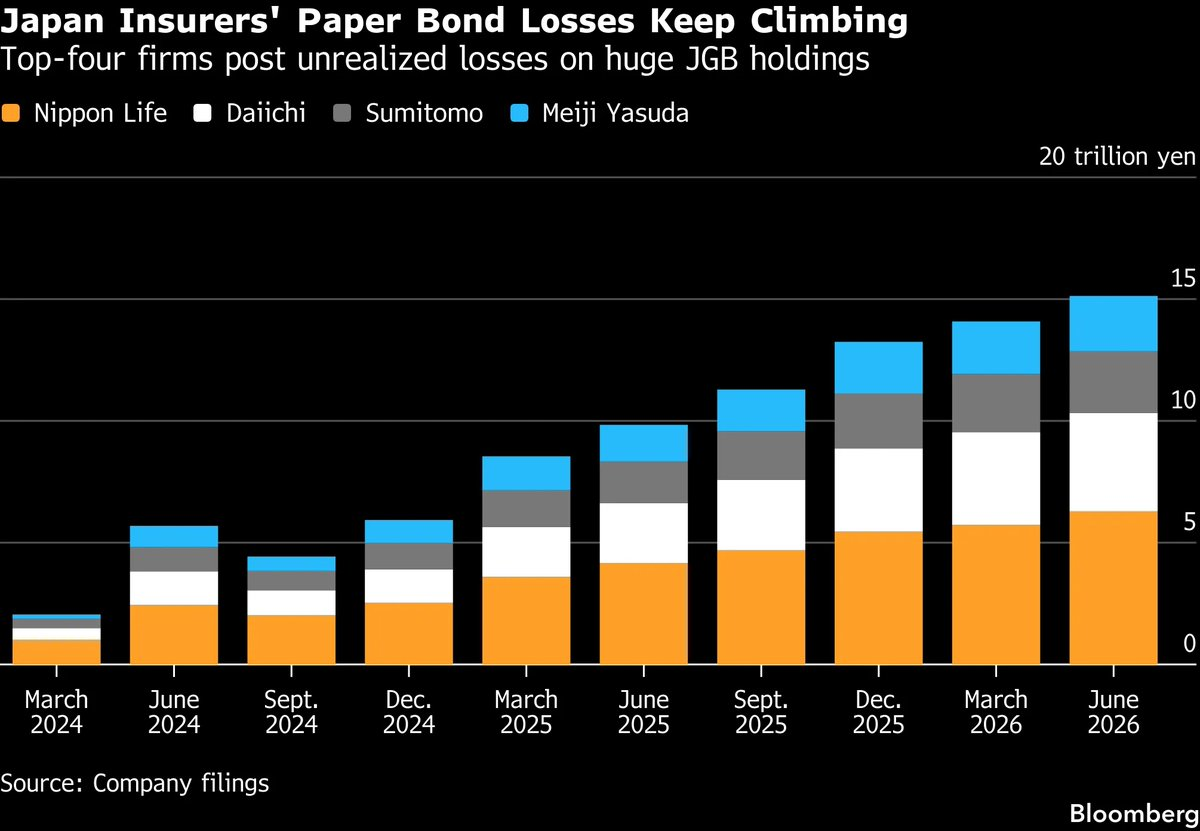
Data from the end of June 2026 reveals that insurers such as Nippon Life, Dai-ichi Life, Sumitomo Life, and Meiji Yasuda collectively reported unrealized losses of approximately ¥15.13 trillion ($96 billion) on domestic government bonds, marking a 7% increase from the prior quarter. These losses are primarily an accounting challenge, as most insurers plan to hold the bonds until maturity to cover long-term liabilities.
However, the situation highlights a critical dilemma for the BOJ. While rate hikes are essential for stabilizing the yen and curbing inflation, they simultaneously reduce the market value of existing bonds. This creates a ripple effect, impacting not only insurers but also banks and pension funds that hold significant Japanese government debt.
> “Something is breaking inside Japan’s financial system,” remarked analyst Bull Theory.
### Why the BOJ Has Become Increasingly Constrained
The BOJ now faces a delicate balancing act. Inflation remains above target, and the yen has shown consistent weakness against the US dollar—both factors typically warrant tighter monetary policy. However, aggressive rate hikes exacerbate losses across the financial sector, creating a scenario where policymakers struggle to find the right pace of normalization.
### Why America’s Debt Market Is Paying Attention
Japan’s influence extends far beyond its domestic markets. As the largest foreign holder of US Treasury securities, with roughly $1.14 trillion invested, Japan plays a crucial role in the stability of American debt markets. Any large-scale sale of US Treasuries by Japanese institutions could drive US yields higher, increasing borrowing costs.
While there’s no immediate indication of such a move, even moderate portfolio adjustments by Japan can create market volatility. Authorities have alternative tools, such as the Federal Reserve’s FIMA Repo Facility, to manage liquidity without fully liquidating bond holdings.
### Bitcoin Is Watching the Yen Carry Trade
For Bitcoin investors, the significance of Japan’s bond losses lies in what they reveal about the future of the yen carry trade. This strategy—where investors borrow in low-yield yen and invest in higher-yield assets—has been a key source of global liquidity. Rising Japanese rates and a stronger yen could force investors to unwind these positions, potentially triggering volatility in both traditional and crypto markets.
Bitcoin has remained relatively stable, trading above $65,000 following the bond loss reports. This indicates that markets view the losses as a symptom of Japan’s gradual policy transition rather than an immediate crisis. Nevertheless, shifts in the yen carry trade could influence global liquidity and risk asset performance over time.
### What Investors Should Watch Next
The $96 billion in unrealized losses does not pose an immediate threat to Japan’s financial stability. Instead, it signals the economic implications of moving away from years of extraordinary monetary stimulus. Key indicators to monitor include:
– The trajectory of Japanese bond yields.
– Policy surrender rates and policyholder behavior.
– The BOJ’s approach to interest rate normalization without disrupting financial markets.
For Bitcoin and crypto investors, the critical factor will be whether rising Japanese rates trigger a broader unwinding of the yen carry trade, which historically has led to tighter global liquidity and pressure on risk assets.
—
## FAQ Section
### What caused the $96 billion loss reported by Japanese insurers?
The loss resulted from rising Japanese government bond yields, which lowered the market value of older bonds with lower coupon rates. This is a direct consequence of the BOJ moving away from ultra-low interest rates.
### Are these losses a threat to Japan’s financial stability?
The losses are largely unrealized, meaning they exist on paper rather than as actual cash losses. However, they highlight liquidity risks, especially if insurers are forced to sell bonds prematurely to meet policyholder demands.
### How does this affect global markets?
As the largest foreign holder of US Treasury securities, Japan’s bond market instability could lead to higher US borrowing costs if Japanese institutions begin liquidating their overseas holdings.
### What role does Bitcoin play in this scenario?
Bitcoin is indirectly affected through the yen carry trade. If higher Japanese rates force investors to unwind these positions, it could create volatility in risk assets, including cryptocurrencies.
—
## Conclusion
Japan’s move away from decades of ultra-low interest rates is exposing hidden vulnerabilities within its financial system. The $96 billion in unrealized losses on government bonds held by major insurers illustrates the cost of monetary normalization. While the losses are largely accounting issues, they raise concerns about liquidity and systemic stability. The global economy, particularly the United States’ debt market and cryptocurrency markets, will need to closely monitor Japan’s financial trajectory as the BOJ navigates this challenging transition.
