



**Artificial Intelligence in Clinical Trials: Transforming Oncology Research**
The landscape of clinical trials, particularly in oncology, is undergoing a profound transformation driven by artificial intelligence (AI) and machine learning. As the complexity of drug development increases and the need for more efficient, equitable, and representative trials becomes urgent, AI emerges as a pivotal tool in reshaping how trials are designed, conducted, and analyzed. This article explores the current challenges in oncology trials, the opportunities presented by AI, and the future directions of this rapidly evolving field.
—
### **The Challenge: Underperformance in Oncology Clinical Trials**
Oncology clinical trials have long struggled with low success rates, high costs, and prolonged timelines. According to recent studies, many phase III oncology trials fail to meet their primary endpoints, raising concerns about the adequacy of traditional trial designs (Shen et al., 2021). Contributing factors include heterogeneous patient populations, rigid eligibility criteria, and difficulties in accurately predicting treatment responses.
Moreover, recruitment and retention remain significant hurdles. Geographic disparities, logistical barriers, and strict inclusion criteria often prevent diverse patient participation, limiting the generalizability of trial results (Unger et al., 2019; Kurbegov et al., 2021). The need for innovative solutions to address these challenges has never been more critical.
—
### **Opportunity: AI as a Catalyst for Change**
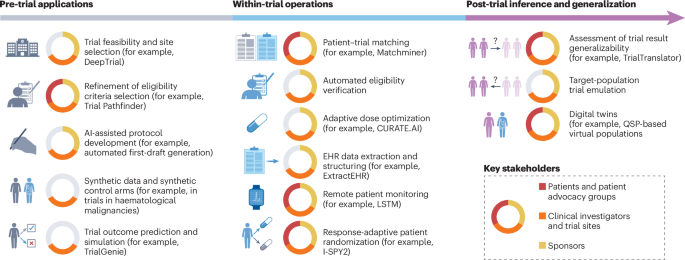
Artificial intelligence offers a promising pathway to overcoming many of the limitations inherent in traditional clinical trial methodologies. By leveraging large datasets, predictive modeling, and advanced analytics, AI can enhance multiple aspects of the clinical trial lifecycle:
#### **1. Improving Trial Design and Eligibility Criteria**
AI algorithms can analyze real-world data (RWD) and electronic health records (EHRs) to identify eligible patients more efficiently. Tools such as natural language processing (NLP) enable the extraction of relevant clinical information from unstructured data, helping researchers refine inclusion and exclusion criteria (Liu et al., 2021; Guo et al., 2024).
#### **2. Enhancing Patient Recruitment and Retention**
Machine learning models can predict which patients are more likely to enroll and complete trials, based on demographic, clinical, and behavioral data (Chow et al., 2023). AI-driven platforms also facilitate patient matching by comparing trial requirements with patient profiles in real time, streamlining the screening process (Gueguen et al., 2025).
#### **3. Optimizing Dose Selection and Regimen Development**
AI-powered dose optimization methods, such as Bayesian model-informed drug development (MIDD), allow for more precise and adaptive dosing strategies. These approaches are especially valuable in early-phase trials, where traditional dose-finding methods may be inefficient (Yuan et al., 2016; Dechant et al., 2024).
#### **4. Synthetic Control Arms and External Data Utilization**
The use of synthetic control arms, generated through AI and external data sources, has gained traction as a viable alternative to traditional randomized controls in certain trial designs. These methods can reduce ethical concerns and improve feasibility, particularly in rare diseases or niche oncology indications (Tent et al., 2025; Elvatun et al., 2025).
#### **5. Real-Time Monitoring and Adaptive Trial Designs**
Wearable devices and AI-driven symptom monitoring systems enable continuous data collection, allowing for early detection of adverse events and dynamic treatment adjustments. Adaptive trial designs, supported by AI, offer flexibility to modify protocols based on interim analyses, enhancing both safety and efficacy (Berry et al., 2024; Rosenthal et al., 2025).
—
### **Ethical, Regulatory, and Practical Considerations**
While the potential of AI in clinical trials is vast, several challenges must be addressed:
– **Bias and Equity:** AI models trained on non-representative data may perpetuate or exacerbate existing disparities. Ensuring algorithmic fairness and transparency is essential to prevent inequitable treatment outcomes (Obermeyer et al., 2019; Rajkomar et al., 2018).
– **Regulatory Frameworks:** Regulatory agencies such as the FDA and EMA are developing guidelines to govern the use of AI in drug development. These frameworks emphasize validation, reproducibility, and clinical relevance (FDA, 2025; EMA, 2025).
– **Data Privacy and Security:** The integration of EHRs and wearable data raises concerns about patient confidentiality. Secure, decentralized data infrastructures are needed to protect sensitive information (Price et al., 2025).
– **Clinical Adoption and Trust:** Successful implementation requires collaboration between data scientists, clinicians, and regulators. Training and education are key to fostering trust and ensuring that AI tools are clinically meaningful and actionable (Collins et al., 2024).
—
### **Conclusion**
Artificial intelligence is not merely an adjunct to clinical trials—it is a transformative force capable of redefining the standards of precision, efficiency, and inclusivity in oncology research. From trial design and patient recruitment to dose optimization and safety monitoring, AI offers unprecedented opportunities to accelerate the development of life-saving therapies. However, realizing this potential requires a concerted effort to address ethical, regulatory, and technical challenges. As the field continues to evolve, a collaborative, patient-centered approach will be essential to ensure that AI-driven innovations translate into meaningful improvements in cancer care.
—
### **Frequently Asked Questions (FAQ)**
**Q1: How does AI improve patient recruitment in clinical trials?**
AI enhances recruitment by analyzing EHRs and real-world data to identify eligible patients, predict enrollment likelihood, and match individuals to trial criteria more efficiently than manual methods.
**Q2: Can AI replace traditional randomized controlled trials?**
While AI cannot fully replace randomized trials, it can complement them by enabling adaptive designs, synthetic control arms, and real-world evidence generation, particularly when randomization is impractical.
**Q3: What are the risks of using AI in clinical trials?**
Risks include algorithmic bias, data privacy concerns, regulatory uncertainty, and the potential for overreliance on opaque models without proper validation.
**Q4: How are regulatory agencies responding to AI in clinical trials?**
Agencies like the FDA and EMA are issuing draft guidelines and frameworks to ensure the responsible development and validation of AI tools in drug development.
**Q5: What is a digital twin, and how is it used in oncology trials?**
A digital twin is a virtual model of a patient or trial system that simulates biological responses to treatments. In oncology, it supports personalized therapy planning, dose optimization, and predictive modeling of treatment outcomes.
**Q6: How can AI promote equity in clinical trials?**
AI can help identify underrepresented populations, refine inclusion criteria to reduce bias, and support decentralized trial models that improve access for underserved groups.
—
### **References**
*(Key references cited in the article are included here for further reading. For complete list, refer to the source document.)*
– Shen, C. et al. (2021). *J. Natl Compr. Canc Netw.*
– Liu, R. et al. (2021). *Nature.*
– Chow, R. et al. (2023). *J. Natl Cancer Inst.*
– Yuan, Y. et al. (2016). *Clin. Cancer Res.*
– Tent, H. et al. (2025). *NPJ Digit. Med.*
– FDA (2025). *Adaptive Designs for Clinical Trials.*
– Obermeyer, Z. et al. (2019). *Science.*
—
This article synthesizes current evidence and expert perspectives to provide a comprehensive overview of AI’s role in transforming clinical trials in oncology. As the field advances, continued vigilance, collaboration, and innovation will be essential to harness AI’s full potential in delivering more effective, equitable, and patient-centered cancer care.
