



**Cyberspace: The Fourth Domain Reshaping Modern Geopolitics and Conflict**
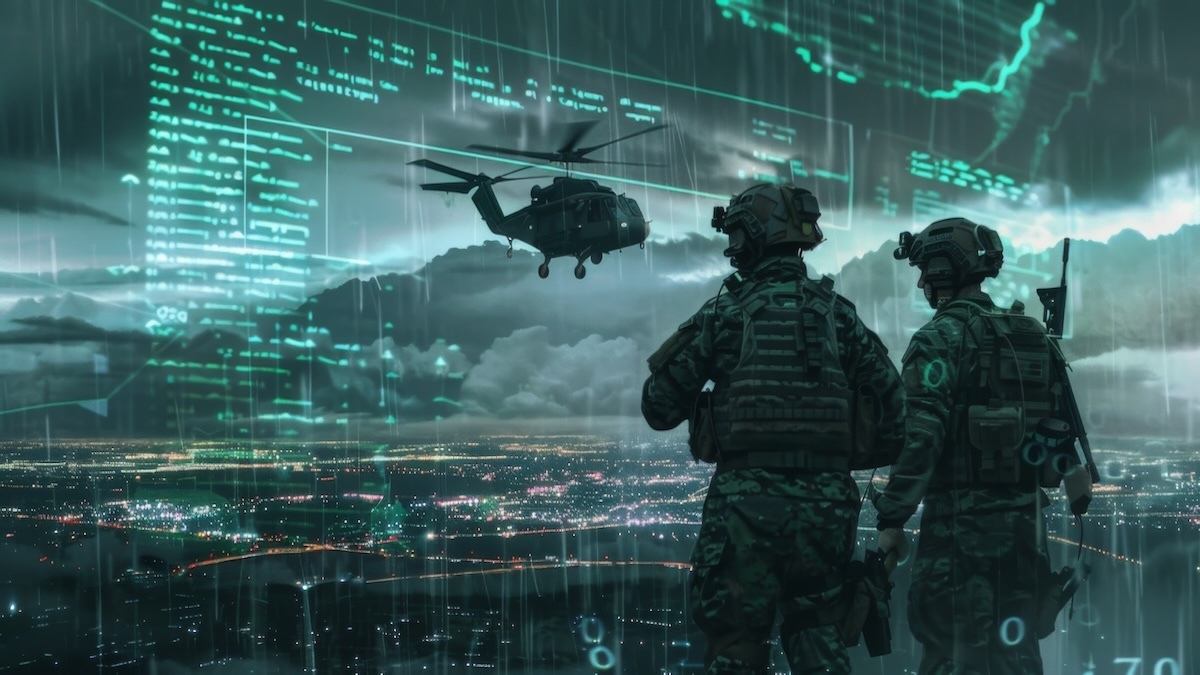
In the contemporary landscape of global conflict, cyberspace has emerged as the fourth domain of military operations, standing alongside the traditional realms of land, sea, and air. This development is not occurring in a vacuum; it is deeply intertwined with the ancient art of geopolitics, which is defined by the interaction of a nation’s history, geography, economic state, and leadership psychology. While diplomacy remains the primary tool for resolving international disputes, the use of physical force—manifesting as kinetic war involving army, navy, and air force—remains a persistent option. Today, cyberspace has been increasingly co-opted into these conflicts, acting as a powerful enabler and precursor to kinetic military action. This article explores the complex and critical intersection of geopolitics and cyberspace.
### Background: The Three Types of Modern Warfare
Modern conflict is generally categorized into three distinct, yet often overlapping, types: kinetic war (traditional ground-based conflict), cyberwar (offensive cyber operations), and cyber-kinetic warfare (cyber operations designed to cause physical damage). These are all typically motivated by political or geopolitical objectives, making the study of geopolitics and cyberspace essential for understanding 21st-century power dynamics.
Nation-state cyber operations are primarily driven by three motivations: **espionage**, **regime change**, and **territorial disputes**. In each scenario, cyber operations have become a standard precursor to, or concurrent element of, kinetic warfare. The global arena is broadly divided into an “East,” comprising nations like China, Russia, Iran, and North Korea (often termed CRINK), and a “West,” led by the Five Eyes alliance (US, Canada, UK, Australia, and New Zealand).
A key distinction exists between state-sponsored activity and common criminal behavior. Criminal acts are typically noisy, rapid, and financially motivated. In contrast, nation-state operations are characterized as “low and slow,” emphasizing stealth and long-term presence. As cyber expert Dmitri Alperovitch notes, by the time an organization detects a nation-state actor on its network, the intruders have often been present for weeks or months.
### Cyberspace and Espionage: The New Frontier
While espionage is as old as civilization itself, cyber technology has elevated it to an unprecedented scale. The motivations are dualistic, serving both military and economic aims. Nations use cyber espionage to monitor military capabilities and steal state secrets, but also to exfiltrate intellectual property from corporations, impacting commerce as much as defense.
All nations with cyber capabilities engage in espionage. The Five Eyes alliance, with its historical roots in signals intelligence, represents what is generally considered the most ethical and restrained approach. They focus on intelligence gathering to protect national security, adhering to a “rule of law” that avoids escalation unless in a declared military conflict. A crucial boundary for Western nations is the theft of intellectual property for commercial gain—a line that nations like China are known to cross.
The rise of AI provides a compelling hypothetical scenario. While a Western alliance might monitor a rival AI company for intelligence, an adversary might seek to steal proprietary algorithms and research to fuel its own domestic AI industry.
### Cyberspace and Kinetic Conflict: Preparation and Support
Cyber activity rarely wins a war on its own; its primary purpose is to prepare the battlefield, support ground troops, and hasten a kinetic victory. Two recent examples illustrate this: Venezuela and Iran.
In **Venezuela**, the January 2026 operation to arrest Nicolás Maduro almost certainly involved a cyber component for intelligence gathering and operational support, such as disrupting power. While the operation succeeded in its immediate goal, it failed to achieve regime change or stop the flow of narcotics, highlighting the limits of cyber-enabled kinetic operations.
In **Iran**, the US and Israeli joint missions in 2026 used cyber operations to degrade radar grids, enabling a successful initial airstrike that decapitated the regime’s leadership. Subsequent psychological cyber operations failed to incite an Iranian uprising, and the conflict has endured for months, demonstrating that while cyber can cripple defenses, it cannot replace boots on the ground.
### Cyberspace and Territorial Disputes: The Cases of Ukraine and Taiwan
Territorial disputes are another major catalyst for cyber-enabled conflict, with Ukraine and Taiwan serving as primary flashpoints.
In **Ukraine**, Russia’s 2022 invasion was preceded by years of cyber aggression. Operations like Sandworm and WhisperGate were clear indicators of Russia’s intent. While cyber activities have successfully disrupted communications and military command, they have not altered the fundamental stalemate on the ground, proving that cyber power can assist but not guarantee kinetic success.
The **Taiwan** dispute is arguably more critical. China’s “Volt Typhoon” cyber campaign represents a long-term strategy of pre-positioning and stealthy infiltration within critical US infrastructure. This is not merely offensive posturing but a defensive measure designed to neutralize US intervention in the event of an invasion. The stakes are incredibly high because Taiwan is the world’s leading supplier of advanced semiconductors, making it vital to the global economy and the future of AI.
### Summary and Conclusion
The examples of Venezuela, Iran, Ukraine, and Taiwan collectively demonstrate that for the past 15 years, cyberspace has been deeply embedded in military action worldwide. Cyber operations have consistently acted as a force multiplier for kinetic power, but they have rarely been decisive on their own.
The most significant concern is the Taiwan scenario. It represents a potential first major conflict between two nuclear-armed powers, where cyber operations are not just a tool but a central strategic pillar. While the hope is that geopolitical hostilities can be contained to the cyber domain, the historical trajectory suggests that cyber and ground force will continue to work in tandem. The world must hope that for the sake of global stability, this dangerous synergy remains confined to the digital battlefield.
