



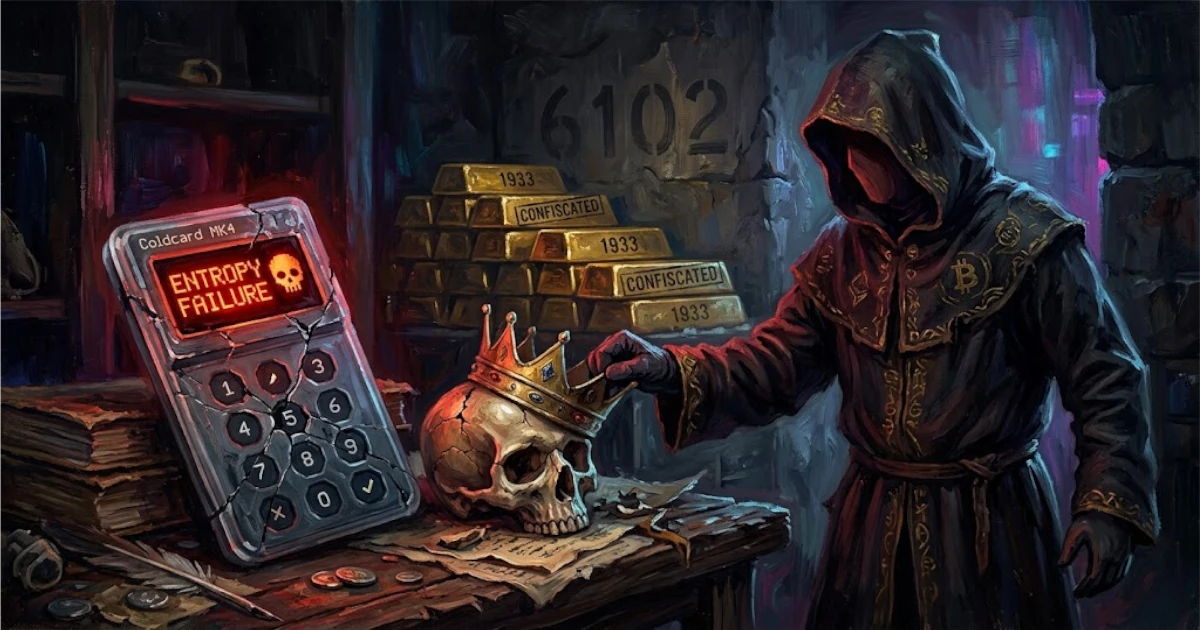
**The Coldcard Hack: A Wake-Up Call for Bitcoin Self-Custody**
The recent Coldcard hack sent shockwaves through the Bitcoin community, forcing a harsh and necessary introspection on the state of retail security. A critical vulnerability in the hardware wallet’s firmware led to the theft of an estimated 1,300 to 2,000 bitcoins, shattering the illusion of absolute security that the device, known for its “paranoid” design choices, had cultivated for years. While the incident wounded some of the most dedicated Bitcoiners, it has ignited a crucial conversation about the challenges and future of self-custody in the digital age.
### The Flaw in the Fortress: How the Hack Happened
Coldcard, manufactured by Coinkite under the leadership of its founder NVK, was celebrated for its security-first approach. It utilized air-gapped technology to prevent malware infiltration, low-resolution LED screens to avoid complex and potentially vulnerable touch interfaces, and innovative protocols like BBQR and NFC for data transfer. This collection of deliberate, paranoid design choices was intended to create a fortress for private keys.
However, the hackers bypassed all these sophisticated defenses by exploiting a single, fundamental weakness: the generation of private keys. The firmware contained a bug that compromised the entropy, or randomness, used in the key-generation process. This critical flaw resulted in private keys that were not mathematically hard to guess, rendering the entire security apparatus useless. The bug, which went undiscovered for years, highlights a brutal truth: in the world of cryptography, a chain is only as strong as its weakest link.
### Beyond the Hack: The Enduring Case for Self-Custody
Despite the financial loss and the blow to confidence, the case for self-custody and decentralization remains stronger than ever. The hack occurred in the shadow of Satoshi Nakamoto’s original vision, which was to create a peer-to-peer electronic cash system free from “trusted third parties.” This mission was born from the lessons of the 2008 financial crisis, which exposed the deep systemic risks of a centralized, fiat-based financial system.
History provides a stark parallel. The U.S. government’s 1933 executive order (6102) forced citizens to turn in their gold holdings, consolidating power with centralized institutions. Had gold ownership been more distributed and its movement easier to facilitate on a large scale, such a confiscation might have been impossible to execute. Bitcoin, engineered from the ground up to be superior digital gold, offers a solution to this very problem.
Its digital nature allows for properties gold cannot match. Multi-signature (multisig) schemes enable private keys to be distributed across multiple locations or jurisdictions, creating a form of redundancy that is immune to a single point of failure or a state actor’s coercive power. Furthermore, the ability to move vast sums of value digitally and without a centralized custodian is Bitcoin’s ultimate superpower. As the world continues to grapple with the consequences of debt and inflation, the need for a sound, decentralized monetary alternative has never been greater.
### Conclusion
The Coldcard hack was not just a failure of one product; it was a failure of implementation that serves as a wake-up call for the entire industry. It proves that no device is impenetrable and that the human and supply-chain elements of security are just as vital as the code itself. However, it did not break Bitcoin. Instead, it reinforced the necessity of its core tenets: decentralization, self-custody, and resilience. The path forward requires a renewed commitment to robust security practices, open-source auditing, and a deeper understanding of the cryptographic fundamentals. Bitcoin’s promise—a world order where sound money is free from the control of any single entity—is more relevant now than ever. The king is not dead; his guardians just need to learn from their mistake.
—
### FAQ
**Q: What caused the Coldcard hack?**
A: The hack was caused by a bug in the device’s firmware that compromised the randomness (entropy) used to generate Bitcoin private keys. This flaw made the keys predictable and easy to guess, allowing hackers to steal funds despite Coldcard’s other robust security features.
**Q: Are hardware wallets safe to use now?**
A: Yes, hardware wallets remain one of the most secure ways to store Bitcoin. The Coldcard incident was an isolated case of a firmware flaw. Users should ensure they are downloading firmware updates from official sources and, if possible, using devices that support multi-signature setups for an added layer of security.
**Q: How many bitcoins were stolen in the hack?**
A: Estimates vary, but the number of stolen coins is believed to be between 1,300 and 2,000 bitcoins.
**Q: What can I do to protect my Bitcoin after this news?**
A: If you use a hardware wallet, ensure it is from a reputable manufacturer and that you are running the latest firmware. For the most security-conscious users, considering a multi-signature solution, where multiple keys are required to authorize a transaction, is a highly recommended best practice.
**Q: Does this mean self-custody is dead?**
A: Not at all. While the hack was a significant setback, the principles of self-custody and decentralization are fundamental to Bitcoin’s value proposition. The challenge is to improve the tools and practices around self-custody, not to abandon them for custodial solutions that reintroduce the very problems Bitcoin was designed to solve.
—
### Conclusion
The Coldcard exploit was a stark reminder that security is a process, not a product. It exposed a critical vulnerability that had been hidden for years. Yet, the Bitcoin network itself remained untouched, and the philosophical argument for self-custody is stronger than ever. Bitcoin, engineered to be a superior form of money, offers a path toward financial sovereignty that legacy systems and even previous iterations of money, like gold, could not. The lesson is not to abandon self-custody, but to refine and fortify it, ensuring that Satoshi Nakamoto’s vision can survive not just hacks, but the much larger threats posed by centralized financial power.
