



**Whale Bets $23 Million on Gold as Deutsche Bank Sees Fair Value at $4,700**
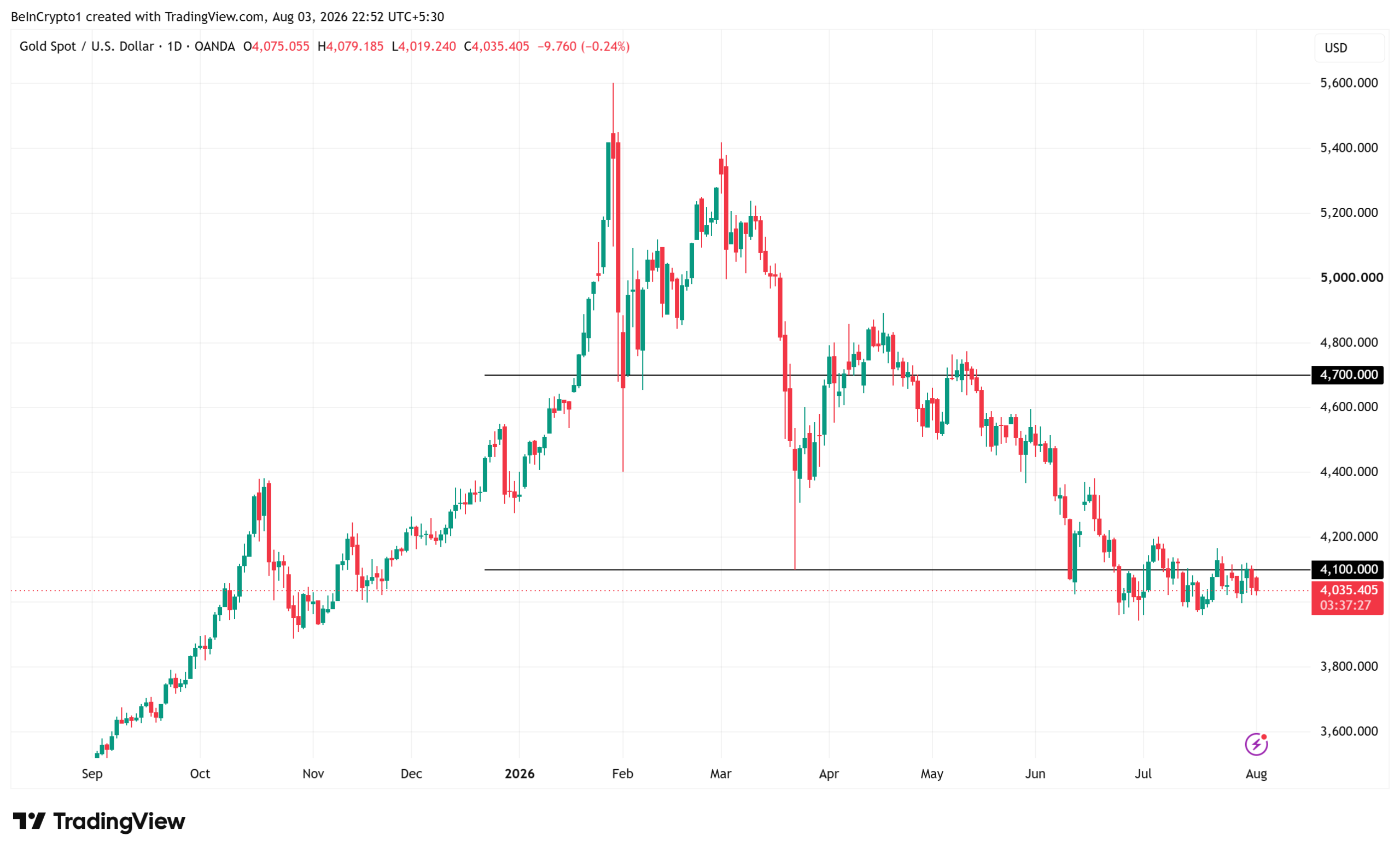
A significant move has shaken the financial markets as a crypto whale has placed a bet exceeding $23 million on the rise of gold prices. Adding weight to this bullish stance, Deutsche Bank analysts have also voiced their support, setting a fair value for gold at around $4,700 an ounce, a figure notably higher than recent market prices. However, this optimistic view is countered by the gold industry’s own research body, which maintains a more cautious outlook, predicting the price will remain stable near $4,100 for the remainder of the year. This discrepancy highlights a critical point of contention that investors will be closely watching.
### The Whale Sold Crypto to Buy Gold
On-chain data monitored by platforms tracked a series of sophisticated moves across multiple wallets identified as belonging to “Loracle,” a highly watched trader on the Hyperliquid platform. The transactions revealed a clear shift in strategy: Loracle closed a significant long position on HYPE worth $26.5 million and subsequently sold another large holding for $52.7 million. In its place, a short position of $31.4 million was established. This activity wasn’t isolated; approximately $95 million in long bets on Ethereum, Zcash, and Solana were also closed. Following these moves, a substantial long position on gold was initiated, accompanied by a short on Ethereum worth over $28 million.
> “Loracle seems to be done with hyperliquid:native for now Probably the most tracked hyperliquid whale Closed his hype long , sold hype and turned short
Is currently long on GOLD”
>
> — myst (@mystcapital) August 3, 2026
While the scale of the bet is substantial, it exists within a specific market segment. Thanks to the HIP-3 upgrade, Hyperliquid hosts external futures markets, meaning gold and stock contracts trade there rather than on the main exchange. Although the total open bets in these markets reached $3.59 billion as of Monday, Loracle’s $23 million move is large but not dominant enough to sway the entire market.
### Why Deutsche Bank Sees $4,700
In a note to clients dated Monday, Deutsche Bank analysts Michael Hsueh and Bryant Xu presented a compelling case for higher gold prices. They described gold as being in an “explosive price phase” reminiscent of only five other periods since 1975. To determine the asset’s trajectory, the analysts employed three distinct tests.
The first test, which compares gold to other commodities, pointed to a price of $2,600 an ounce. The second, a statistical bubble test suggesting the recent decline may have already found a bottom, indicated a level near $3,900. The third test, however, provided the decisive signal.
> “Third, gold has closed the gap to fair value… we would still see gold fair value as likely to register around USD 4,700/oz by year-end, above our USD 4,600/oz forecast for Q4’26.”
The bank maintained its $4,600 target for the fourth quarter, and the $3,900 level aligns with the recent gold price bottom of $3,959.33 recorded on June 24.
### The Bubble Test Nobody Can Time
The cornerstone of Deutsche Bank’s analysis is the Backward Supremum Augmented Dickey-Fuller (BSADF) test, a tool designed to identify prices increasing faster than what normal market conditions would typically allow. According to the bank, the test’s reading has dropped from 3.3 to 1.3 but remains above the threshold that officially flags a bubble.
This specific test was developed by the Bank for International Settlements (BIS), often called the central bank for central banks. A December 2025 BIS study famously found that gold and the S&P 500 were in a bubble territory simultaneously, a phenomenon unseen in 50 years. The authors issued a stark warning: while the test can identify past bubbles, it cannot predict when they will burst.
The BIS research further revealed that small investors were heavily funneling money into gold funds, while large institutions were either selling their holdings or maintaining a wait-and-see approach.
### The Gold Council Sees a Smaller Range
In stark contrast to Deutsche Bank, the World Gold Council, the industry’s dedicated research body, presents a much more subdued forecast. Its mid-year outlook suggests that gold will likely trade within a narrow 5% range of $4,100 for the rest of the year, capping the potential price near $4,305. Achieving the higher Deutsche Bank target of $4,500 would require a significant trigger, such as a major geopolitical shock, a shift in interest rate expectations, or a return to consistent long-term buying.
Current indicators suggest the opposite may be occurring, as traders anticipate the Federal Reserve to raise interest rates before October. Higher interest rates generally make non-yielding assets like gold less attractive to investors. The council notes that every additional 20 to 30 tonnes of central bank purchases above the typical 600-tonne annual average can boost gold prices by roughly 1%.
While gold futures traded near $4,093 on Monday, reflecting a flat outlook for August, the market’s dynamics are changing. Crypto money has already begun migrating into tokenized gold products, and now, a major whale has added direct leverage to this bet. As the market watches and waits, the test being played by Loracle—and analyzed by Deutsche Bank—remains one that standard models cannot definitively time.
—
## FAQ Section
**Q1: Who is the crypto whale mentioned in the article, and what did they do?**
A1: The whale is a trader known as Loracle on the Hyperliquid platform. They executed a significant portfolio shift, closing large long positions on cryptocurrencies like HYPE, Ethereum, Zcash, and Solana. They then used those proceeds to open a substantial long position on gold, effectively betting more than $23 million on a rise in gold prices.
**Q2: What is the “bubble test” mentioned in the article, and why is it important?**
A2: The “bubble test” refers to the Backward Supremum Augmented Dickey-Fuller (BSADF) test, developed by the Bank for International Settlements (BIS). It is a statistical tool used to identify when asset prices are rising faster than what is logically sustainable, signaling a potential market bubble. Its importance lies in its ability to flag these periods, although it cannot predict when a bubble will burst.
**Q3: Why is there a disagreement between Deutsche Bank and the World Gold Council?**
A3: Deutsche Bank analysts are bullish, citing specific tests that suggest gold is undervalued and could reach a fair value of $4,700 per ounce by year-end. Conversely, the World Gold Council, the industry’s research arm, is more cautious, forecasting that gold will remain range-bound near $4,100 for the rest of the year, requiring major external triggers to break higher.
**Q4: What factors could cause gold prices to rise according to the World Gold Council?**
A4: The World Gold Council stated that gold needs a specific trigger to climb toward $4,500. These triggers include a geopolitical shock, a shift in rate expectations (such as delays in Fed rate cuts), or a steady stream of long-term buying interest.
**Q5: How do central bank purchases affect the gold market?**
A5: Central bank purchases are a key bullish indicator. According to the World Gold Council, every additional 20 to 30 tonnes of gold purchased by central banks above the average 600 tonnes per year can lift the global gold price by approximately 1%. Recent data showed central banks bought a record 289 tonnes in the second quarter of the year.
—
## Conclusion
The market is currently divided between two starkly different outlooks for gold. On one side, a crypto whale and Deutsche Bank analysts are making a aggressive bet on a significant price increase, pointing to a “fair value” of $4,700. Their confidence is bolstered by historical bubble tests and central bank buying trends. On the other side, the World Gold Council provides a counter-narrative, predicting a stable, range-bound market constrained by macroeconomic factors like potential interest rate hikes. The coming months will reveal which perspective is correct, but one thing is clear: the $23 million whale bet ensures that gold’s explosive potential remains a primary focus for investors.
