



**Binance Founder CZ Says Bear Market Money is Hunting, Social Capital Founder Says Skip AI Chips**
A recent exchange between prominent figures in the tech and finance world highlights a major debate on where vast sums of capital are flowing amidst a sluggish cryptocurrency market. Binance founder Changpeng Zhao (CZ) stated that the bear market is brimming with money desperately searching for a destination. In contrast, Social Capital founder Chamath Palihapitiya argued that the smartest place for that money is certainly not in artificial intelligence (AI) chips.
### The Bear Market Has Money. It Is Not Buying Crypto
CZ acknowledged the immense liquidity present in the market, despite the ongoing bear sentiment. He tweeted, “We might be in a bear market, but there is a lot of money looking for things to invest in,” underscoring the paradox of idle cash in a downturn.
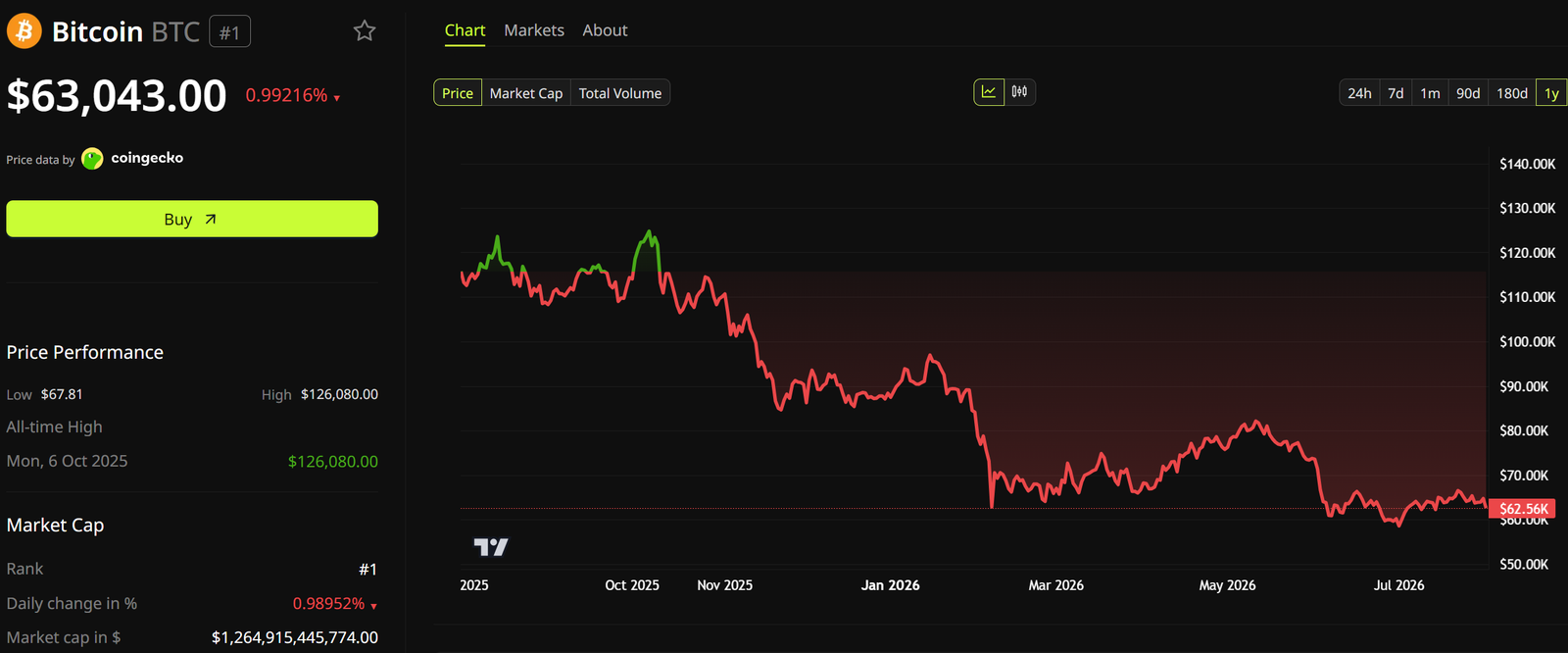
The data supports the idea that this liquidity is largely avoiding crypto. Bitcoin (BTC), the flagship cryptocurrency, is trading near $63,037. This represents a 45% decline over the past year, sitting at almost exactly half of its all-time high recorded in October. For investors sitting on significant gains from the bull run, the current market presents considerable risk, leading them to park their funds in safer assets.
***
### Chamath Is Buying Land, Not Chips
While others wait for the crypto winter to thaw, Social Capital founder Chamath Palihapitiya is making moves in a completely different sector. Palihapitiya, a former Facebook executive and prominent SPAC sponsor, is focusing on acquiring land, securing power connections, and obtaining empty buildings that can house data center servers.
His rationale is stark: **”LPS (Land Power Shell) is still the most obvious and fastest path to cash on cash returns.”**
His insight is driven by a significant barrier in the data center industry: local government approval. Towns are increasingly blocking new data center projects. Sites that already have power infrastructure are becoming exceedingly rare. The data bears this out, with at least 75 US data center projects worth around $130 billion being blocked or delayed in the first quarter of 2026—the worst quarter on record.
***
### Why He Quit the Chip Business
Palihapitiya elaborated on why the chip business itself is not for him. He pointed to his experience helping start Groq, an AI chip company that licensed its technology to industry giant Nvidia in a deal reportedly worth around $20 billion.
However, he concluded that the chip business is too difficult. The technical requirements are immense, with chips needing to run at incredible speeds, and manufacturing facilities requiring extreme precision. For a startup, securing the necessary memory and navigating the complex supply chain proves to be a monumental task.
***
### How Much Power He Has Bought
The scale of Palihapitiya’s ambition is reflected in the sheer amount of power he has acquired. He and his partner, Anita Vlallian, have secured almost six gigawatts (GW) of power capacity, with agreements unfolding through 2029.
A specific deal with Nasdaq-listed TeraWulf provides a clear example. TeraWulf, which formerly mined Bitcoin, leased a 401-megawatt site in Hawesville, Kentucky, to AI firm Anthropic for 20 years. This lease is forecast to generate approximately $19 billion in revenue.
The crucial point is that this site is not even built yet. Power is not expected to flow until late 2027, reaching full capacity in early 2028. This highlights that Palihapitiya is making long-term bets on power scarcity, a bet that is already committed capital, regardless of whether the facilities are fully utilized.
***
### What Could Go Wrong
Palihapitiya’s strategy is not without significant risks.
* **AI Growth Slowdown:** The entire premise relies on insatiable demand for AI computing power. If the AI boom cools and yields only 30% annual returns instead of 100%, the land and power could become stranded assets.
* **Regulatory Reversal:** The wave of opposition from local towns could subside. If governments begin approving data center projects again, the scarcity of suitable land with power access will vanish, devaluing his investments.
* **Market Saturation:** TeraWulf’s $19 billion figure is a forecasted revenue stream, not a guaranteed profit. Furthermore, traditional miners were already on the ground first, securing cheap power and existing infrastructure, potentially crowding out latecomers.
***
### FAQ
**Q1: What did Changpeng Zhao (CZ) say about the bear market?**
A1: CZ stated that despite the bear market, there is a significant amount of money looking for investments. He tweeted that “there is a lot of money looking for things to invest in.”
**Q2: Why isn’t this money flowing into crypto according to the article?**
A2: The article explains that Bitcoin’s price has dropped 45% from its peak, making the market highly volatile and risky for investors sitting on large profits. This has caused capital to flee to more stable assets.
**Q3: What is Chamath Palihapitiya investing in instead of AI chips?**
A3: Palihapitiya is investing in land, power connections, and empty buildings. He views this as the fastest path to cash returns, capitalizing on the data center shortages caused by local government bans.
**Q4: Why did Chamath say he quit the chip business?**
A4: He stated that chips have to run too fast, factories have to be too exact, and a startup cannot get enough memory. He found the business model for chips to be too difficult and capital-intensive.
**Q5: How much power has Palihapitiya acquired?**
A5: He and his partner have acquired almost six gigawatts (GW) of power capacity, with agreements in place through 2029.
**Q6: What is the risk of Palihapitiya’s land and power strategy?**
A6: The main risks are a potential slowdown in AI growth, a reversal in local government regulations allowing data centers to be built again, and market saturation from existing miners who already own prime infrastructure.
***
### Conclusion
The contrasting views of CZ and Chamath Palihapitiya paint a clear picture of the current investment landscape. On one hand, there is capital abundant but risk-averse, fleeing the volatility of crypto markets. On the other hand, there are investors aggressively pivoting to the foundational infrastructure of the AI revolution—land and power. While Palihapitiya is making a massive bet on the continued scarcity of data center resources, the inherent risks of regulatory change and market dynamics mean his strategy is as much a gamble as waiting for crypto to recover. The question remains: will the money hunting for a home find its way back to crypto, or will it solidify its commitment to the physical engines of the AI age?
