



**Harnessing AI and Deep Learning for Protein Design: A New Era in Biotechnology**
The landscape of protein design has been revolutionized by advances in artificial intelligence (AI) and deep learning. What was once a labor-intensive process of trial and error is now rapidly evolving into a sophisticated field where algorithms generate novel proteins with remarkable precision. From foundational models to sophisticated generative techniques, AI is enabling scientists to tackle biological challenges with unprecedented creativity and efficiency.
### The Evolution of Protein Design
Early methods of protein design relied heavily on computational simulations and rational approaches, which, while insightful, were often limited by the complexity of protein folding and interaction dynamics. The advent of deep learning has transformed this paradigm. Techniques such as those seen in **ProteinMPNN** and **RoseTTAFold** have set new benchmarks in predicting protein structures and designing sequences with desired functionalities. These tools leverage large datasets and intricate neural networks to decode the relationships between amino acid sequences and their three-dimensional structures.
### Key Breakthroughs in AI-Driven Protein Design
1. **De Novo Protein Design**: Pioneering work like **RFdiffusion** and **ProteinMPNN** has enabled the creation of entirely new proteins from scratch. By using diffusion models and sequence optimization, these tools craft proteins with stable structures and tailored functions.
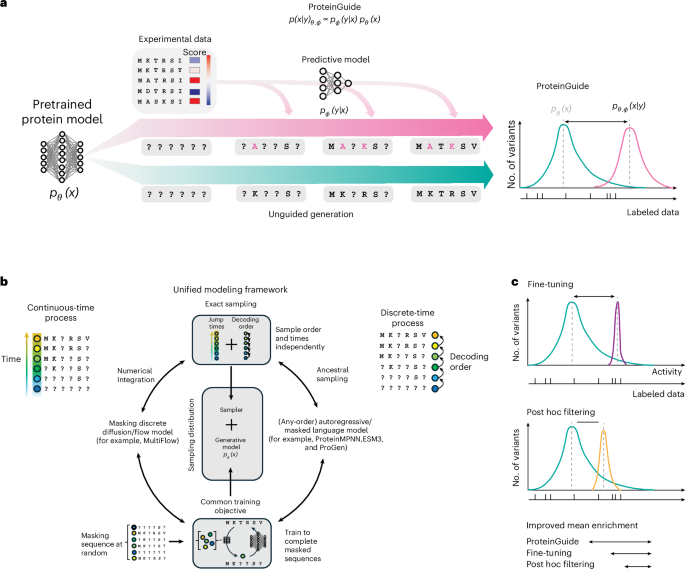
2. **Generative Models and Flow Matching**: Advanced generative frameworks, including **SE(3) diffusion models** and **flow matching**, have empowered the design of proteins with multi-state functionalities and complex interactions. These models excel in capturing the stochastic nature of protein folding, offering a probabilistic approach to sequence generation.
3. **Reinforcement Learning for Optimization**: Techniques that integrate reinforcement learning are being used to fine-tune protein designs based on experimental feedback. This approach aligns computational predictions with real-world biological activity, enhancing the practicality of AI-designed proteins.
4. **Large Language Models (LLMs)**: The application of LLMs, such as those used in **ESM Cambrian**, has introduced a new layer of understanding in protein design. These models predict functional protein sequences across diverse families by learning from vast genomic and proteomic datasets.
### Applications and Impact
AI-driven protein design is making waves across multiple sectors:
– **Biopharmaceuticals**: Rapid development of novel enzymes and antibodies for therapeutic use.
– **Agriculture**: Engineering proteins to enhance crop resilience and productivity.
– **Industrial Biotechnology**: Creating sustainable solutions for chemical manufacturing and waste management.
The integration of AI has significantly reduced the time and cost associated with protein development, while simultaneously expanding the scope of what is biologically possible.
—
### Frequently Asked Questions (FAQ)
**Q1: What is AI-driven protein design?**
AI-driven protein design involves the use of artificial intelligence, particularly deep learning, to predict and create protein structures and sequences. These tools analyze vast biological datasets to generate proteins with specific functions, often surpassing traditional methods in speed and accuracy.
**Q2: How does deep learning contribute to protein design?**
Deep learning models, such as neural networks, identify patterns in protein sequences and structures. They predict how changes in amino acid sequences affect a protein’s shape and function, enabling the design of proteins with desired characteristics.
**Q3: What are some notable AI tools for protein design?**
Notable tools include:
– **ProteinMPNN**: For robust protein sequence design.
– **RFdiffusion**: For de novo protein structure design.
– **RoseTTAFold**: For predicting protein structures and enabling sequence design.
– **ESM Cambrian**: For large-scale protein function prediction using LLMs.
**Q4: Can AI-designed proteins be used in medicine?**
Absolutely. AI-designed proteins are being developed for use in targeted therapies, vaccines, and diagnostic tools. Their precision and functionality make them ideal candidates for next-generation medical interventions.
**Q5: What challenges remain in AI-driven protein design?**
Challenges include ensuring the biological validity of AI-generated designs, scaling computational requirements, and addressing the ethical implications of creating novel biological entities.
—
### Conclusion
The fusion of AI and protein design marks a transformative moment in biotechnology. By harnessing the power of deep learning, scientists are unlocking new possibilities in medicine, agriculture, and sustainable technology. While challenges persist, the rapid evolution of tools and techniques promises a future where AI-driven proteins play a pivotal role in solving some of the world’s most pressing problems. As research continues to push boundaries, the potential of AI in biology is not just vast—it’s limitless.
