



**US 30-Year Treasury Yield Hits 2007 High as Bond Market Doubts the Fed**
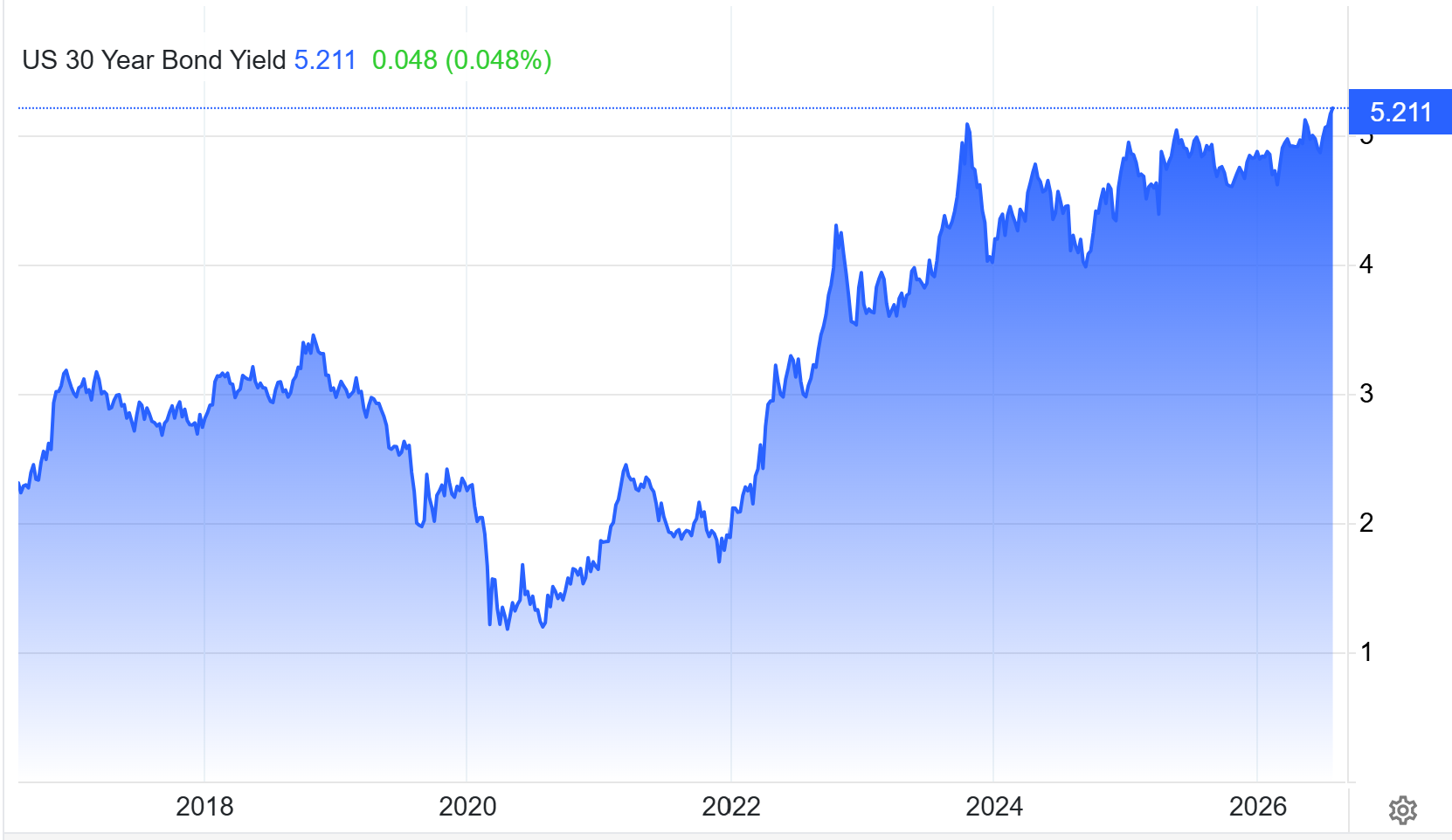
The US government is borrowing money at rates not seen since 2007, as the 30-year Treasury yield closed at 5.20% on Wednesday. This surge happened just hours after the Federal Reserve decided to leave interest rates unchanged, sparking a sharp reaction from bond traders.
### Why the 30-Year Treasury Yield Jumped
A bond yield represents the return lenders demand for holding government debt. When this number rises, borrowing becomes more expensive for everyone. The Federal Open Market Committee (FOMC) maintained its target range at 3.50% to 3.75%, with the vote split 9 to 3. Three officials—Beth Hammack, Neel Kashkari, and Lorie Logan—expressed a desire for a quarter-point increase, and bond traders ultimately sided with them.
Long-term bonds were hit the hardest. The 30-year yield jumped from 5.09% to 5.20%, while the 10-year yield climbed to 4.67%. In contrast, short-term bonds moved in the opposite direction, with the two-year yield slipping to 4.22%. This divergence sends a clear signal: traders are worried about the next 30 years, not the next 30 days. Some intraday quotes even reached as high as 5.244%.
While three dissenting votes may seem dramatic, they are not unusual, and four officials broke ranks in April. What stands out is the direction. The last time three officials voted for a rate hike at a single meeting was in September 2016. The Fed has not raised rates since July 2023, and these dissenting officials want that streak to end. Chair Kevin Warsh, who took office on May 22, refused to call the decision a pause and defended the 2% inflation target at his press conference.
> *”Follow us on X to get the latest news as it happens”*
### This Looks Like 2007, But It Is Not
The last time the 30-year yield sat at these levels, the Fed was about to cut rates. In July 2007, the yield was 5.28%, nearly identical to the Fed’s rate of 5.25%. Two months later, the Fed cut rates by half a point. Warsh, then a Fed governor, voted for that move. Today’s picture is reversed: the 30-year yield sits 1.45 percentage points above the Fed’s rate, and long rates are climbing rather than falling.
This shift has real financial implications. The interest bill on US debt reached $857 billion in nine months, a 13% increase from the previous year. Interest costs now exceed Medicare spending ($778 billion) and are close to military spending ($677 billion). Total US debt has also reached approximately $39.8 trillion.
Global events are adding further pressure. Oil prices rose 6.6% to $84.46 per barrel after the US Central Command reported that Iran fired ballistic missiles at American forces on July 28, all of which were intercepted. The collapse of the US-Iran ceasefire keeps oil markets volatile.
### Where Bitcoin and Gold Fit In
Unlike traditional bonds, crypto did not follow the sell-off. Bitcoin (BTC) traded near $64,730 on Thursday, up 0.48% for the day. Over the past 30 days, Bitcoin has gained 9.2%, though it remains down 45% over the past year. Gold moved higher as well, trading near $4,078 per ounce after settling at $4,036.30 the previous day.
Ellen Zentner, chief economic strategist at Morgan Stanley Wealth Management, suggested that traders are simply delaying their rate hike expectations.
> *”September remains a live meeting, and the incoming inflation data between now and then will be all that matters,”* Zentner said.
Inflation data released on Thursday supported this view. The Fed’s preferred gauge, personal consumption expenditures (PCE), rose 3.7% year-over-year, down from 4.1% in May. Core PCE, which excludes food and fuel, came in at 3.3%.
Even with these numbers, inflation has remained above 2% every month since March 2021. Global bond yields recently climbed to their highest level since 2008, and the long end has not come back down. The Fed will meet again on September 15 and 16—by then, the three dissenting officials will know whether their stance was right.
—
## FAQ
**What caused the 30-year Treasury yield to jump?**
The jump was triggered by the Federal Reserve’s decision to hold interest rates steady, combined with three dissenting officials voting for a rate hike. Bond traders interpreted this as a sign that future borrowing costs would rise, pushing the 30-year yield to a 19-year high.
**Why do higher bond yields matter?**
Higher yields mean the government pays more to borrow, which increases costs for mortgages, corporate loans, and consumer credit. It also impacts stock markets, as investors shift capital toward bonds expecting better returns.
**How many officials dissented, and is this common?**
Three officials dissented, which is not rare. Four officials broke ranks in April, and such votes have happened before, particularly in 2016. What matters here is the direction—three votes for a hike at one meeting is a strong signal of growing internal disagreement.
**How do Bitcoin and gold react to rising Treasury yields?**
In this case, Bitcoin and gold did not fall with bonds. Bitcoin actually rose slightly, showing resilience, while gold inched higher. This suggests that investors are still seeking alternative assets despite stronger traditional yields.
**When will the next decision be made?**
The Federal Reserve meets again on September 15 and 16. Market expectations for a rate hike will be closely watched, and the three dissenting officials will be watching to see if their concerns are validated.
—
## Conclusion
The 30-year US Treasury yield reaching a 19-year high reflects a critical shift in market expectations about the Federal Reserve’s policy path. While the Fed paused this time, three officials pushed for more aggressive action, and bond traders responded decisively. The broader implications include higher borrowing costs, increased pressure on the national debt, and renewed questions about inflation control. With the next FOMC meeting just weeks away, the coming decision could confirm whether this is a turning point—or only the beginning of a new and uncertain phase for US monetary policy.
