



**KubeCon India 2026: LitmusChaos Key Takeaways and Community Momentum**
KubeCon + CloudNativeCon India 2026 marked a significant milestone for the cloud native community, bringing practitioners together in Mumbai to discuss the latest in infrastructure and resilience. For LitmusChaos, the event was more than just attendance—it was a platform to showcase real-world impact, deepen community engagement, and highlight how collaborative open-source drives innovation in production environments.
—
## A Landmark Recognition: The CNCF End User Case Study Contest
One of the most notable moments of the conference was the announcement that Flipkart had won the CNCF End User Case Study Contest India. Their winning story featured LitmusChaos as a foundational tool in building a robust, multi-tenant chaos platform. This recognition underscored the tangible value that LitmusChaos brings to large-scale, production environments.
The award also earned LitmusChaos a keynote slot alongside Flipkart, providing a powerful stage to share how chaos engineering transitions from an afterthought to a core practice in reliability engineering.
—
## Keynote Highlights: From Theory to Production Reality
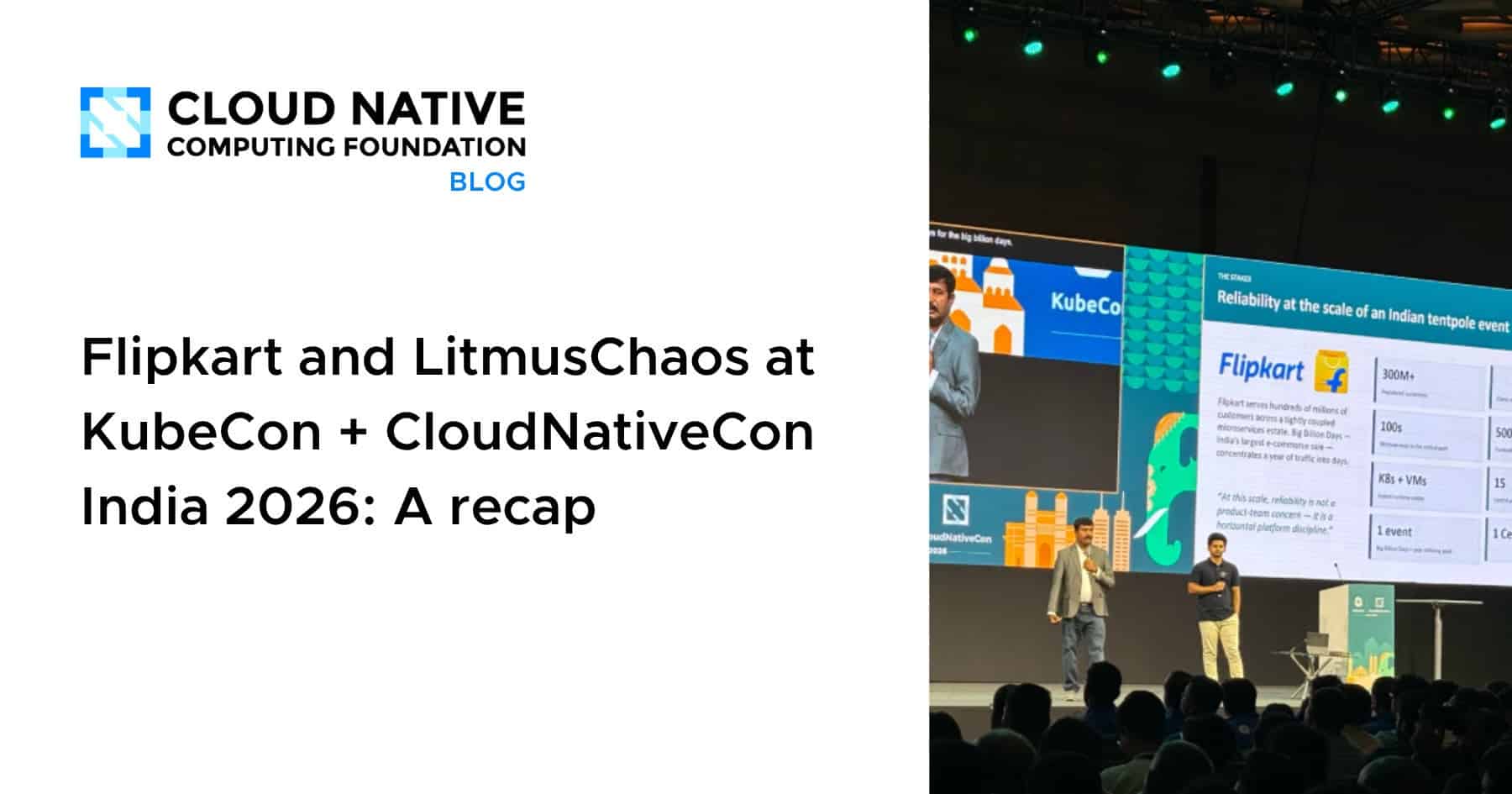
In the keynote titled **“From Afterthought to Practice: How Flipkart Built a Multi-tenant Chaos Platform on LitmusChaos,”** Aditya Sridasyam and Uma Mukkara detailed how Flipkart’s Central Reliability Engineering team leveraged LitmusChaos to handle the demands of high-traffic events like Big Billion Days.
Key production-hardened implementations included:
– **Hybrid Multi-tenancy Architecture:** Balancing cluster-wide and namespace-level isolation for scalable chaos testing.
– **DaemonSet-based High Availability:** Ensuring reliable chaos injection across nodes.
– **Script Runner Fault:** Enabling dynamic target selection and context chaining for flexible experiments.
– **Hybrid VM Chaos Extension:** Extending chaos testing to non-Kubernetes workloads.
These insights illustrated how large-scale deployments can refine open-source tools to meet extreme reliability demands, with Flipkart contributing learnings back to the upstream LitmusChaos project for the benefit of the entire community.
—
## Booth Engagement: What the Community Wanted to Know
The LitmusChaos project booth saw between 100 and 200 visitors, sparking conversations across all levels of expertise. Several themes dominated the discussions:
– **Resilience in the AI Era:** Exploring how chaos testing supports the reliability of AI inference workloads.
– **ChaosHub as the Default Fault Library:** Showcasing pre-built experiments for Kubernetes, AWS, GCP, and Linux environments.
– **Shifting Chaos Left:** Guidance on integrating chaos testing into CI/CD pipelines using tools like LitmusCTL, SDKs, and Terraform.
– **Tool Comparisons:** Explaining LitmusChaos’s CNCF-backed, community-driven approach versus other chaos engineering solutions.
– **Custom Experiments and Best Practices:** Helping teams build their own fault injections and scale their chaos programs.
– **LitmusChaos MCP:** Introducing a Model Context Protocol integration that enables natural-language interaction with chaos workflows, lowering entry barriers for new users.
Additional highlights included the Chaos Bird game, which engaged attendees with a fun leaderboard experience, and a ongoing giveaway that kept excitement high throughout the event.
—
## What This Event Meant for the Community
The responses from practitioners in India highlighted a community hungry for scalable, practical resilience solutions. The depth of questions reflected a mature understanding of chaos engineering challenges and the need for tools that grow with production demands.
Sharing Flipkart’s story validated LitmusChaos’s readiness for enterprise use and demonstrated the power of community contributions. The recognition from CNCF and the event organizers provided meaningful reinforcement of the open-source model’s long-term value.
—
## Frequently Asked Questions (FAQ)
**Q: What is LitmusChaos?**
A: LitmusChaos is a CNCF-incubated open-source chaos engineering platform designed to bring resilience testing to Kubernetes and cloud-native environments. It enables teams to safely experiment on systems to identify weaknesses before they cause outages.
**Q: How can I get started with LitmusChaos?**
A: Visit the LitmusChaos website for installation guides, architecture overviews, and use cases. You can also join the #litmus channel on Kubernetes Slack to ask questions and connect with contributors and users.
**Q: What is ChaosHub?**
A: ChaosHub is LitmusChaos’s curated fault library, offering pre-built experiments for Kubernetes, AWS, GCP, Azure, Linux, and other environments. It allows users to run chaos tests without starting from scratch.
**Q: How does LitmusChaos integrate into CI/CD pipelines?**
A: Through tools like LitmusCTL, SDKs, and Terraform providers, LitmusChaos can be integrated into existing pipelines to enable “shift-left” chaos testing without disrupting current workflows.
**Q: What makes LitmusChaos different from other chaos engineering tools?**
A: LitmusChaos is backed by the Cloud Native Computing Foundation and driven by a strong open-source community. It is designed for extensibility, allowing users to build custom experiments while benefiting from a large, shared fault library.
**Q: Can LitmusChaos test non-Kubernetes workloads?**
A: Yes. With hybrid VM chaos extensions, LitmusChaos can apply chaos engineering practices to virtual machines and workloads outside of Kubernetes clusters.
**Q: What was the significance of Flipkart’s win in the CNCF End User Case Study Contest?**
A: Flipkart’s win highlighted real-world, large-scale adoption of LitmusChaos. Their implementation of a multi-tenant chaos platform demonstrates how organizations can use LitmusChaos to strengthen reliability at scale.
—
## Conclusion
KubeCon + CloudNativeCon India 2026 was a pivotal event for LitmusChaos, reinforcing its role as a critical tool in cloud native resilience. The conference showcased how community contributions drive innovation, turning projects like LitmusChaos into production-grade platforms capable of supporting enterprises at scale.
From Flipkart’s groundbreaking keynote to hands-on conversations at the project booth, the event demonstrated that chaos engineering is no longer a niche practice—it’s an essential component of modern infrastructure reliability. For LitmusChaos, the momentum generated in Mumbai will fuel continued growth, collaboration, and impact across the global cloud native community.
