



**Polygon Labs and 1inch Setbacks Signal Crypto’s Pivot to Profitability Comes With Pain**
The cryptocurrency industry is undergoing a significant reckoning, as evidenced by recent events at two major firms. Polygon Labs has commenced its second round of layoffs in 2026, coinciding with the news that 1inch co-founder Anton Bukov was let go in November 2025. Both companies are undergoing strategic shifts toward commercial viability, a move reflected in their tokens trading at multi-year lows.
These parallel shakeups highlight a broader industry truth: the pioneers who built crypto’s foundational infrastructure are now facing the consequences of a market demanding real-world revenue and profitability. The era of purely speculative growth is giving way to a focus on sustainable business models.
### Polygon Layoffs Mark Fourth Round of Cuts in Three Years
In a statement, Polygon Labs CEO Marc Boiron framed the layoffs as a necessary step in the company’s evolution. “We are in the final stages of completing the Coinme acquisition, which will involve integrating that team into Polygon Labs, a move that will grow our organization as part of a broader merger exercise to position Polygon Labs to be profitable in 2027,” he stated.
This latest reduction is part of a consistent downsizing trend:
* **2023:** Approximately 100 roles cut.
* **2024:** Around 60 positions eliminated.
* **January 2026:** Another 60 jobs lost following the acquisition of wallet developer Sequence.
The strategic rationale is underscored by on-chain data. Polygon’s ecosystem now hosts $3.36 billion in stablecoin supply, ranking eighth highest across all blockchains. Furthermore, the network processed a record $9.12 billion in stablecoin volume in June, a milestone solidified by Visa’s integration of Polygon into its stablecoin settlement program. Boiron emphasized that the pivot is driven by momentum, stating, “We chose to move now because momentum like this deserves a company built to run with it.”
Adding to the internal transformation, Polygon Foundation CEO Sandeep Nailwal recently noted that a third of the team was temporarily paused to focus on building 13 distinct AI projects within a three-day sprint, signaling a push for innovation beyond core payments.
### 1inch Co-Founder Says He Was Fired, Launches Second Tier
While Polygon navigates its corporate evolution, 1inch provides a contrasting narrative of exit and disillusionment. Anton Bukov, a co-founder who had been with the DEX aggregator since its inception in 2019, revealed he was terminated in late November 2025. Crucially, despite holding a 50% stake in the company, he claimed to retain “no operational or security oversight.”
Bukov characterized his departure not as a strategic pivot, but as a leadership dispute. He asserted he was let go after advocating for changes in management and communication based on feedback from users and teammates. “The most important lesson that stayed with me: the long-term success of any project stands on two pillars of equal weight – technical excellence and leadership grounded in values that hold under pressure,” he reflected.
He has since channeled his efforts into a new venture, **Second Tier**, an infrastructure startup aimed at creating an “open financial system without friction or middlemen.”
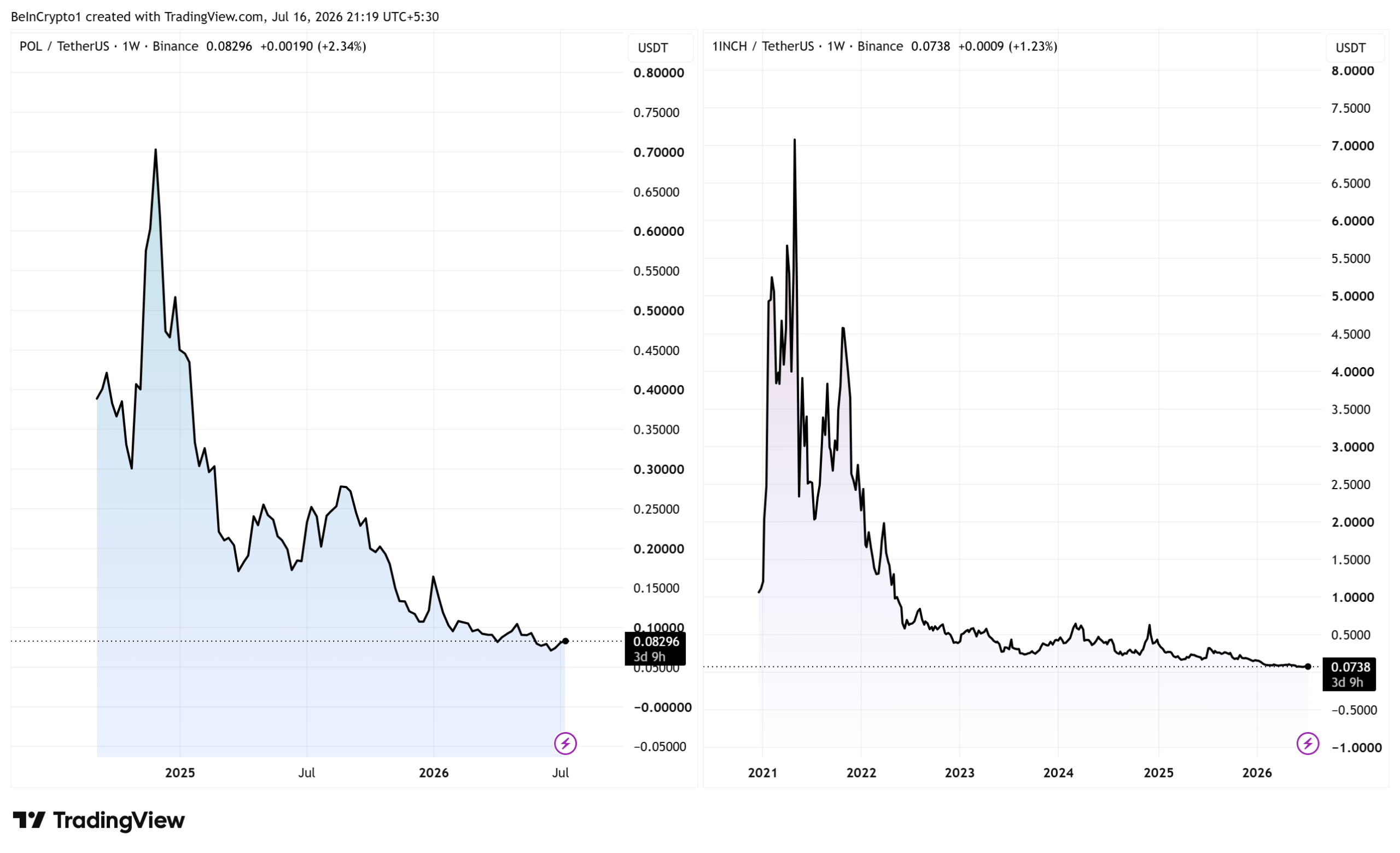
### Tokens Near Record Lows as Builders Bear the Cost
The market’s verdict on these strategic realignments has been severe, with both associated tokens reaching critical lows.
* **Polygon (POL):** The token hit an all-time low of $0.068 in July 2026 and, as of the report, was trading at $0.0838. This represents a decline of nearly 64% over the preceding year. Long-term holders have voiced frustration, questioning how a for-profit pivot by the foundation creates value for a token that is down roughly 98% from its peak. One holder poignantly asked, “How will the success of this company create measurable value for POL?”
* **1inch (1INCH):** The token fared similarly, trading at $0.0739, which marks a drop of 78% since its own all-time high in June.
These declines illustrate a painful reality for crypto’s early builders. As the industry matures, the pressure to monetize is forcing difficult personnel decisions. However, the disconnect between corporate profitability and tokenholder value remains a critical challenge for the sector.
***
### FAQ
**Q: Why is Polygon Labs conducting another round of layoffs in 2026?**
A: Polygon Labs is restructuring to transform from a blockchain foundation into a blockchain-enabled payments company. The CEO stated the goal is to achieve profitability in 2027, and the cuts are part of this strategic commercial pivot, not a reflection of poor performance.
**Q: What was the reason for 1inch co-founder Anton Bukov’s firing?**
A: Anton Bukov was fired in November 2025 following a leadership dispute. He claimed he was dismissed for pushing for changes in management and communication after receiving feedback from users and teammates.
**Q: How have the tokens POL and 1INCH performed?**
A: Both tokens are trading near record lows. Polygon (POL) is down nearly 64% from its peak a year ago, while 1inch (1INCH) is down 78% from its all-time high in June 2026.
**Q: What is the “Second Tier” that 1inch’s co-founder is building?**
A: It is an infrastructure startup described as pursuing an open financial system without friction or middlemen.
**Q: What is the on-chain data used to justify Polygon’s strategic shift?**
A: Polygon cites a stablecoin supply of $3.36 billion (eighth-largest on any blockchain) and record monthly stablecoin volume of $9.12 billion in June as evidence of a strong commercial case for its payments focus.
### Conclusion
The simultaneous upheavals at Polygon Labs and 1inch offer a stark window into the evolving dynamics of the cryptocurrency industry. The focus is shifting decisively from protocol-centric growth to revenue-driven sustainability. While these moves may be necessary for the companies’ commercial survival, they come at a significant cost, alienating early builders and challenging the perceived value of their respective tokens. The coming quarters will be critical in determining whether this painful recalibration ultimately delivers returns for both the companies and the holders of their digital assets.
