



**AI Memory Stocks: July 2026 Watchlist**
The AI memory sector has been the standout performer of 2026, driven by the intense demand for the chips that power AI server infrastructure. This scramble has sent prices and profits to record highs for the leading players. However, a closer look reveals a critical divergence: while the fundamental business has never looked stronger, large-scale investor money is quietly pulling back. This gap between stellar financials and cautious positioning creates a unique opportunity for investors.
Three specific AI memory stocks exemplify this phenomenon. Each demonstrates a powerful underlying strength—a record profit, elite margins, or a monumental year-to-date rally—coupled with unmistakable signs that major investors are stepping away. This disconnect makes the following stocks worth a watchlist through July 2026.
### Samsung Electronics (KOSPI: 005930)
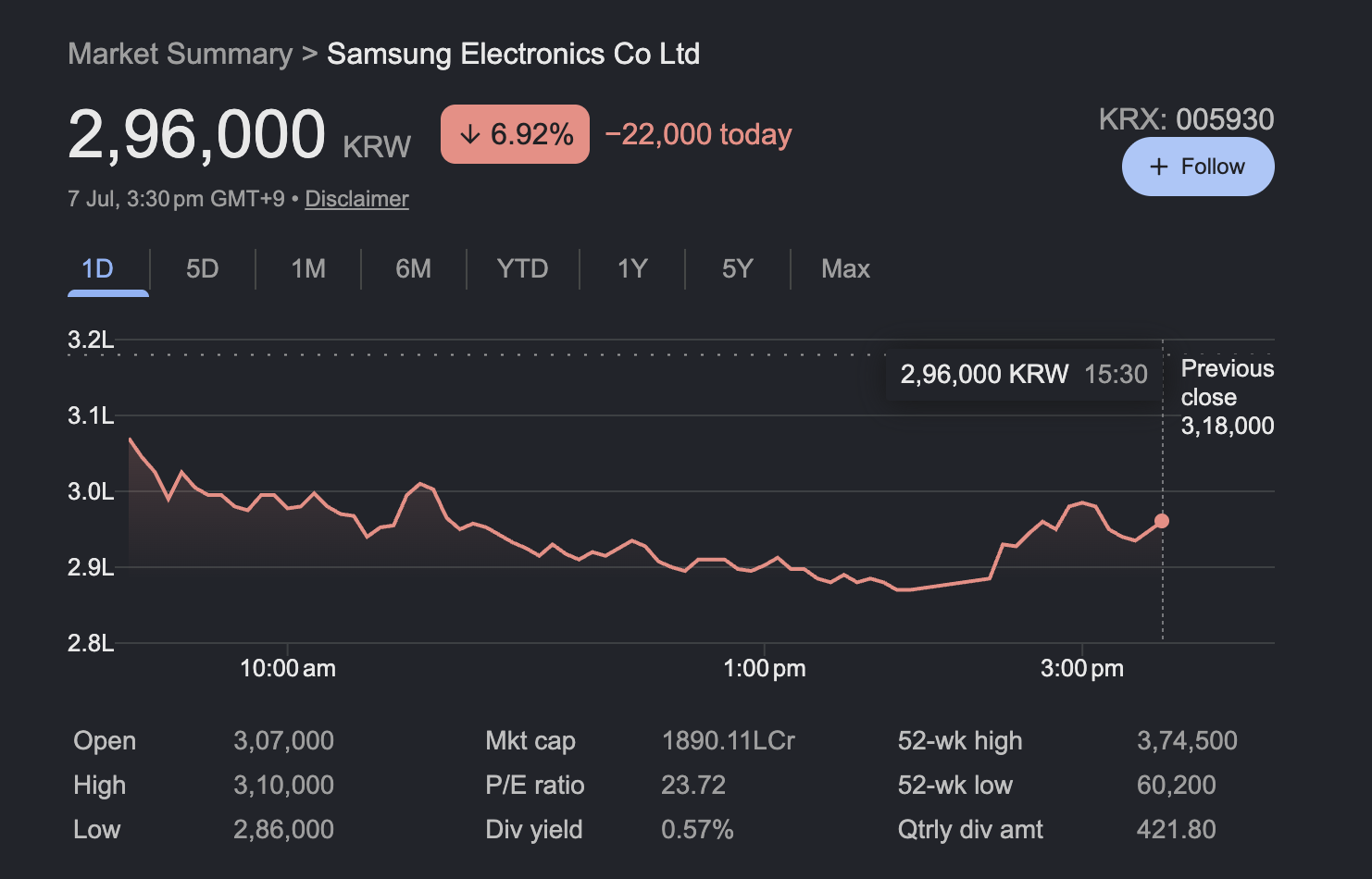
Samsung, a giant in the AI memory space, issued a mixed signal in early July. Preliminary second-quarter guidance pointed to a record operating profit of approximately 89.4 trillion won ($58.4 billion), a roughly 19-fold increase year-over-year, fueled by booming demand for AI server chips.
While the profit figure signaled a massive boom, the stock reacted negatively, falling almost 7% to around 296,000 won ($194). This decline occurred even as the company reported higher profits and beat revenue expectations. The reason lies in investor behavior: big money is fleeing. Foreign investors initiated a sell-off spanning six consecutive sessions, involving around 26 million shares, with JPMorgan, Morgan Stanley, and UBS leading the exit.
Technical indicators confirm this hesitation. The Chaikin Money Flow, a measure of institutional activity, turned negative at -0.07, indicating selling pressure. The Money Flow Index, which tracks retail participation, also dipped to a weak 42, falling below the crucial 50 buy/sell line. The combined flow score of -0.48 suggests a lack of aggressive buying to offset the institutional exits.
Furthermore, the stock’s valuation is not cheap, trading at approximately 24 times earnings. This premium valuation means investors are already pricing in significant future growth; a smaller-than-expected result could trigger a sharp correction. The record profit confirms the AI boom is real, but it appears to have already been priced in, leaving the stock in a standoff between fundamental strength and technical weakness. The July 30 full earnings report will be the next major test.
### SK Hynix (KOSPI: 000660)
SK Hynix represents the pure-play angle on AI memory. As the primary supplier of high-bandwidth memory (HBM)—the critical component for Nvidia’s AI chips—the company holds a dominant market position. It is reportedly winning about 70% of Nvidia’s next-generation HBM4 orders, making it one of the biggest direct beneficiaries of the AI boom.
Consequently, SK Hynix has delivered exceptional profitability. Its return on equity (ROE) stands at an impressive 61%, roughly triple that of its rival Samsung. The stock’s recent pullback—from a high of 2,201,000 won to a low of 2,080,000 won—highlights that the best performers often face the most volatile pullbacks.
The selling pressure has been consistent. Foreign investors have sold the stock for six straight sessions, offloading roughly 3.3 million shares. The technical picture is the weakest of the three stocks analyzed. The Chaikin Money Flow is deeply negative at -0.139, and the Money Flow Index is just 36, well below the neutral mark. The overall flow score of -1.65 is the worst in the group, signaling significant institutional caution.
Valuation provides context for this nervousness. SK Hynix trades at a P/E ratio of 21 and a price-to-book ratio of 9, compared to Samsung’s more modest P/E of 4. These higher multiples reflect the market’s lofty growth expectations, but they also mean the stock has more to lose if the boom cools, even slightly. Investors appear to be trimming the most-crowded trade ahead of its July 29 earnings announcement.
### SanDisk (NASDAQ: SNDK)
SanDisk plays a different but equally crucial role in the AI ecosystem, manufacturing NAND flash chips that data centers use for storage. The stock has experienced a meteoric rise in 2026, with gains exceeding 500% year-to-date. However, this incredible run-up has recently stalled, with the stock cracking 16% over the past five days and slipping another 3% in after-hours trading to around $1,690.
The good news is that Wall Street’s conviction in the story remains intact. Both Goldman Sachs and Bank of America have reiterated buy ratings and raised their price targets in early July, betting that the AI-driven memory shortage will keep NAND demand elevated.
However, the technical and trader-driven picture is cooling off. Options traders have turned cautious, as evidenced by a put-call ratio above 1 on both volume (1.18) and open interest (1.43), signaling that more bets are placed on a price decline than an increase. The Chaikin Money Flow (CMF) dropped below zero on July 1 and continues to slide, while sell volume has dominated the trading landscape since June 26.
Historical data offers a mixed hint; the last time the CMF went negative, the stock rose about 14%. However, that previous bounce was supported by steady retail buying, a catalyst that appears to be missing now. SanDisk had the biggest run among the three stocks, and without fresh retail demand, that year-to-date rally may struggle to continue.
***
In summary, the AI memory sector is a study in contrasts in July 2026. The fundamental case for Samsung, SK Hynix, and SanDisk is robust, but the money flow data suggests that the most significant gains may lie ahead of the curve. Investors are closely watching the upcoming earnings reports and broader market sentiment to determine if this is a temporary pause or a more lasting shift in sentiment.
**Source:**
Harsh Notariya, “3 AI Memory Stocks to Watch in July 2026,” BeInCrypto, July 7, 2026. [https://www.beincrypto.com/](https://www.beincrypto.com/)
