



**Advancing subcellular localization prediction: hierarchical benchmarking, model evaluation, and insights from protein language models**
Subcellular protein localization is a fundamental aspect of cellular function, and its accurate prediction from amino acid sequences remains a challenging problem in computational biology. Recent advances in protein language models (PLMs) and large-scale datasets have created new opportunities for improving localization prediction. In this article, we synthesize insights from a recent benchmark study that addresses key challenges in data integration, model evaluation, and biological interpretation.
—
### Integrating heterogeneous protein localization datasets
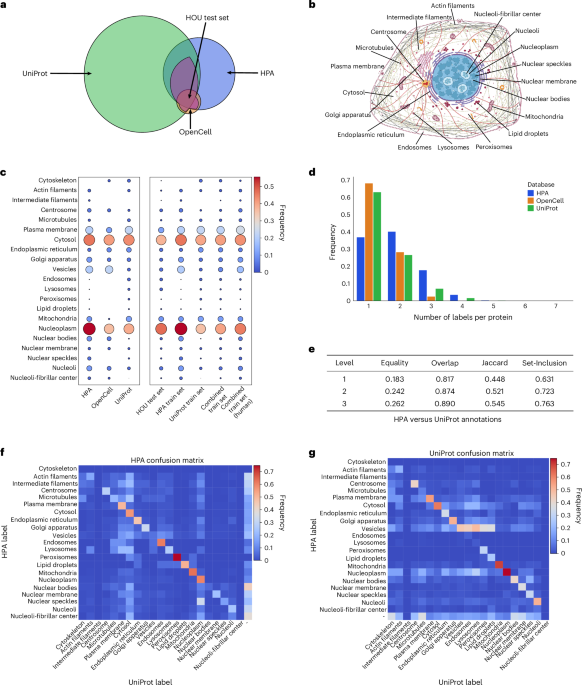
One of the central challenges in predicting protein localization is the heterogeneity of annotation sources. Researchers often rely on different databases that vary in coverage, granularity, and experimental basis. In a recent effort to create more robust benchmarks, localization annotations were integrated from three major resources:
– **UniProtKB/SwissProt**, a manually curated repository with rich, literature-derived annotations
– **The Human Protein Atlas (HPA)**, based on high-resolution immunofluorescence imaging across multiple cell lines
– **OpenCell**, an image-based dataset derived from CRISPR labeling in a single human cell type
Each dataset uses its own vocabulary and experimental strategy, leading to systematic differences in annotation specificity and overlap. For instance, UniProt uses hundreds of localization terms, while imaging-focused datasets use far fewer but often more visually defined compartments. Moreover, proteins frequently appear with multiple localization labels, and agreement between databases is only partial—especially at finer levels of cellular organization.
To address these issues, the authors constructed a unified, three-level hierarchy of cellular compartments and defined a high-confidence test set (HOU) based on overlapping annotations supported by at least two independent sources. This design enables more reproducible and less biased benchmarking of prediction methods.
—
### Benchmarking existing localization predictors
The study evaluated several state-of-the-art sequence-based localization models, including deep learning approaches based on PLMs and traditional methods relying on position-specific scoring matrices (PSSMs). Performance was assessed across the full hierarchical compartment space.
Key findings included:
– Improved performance for broad, abundant compartments such as the cytosol, plasma membrane, and mitochondria
– Reduced accuracy for fine-grained or rare compartments, particularly within the nucleus and for cytoskeletal structures
– Strong dependence of performance label frequency, highlighting the risk of inflated metrics for rare classes
– Among existing models, **LAProtT5** generally achieved higher precision, often at the cost of fewer predicted localizations per protein
These results emphasize that current models remain brittle when it comes to rare or highly specific compartments.
—
### Systematic evaluation of protein language models and aggregation strategies
Beyond existing prediction tools, the authors systematically explored how different **pretrained language models** and **aggregation strategies** perform for localization prediction. Models evaluated included:
– ESM2
– ESM3-small-open
– ProtT5
– ProtBERT
Each model’s per-residue representations were compressed using strategies such as mean pooling, max pooling, attention-based pooling, and multihead attention.
The best-performing configuration combined **ProtT5 with multihead attention (ProtT5-MHA)**. This model consistently outperformed prior methods across multiple metrics and hierarchical levels. However, even ProtT5-MHA struggled with rare compartments, particularly those lacking sufficient training examples, such as intermediate filaments.
—
### Understanding what models learn: attention and biological relevance
A key question is whether PLMs focus on biologically meaningful signals. By analyzing attention patterns in ProtT5-MHA, the authors found:
– Strong responses to known **sorting signals**, especially those targeting mitochondria, the secretory pathway, and the plasma membrane
– Weaker overlap with generic **PROSITE motifs**, many of which are not directly linked to localization
– Some attention patterns that do not correspond to annotated signals, suggesting the model may capture structural or compositional cues
These results indicate that PLMs do learn localization-relevant features, but they also highlight limitations in our ability to fully interpret or annotate all model-driven sequence preferences.
—
### Incorporating protein–protein interaction data
Given that localization can depend on physical interactions, the authors explored whether **PPI network data** could complement sequence-based information. A graph neural network component was added to the best-performing model to propagate localization information across interacting proteins.
While integration of PPI data did not substantially improve overall performance, it provided modest gains for specific compartments—particularly when multiple interactors shared the same localization. This suggests that PPI information may be most useful for refining predictions in cases where localization signals are weak or ambiguous.
—
### Model behavior toward pathogenic protein variants
Finally, the study probed whether current models can detect **mislocalization caused by pathogenic mutations**, using a publicly curated variant dataset. Results showed that:
– Models performed well on wild-type sequences
– Performance dropped significantly for mislocalized variants
– In many cases, models failed to change their predictions even after mutation
This indicates that existing PLM-based predictors are largely insensitive to subtle sequence changes that lead to mislocalization—likely because such events often arise from folding, stability, or trafficking defects rather than direct changes in sorting signals.
—
### Conclusions and future directions
The study demonstrates that careful dataset curation and hierarchical evaluation are essential for meaningful benchmarking of subcellular localization predictors. While modern PLMs—particularly those combining ProtT5 with attention-based pooling—achieve state-of-the-art performance, key challenges remain:
– Handling rare and fine-grained compartments
– Detecting subtle effects of pathogenic mutations
– Incorporating spatial, structural, and contextual information beyond sequence
Future efforts may benefit from multimodal architectures, variant-aware training, and tighter integration of structural, interaction, and experimental context.
—
**Original article source:**
The information presented here is derived from the methods and benchmarking content described in the article referenced as:
https://www.nature.com/articles/s41587-025-02778-x
