



**Boston Dynamics Showcases Robot Soccer Skills and Security Applications at FIFA World Cup**
Boston Dynamics, recently acquired by Hyundai Motor Co., is bringing its advanced legged robots to the 2026 FIFA World Cup, demonstrating both athletic prowess and practical security applications. The collaboration highlights how robots can perform complex, human-like tasks in dynamic environments.
**Teaching Robots to Kick: The “Ghost Rabona” Technique**
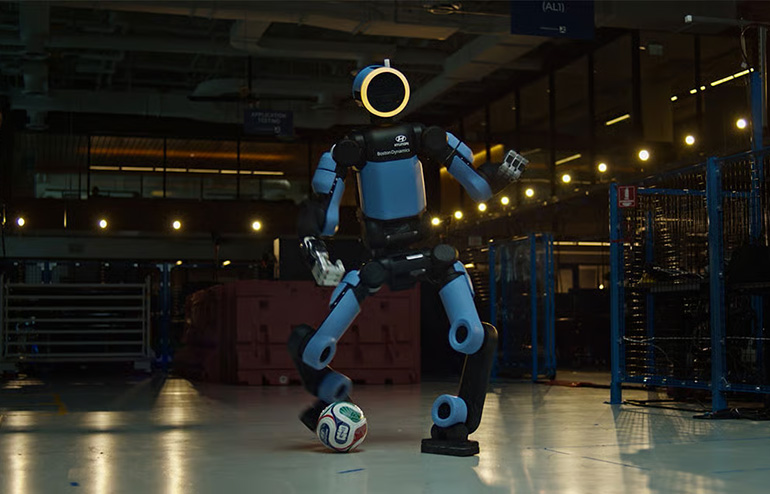
Alberto Rodriguez, director of robot behavior at Boston Dynamics, explained that the company sought a challenging and visually impressive demonstration for the World Cup. “The World Cup was too good of an opportunity to pass on,” he said. The chosen feat was the “Ghost Rabona” kick, a deceptive soccer trick requiring extreme coordination between the robot’s foot, the ball, and the ground.
Unlike previous maneuvers like jumps and flips, which are more self-contained, the Rabona involves intricate interaction with an external object. To teach Atlas this skill, the team utilized motion capture technology. “We put someone good at soccer in a mocap suit and studio,” Rodriguez said. “We put that data into a simulation engine, and the policy came out only a few hours to a day after that.”
This process was made significantly faster by Boston Dynamics’ shift toward reinforcement learning (RL) for robot control. About a year ago, the company moved from classical predictive control methods to RL, allowing Atlas to learn behaviors beyond what could be explicitly programmed. “Reinforcement learning makes it possible to go beyond what you can demonstrate,” Rodriguez noted. The team optimized the motion in simulation, where they could introduce randomizations—such as the compliance of grass versus concrete—to ensure the robot’s robustness.
**Challenges of Soccer and Real-World Applications**
Training Atlas for soccer revealed unique challenges. Grass fields are far more compliant and unpredictable than the hard surfaces used in training. “The algorithm had to be robust enough to deal with unexpected compliance,” Rodriguez said. “The robot’s foot can sink, slip, or get caught on turf.” Additionally, the quick footwork and lower-body motion required improvements in latency and deployment of control policies to prevent tripping or slipping.
The knowledge gained from this project extends beyond entertainment. According to Rodriguez, the techniques developed for Atlas will translate to industrial applications, such as more stable navigation over different terrains and mobile manipulation tasks in warehouses. “We wanted the capacity on the software side to learn in simulation and for it to just work on the robot,” he said. “The same techniques we used to get Atlas to carry a fridge enable mobile manipulation for carrying a box in the warehouse.”
**Spot’s Role in Stadium Security**
While Atlas demonstrates cutting-edge athletic abilities, Boston Dynamics’ Spot quadruped robots are serving a more practical role in World Cup security. Spot is deployed in stadiums across the U.S. to support public safety operations. “Spot is a working dog—it’s not a photo op,” said Merry Frayne, senior director of product for Spot at Boston Dynamics.
Equipped with a 360-degree camera, 4K high-definition video, thermal imaging, and an enhanced autonomy package with lidar, Spot acts as a “second pair of eyes.” It patrols perimeters, identifies hazards, and searches for suspicious packages. “There are two in Dallas and two at Citi Field,” Frayne said. “Most of these robots are used behind closed doors at nuclear facilities or mines… For the World Cup, Spot is more on the perimeter, doing rounds when most people are gone.”
Frayne noted that Spot integrates well into existing security workflows and requires minimal modification for this new application. “We haven’t had to modify it a lot for security as we move from industrial applications into the service area,” she said. The robots are operated by the security teams themselves, with Boston Dynamics providing setup support.
**Looking Ahead: Integration and New Applications**
Boston Dynamics enables a complementary ecosystem where legged robots like Spot work alongside wheeled and aerial robots. With the integration of AI tools, the data collected by these robots can provide richer environmental understanding. “With new AI tools that you can apply to data that robots like Spot are collecting, you can get richer understanding of the environment or communication with people,” Frayne said.
Beyond stadiums, the company is exploring promising applications in welding, through partnerships like the one with Path Robotics, and in circuit-breaker racking for data centers. Boston Dynamics is also deeply involved with first responders, labs, and munitions detection. “We’re working with partners… building interesting momentum for our platform,” Frayne concluded.
—
**Source:** *Boston Dynamics brings its legged robots to the FIFA World Cup* by Alex McCalmont, The Robot Report, July 2026.
[https://www.therobotreport.com/boston-dynamics-brings-its-legged-robots-to-the-fifa-world-cup/](https://www.therobotreport.com/boston-dynamics-brings-its-legged-robots-to-the-fifa-world-cup/)
