



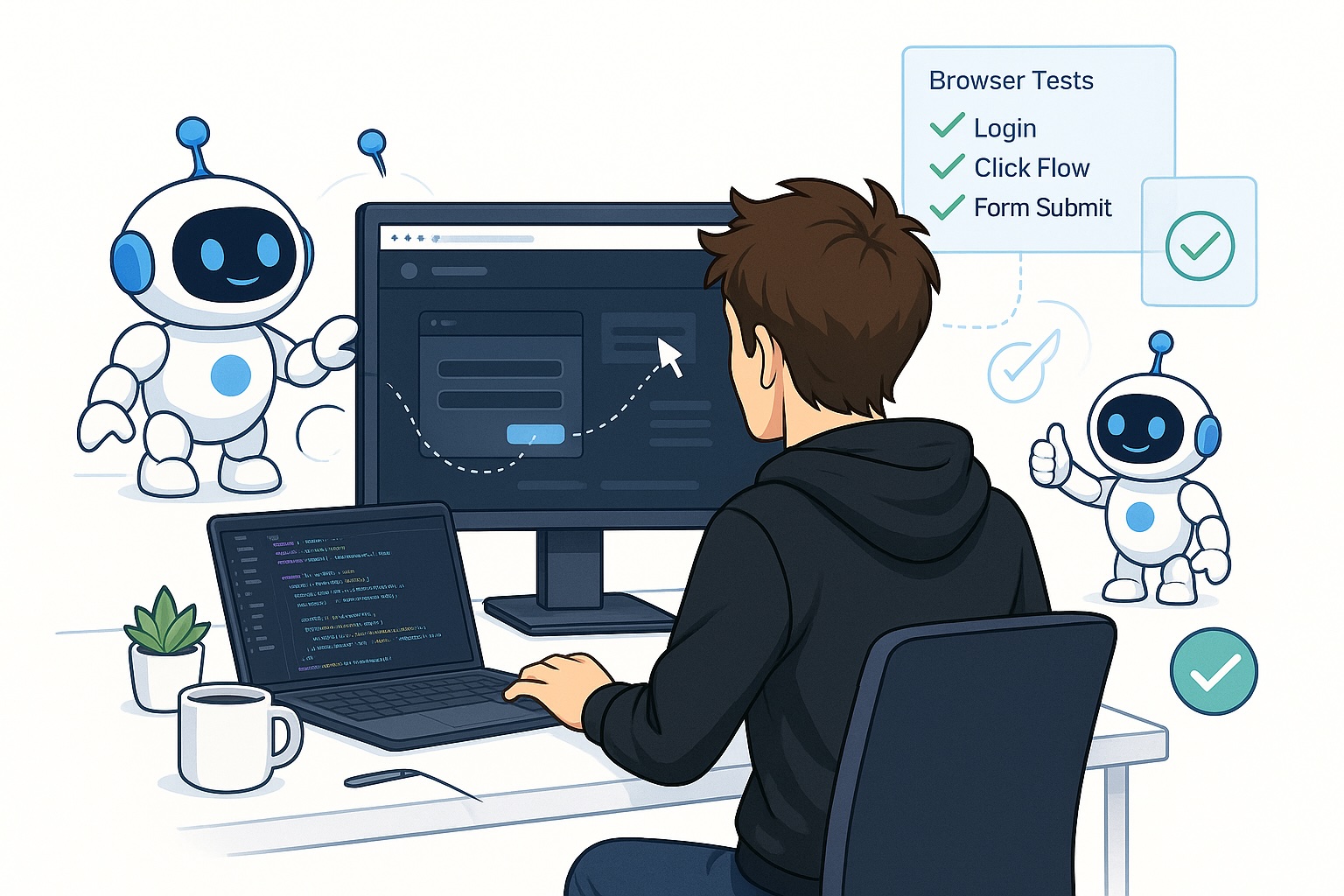
**Leverage Claude Code for End-to-End Testing: A Guide to Better Implementation Quality**
Modern coding agents like Claude Code have revolutionized development by drastically reducing the time required to implement new features and bug fixes. However, as these agents become more powerful, a new bottleneck has emerged: **testing**. Manual testing is slow and defeats the purpose of automation. The best practice is to turn the agent itself into a verification tool.
This article explores how to run end-to-end (E2E) tests using Claude Code to ensure your applications are robust and function as expected from a user’s perspective.
### Why Use Claude Code for End-to-End Testing?
End-to-end testing simulates real user behavior by interacting with the application’s entire stack—clicking buttons, filling forms, and navigating flows just like a human would. The primary reason to use Claude Code for this task is **verifiability**.
Once a coding agent generates code, the bottleneck shifts from *creation* to *validation*. You cannot manually verify every line of code an agent produces. By instructing Claude Code to run E2E tests, you create a feedback loop where the agent reviews its own work. This process encourages “one-shot” implementations—where the agent writes correct code the first time—saving you significant engineering time.
### How to Set Up Automated E2E Testing
The core concept is simple: grant Claude Code access to a browser automation tool and let it validate its work. Here’s how to structure the process:
1. **Tooling:** While Claude Code has a built-in browser MCP, many practitioners prefer the **Playwright MCP** for its superior interaction capabilities. You can instruct Claude Code to install this tool itself.
2. **Access:** Provide the agent with login credentials and access to the browser so it can navigate your application freely.
3. **Execution:** Ask the agent to perform the testing *before* marking a task as complete.
### Optimization Techniques and Prompts
To make this process reliable, you need a robust prompt that moves beyond simple unit tests and forces the agent to interact with the UI.
**The Core Prompt**
I use a daily prompt that instructs the agent to verify its work through user-like interaction:
> “Implement everything I asked for. Verify it end to end by clicking through the browser using the Playwright MCP. It’s not acceptable to test the application only through integration tests. You need to actually click around the app. Continue like this until it works. Fix any issues if you encounter them then do an end to end test again. Run codex exec and run the review skill with codex and make him approve it and iterate until codex has approved it. When codex has approved it, get this to dev, and then test end to end in dev again. Continue until its running fine in dev.”
To streamline this, I use voice transcription software (like FluidVoice) to convert a short command (e.g., “complete merge test”) into this full prompt, saving time.
**Leveraging the `/goal` Command**
Combining E2E testing with the `/goal` command is a powerful strategy. The `/goal` command tells the agent to continue working until a specific condition is met. This ensures the agent doesn’t stop prematurely and keeps iterating until the E2E tests pass, verifying that the implementation truly meets the requirements.
### Scaling E2E Testing with OpenClaw
E2E testing isn’t just for human-initiated tasks. If you use **OpenClaw** (an open-source agent framework), you can schedule automated testing workflows:
* **Scheduled Checks:** You can configure an OpenClaw agent to run a full E2E test suite against your production application at regular intervals (e.g., daily). This catches regressions before your users do.
* **Automatic Repair:** Because the agent handles the testing, it can also handle the subsequent fix. If a test fails, the OpenClaw agent can be prompted to identify the bug and patch it automatically, creating a continuous loop of verification and correction.
### Conclusion
Running end-to-end tests with Claude Code transforms the agent from a simple code generator into a fully autonomous development and verification unit. By automating the testing phase, you ensure higher quality code, catch bugs early, and maximize the return on investment of using AI-assisted development. Integrate E2E testing into your workflow today to make your coding agents more reliable and productive.
***
**Source:**
“like Claude Code can be used for a wide variety of tasks. The number one task you might think of is to actually implement code.”
(https://contributor.insightmediagroup.io/2026/07/31/how-to-run-end-to-end-tests-with-claude-code/)
