



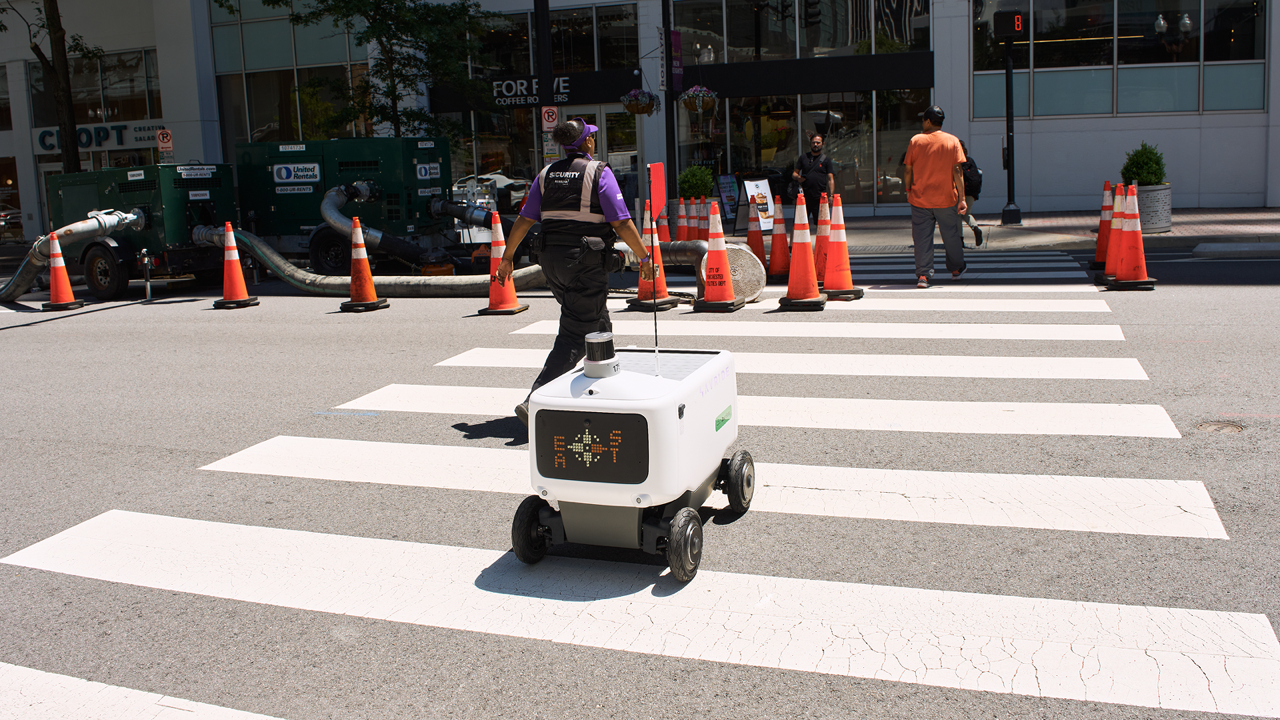
**Context is King: How Avride Uses Cloud Vision-Language Models as a Safety Net for Delivery Robots**
In the fast-evolving world of autonomous delivery robots, the benchmark for success is no longer just efficient navigation. While sidestepping pedestrians and traffic cones is a solved problem, the true test of real-world readiness lies in a robot’s ability to understand the deeper context of its environment. An officer on a sidewalk could be directing traffic or simply taking a walk; wet pavement could be a spill or freshly laid concrete. To solve these nuances, Avride has integrated heavy, cloud-based vision-language models (VLMs) into its fleet, creating an automated “VLM-watcher” that acts as a proactive layer of environmental awareness.
The goal is not to drive the robot, but to ensure it behaves appropriately in sensitive or high-stakes situations, bridging the gap from basic object detection to holistic scene understanding.
### From Object Detection to Holistic Scene Understanding
Avride’s onboard perception stack is already robust, utilizing a combination of sensors and local neural networks to detect surrounding agents such as cyclists, children, wheelchairs, and emergency vehicles. However, detecting these individual elements is sometimes insufficient for grasping the full picture of a dynamic urban scene.
Consider a robot encountering a police officer on the sidewalk. Basic object detection can identify a person in a uniform, but it cannot determine whether the officer is off-duty or actively managing a sensitive incident. This requires a higher level of interpretation—a holistic understanding of how multiple visual elements interact within the frame.
To address this, Avride employs cloud-based VLMs that analyze the broader scene. These models can interpret complex scenarios, such as distinguishing an officer heading home from an active crime scene or identifying unmapped roadwork that blends in with a normal sidewalk. While onboard models handle primary navigation entities, the cloud-based VLM provides the semantic context needed to avoid inadvertently entering emergency zones, crossing live crime scenes, or rolling through fresh construction.
### How It Works: VLMs as Cloud Guardians
It’s important to note that VLMs do not directly control the robot. Relying on a cloud model for real-time steering would introduce latency and connectivity dependencies that compromise safety. Instead, the VLM functions as an automated “early warning system” for Avride’s remote assistance team.
The process works as follows:
1. **Data Ingestion:** As the robot navigates autonomously, it transmits camera snapshots to the cloud every few seconds. To protect public privacy, all visual data is automatically anonymized on-device—faces and license plates are blurred before transmission.
2. **Context Evaluation:** In the cloud, the VLM processes these snapshots, translating visual data into a semantic description of the street environment. Guided by detailed prompts, the model evaluates the scene for unusual, sensitive, or complex situations and assigns high-stakes tags accordingly.
3. **Human-in-the-Loop:** If the model flags a critical scenario, it immediately alerts a remote assistant. A human can then review the live feed to ensure the robot yields properly to emergency workers or avoids restricted zones.
Because the AI landscape is constantly evolving, Avride treats this cloud layer as an open, plug-and-play architecture, continuously testing and benchmarking state-of-the-art models to ensure the most accurate semantic interpretation.
### The Evolution from Data Mining to Live Operations
Integrating live VLMs into Avride’s operations is a natural extension of the company’s internal engineering tools. Storing and processing every minute of video from hundreds of robots is both expensive and unnecessary. The focus is on capturing only data that helps improve technology and maintain safety.
Historically, the 5-second live-stream analysis pipeline served as a data-filtering tool, using cloud VLMs to mine rare and valuable scenarios—such as specific animal interactions or complex infrastructure—for secure, pre-anonymized storage and further labeling.
As the pipeline proved exceptionally accurate at identifying unique real-world context in real time, it became logical to extend this capability to live operations. If the system could already identify rare contexts in real time, it could equally trigger human oversight when needed. This data-mining infrastructure was seamlessly integrated into the production pipeline, creating a direct bridge between cutting-edge AI and human assistance.
### The Road Ahead: Bringing VLMs to the Edge
Operating heavy models in the cloud is a powerful solution for today, but it is only the beginning. As VLMs become more compact through optimization techniques and onboard robotics hardware grows more capable, Avride’s ultimate goal is clear: to migrate this deep semantic layer directly onto the robot’s onboard compute.
This evolution will enable a new level of autonomous decision-making, entirely independent of network connectivity. Until that future arrives, Avride’s cloud-to-remote-assistance safety net ensures that its delivery robots remain polite, responsible, and aware citizens on the sidewalk.
—
**Original Article:**
https://www.therobotreport.com/how-avride-uses-cloud-vlms-safety-net-delivery-robots/
