



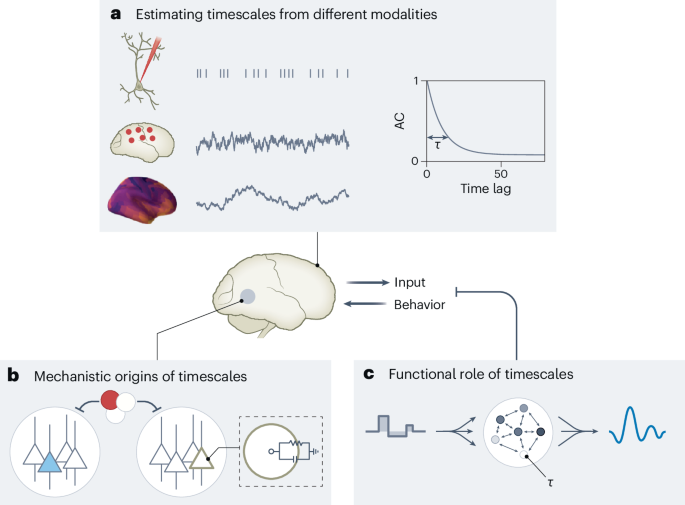
**The Brain’s Hidden Clockwork: How Intrinsic Timescales Shape Neural Computation**
The human brain performs an astonishing range of functions—from moment-to-moment sensory processing to long-term memory—using networks of neurons that operate on vastly different timescales. A new research review synthesizes decades of evidence showing that neural circuits are not limited to a single “clock speed.” Instead, they contain a rich hierarchy of intrinsic timescales that underlie everything from rapid sensory reactions to slow, persistent thought.
**A Spectrum of Timescales in Neural Circuits**
Neurons and synapses do not all respond and adapt at the same rate. Studies using electrical recordings, imaging, and computational models reveal that neural populations can exhibit activity patterns spanning milliseconds to minutes or even hours. This diversity is not noise—it is a structured feature of brain organization.
– **Fast timescales** support rapid encoding of stimuli, immediate decision-making, and high-frequency oscillations such as gamma waves.
– **Intermediate timescales** track task-relevant integration of evidence, working-memory maintenance, and coordinated communication between brain regions.
– **Slow timescales** relate to long-term adaptation, stable internal states, and the accumulation of information over extended periods.
These multiple timescales coexist and interact across cortical layers and brain regions, enabling flexible and robust computation.
**Evidence from Across Neuroscience**
Large-scale studies of primate cortex have shown that intrinsic timescales organize themselves in a hierarchy, often aligning with the brain’s structural and functional architecture. For example:
– Early sensory areas tend to have faster intrinsic timescales, while prefrontal and association areas support slower, more persistent activity.
– The hippocampus exhibits distinct temporal patterns that support navigation and memory sequence integration.
– Slow cortical dynamics are linked to stable representations underlying memory and attention.
This hierarchy is preserved across species and appears to be shaped by both genetic programs and experience-dependent plasticity.
**Why Multiple Timescales Matter**
The existence of multiple timescales allows the brain to:
– **Filter relevant signals** from noise by matching temporal integration windows to task demands.
– **Maintain persistent activity** in circuits that support working memory and long-range coordination.
– **Adapt behaviorally** by shifting between fast responsiveness and stable internal models.
– **Support complex computations** such as decision accumulation, anticipation, and context-dependent processing.
Disruptions in the balance of timescales have been implicated in disorders such as autism, schizophrenia, and attention-deficit/hyperactivity disorder, suggesting that temporal organization is central to healthy brain function.
**Tools and Frameworks for Studying Timescales**
Researchers now use a variety of approaches to measure and model intrinsic timescales:
– **Spiking recordings and calcium imaging** reveal temporal patterns at the single-cell and population level.
– **Functional MRI** captures slower hemodynamic dynamics that reflect integrated network activity.
– **Computational modeling** identifies the optimal timescales for solving specific tasks.
– **Bifurcation and dynamical systems analyses** show how circuits switch between states.
These tools confirm that temporal diversity is built into neural circuit design.
**Outlook**
Understanding how intrinsic timescales are organized and regulated opens new avenues for:
– Designing brain-inspired computing systems that operate across multiple time scales.
– Developing interventions that restore healthy temporal dynamics in neurological disease.
– Refining theories of cognition that go beyond average activity to include temporal structure.
As techniques improve, the temporal dimension of brain function will move from a background detail to a central organizing principle of systems neuroscience.
***
**Reference**
Cavanagh, S. E., Hunt, L. T., & Kennerley, S. W. (2020). A diversity of intrinsic timescales underlie neural computations. *Frontiers in Neural Circuits*, *14*, 615626. https://doi.org/10.3389/fncir.2020.615626
