



Manufacturers continue to struggle with a lack of skilled workers. According to the latest data from the federal Bureau of Labor Statistics, some 438,000 manufacturing jobs went unfilled in the U.S. in February 2026.
For many manufacturers, robots are the obvious answer to problem. If they can automate mundane tasks, such as tending machines or delivering parts, they can free up valuable personnel for tasks that do add value.
Statistics bear this out. North American robot orders rose in 2025, reflecting strong investment in automation across a range of industries. According to the Association for Advancing Automation, companies across the region ordered 36,766 robots valued at $2.25 billion last year. Compared to 2024, this represents a 6.6 percent increase in units ordered and a 10.1 percent increase in sales.
One manufacturer that purchased a robot last year was Vahlco Wheels. Based in New Egypt, NJ, Vahlco makes aluminum wheels for race cars, including dragsters, sprint cars, micro sprint cars and midget cars. These wheels are not small. For example, sprint car wheels are typically 15 inches in diameter, with widths ranging from 8 inches on the front to 18 inches on the rear.
A variety of processes are needed to make racing wheels, including forging, machining and welding.
A variety of processes are needed to make racing wheels, including forging, machining and welding. Photo courtesy Phillips Corp.
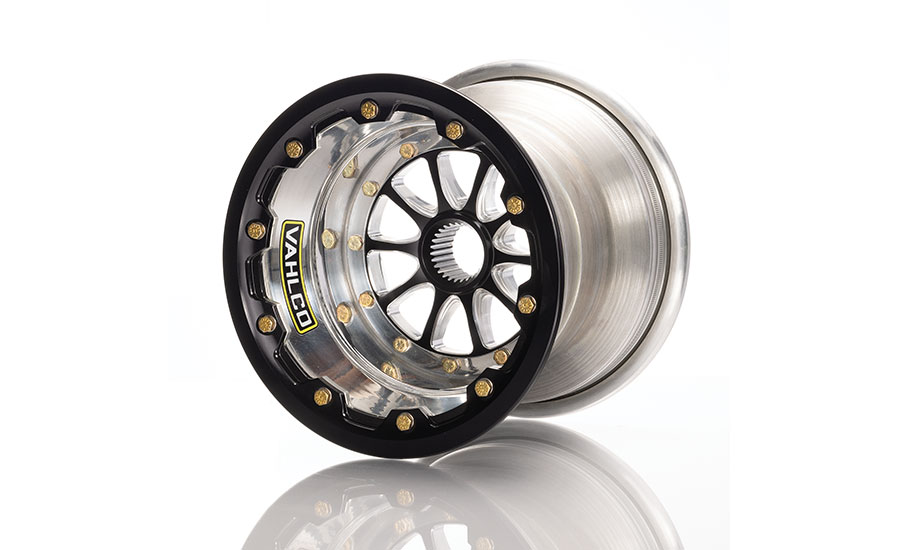
Vahlco makes aluminum wheels for race cars, including dragsters and sprint cars. Photo courtesy Phillips Corp.
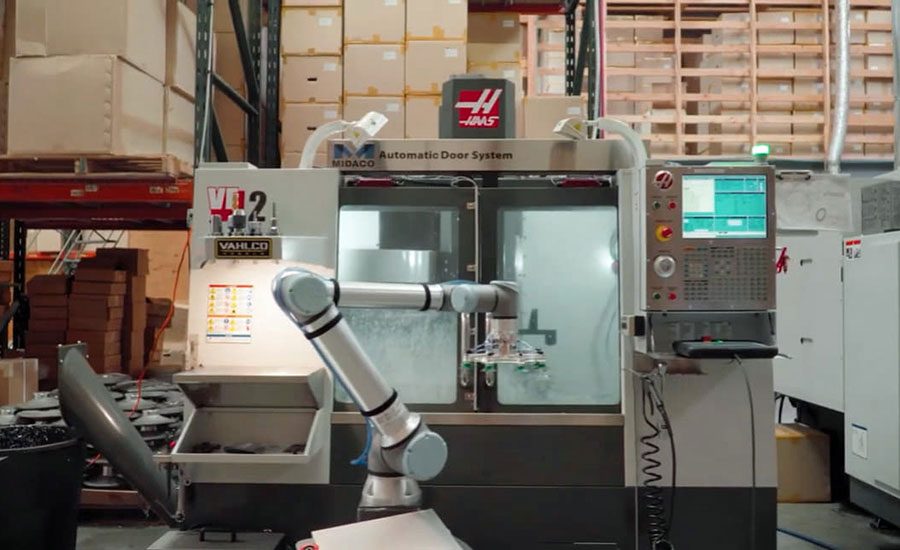
Vahlco was losing valuable time on a repetitive prep operation that tied up skilled labor and limited machine uptime. Operators had to manually tend a Haas CNC machine throughout the day, pulling them away from more complex, higher-value tasks. To stay efficient and competitive, Vahlco needed to automate this process without overhauling the floor layout or increasing staffing.
To solve the problem, Vahlco turned to its machine tool supplier Phillips Corp. Based in Hanover, MD, Phillips has regional offices throughout the Southeast and Mid-Atlantic states. The distributor represents lines such as Haas, Sharp, Markforged, Meltio, Laserline, EOS and Universal Robots (UR).
Looking for quick answers on assembly and manufacturing topics?
Try Ask ASM, our new smart AI search tool.
Ask ASM
Within just two days, Phillips application engineers team installed and programmed a UR cobot to load and unload the machine, enabling it to run with minimal supervision. The cobot is mounted in front of the machine; no cages were necessary.
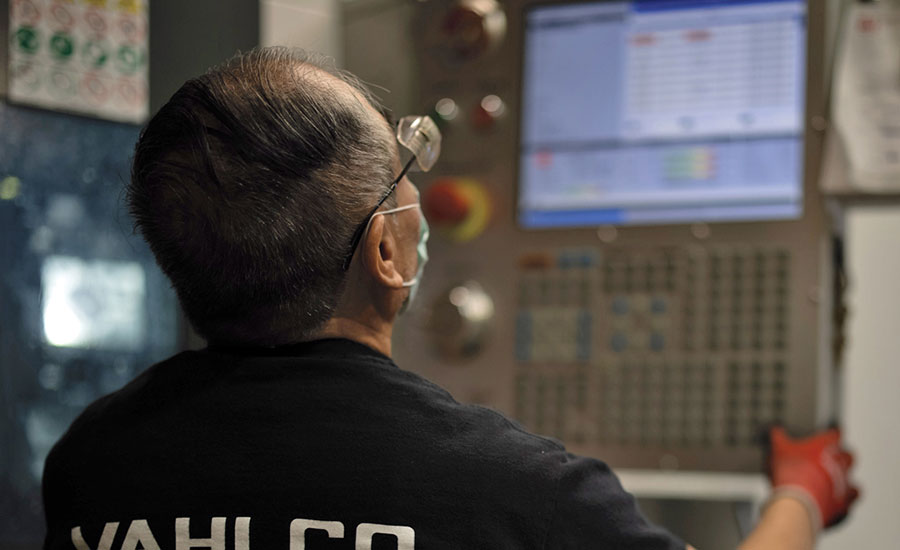
If manufacturers can automate mundane tasks, such as tending machines, they can free up valuable personnel for tasks that do add value. Photo courtesy Phillips Corp.
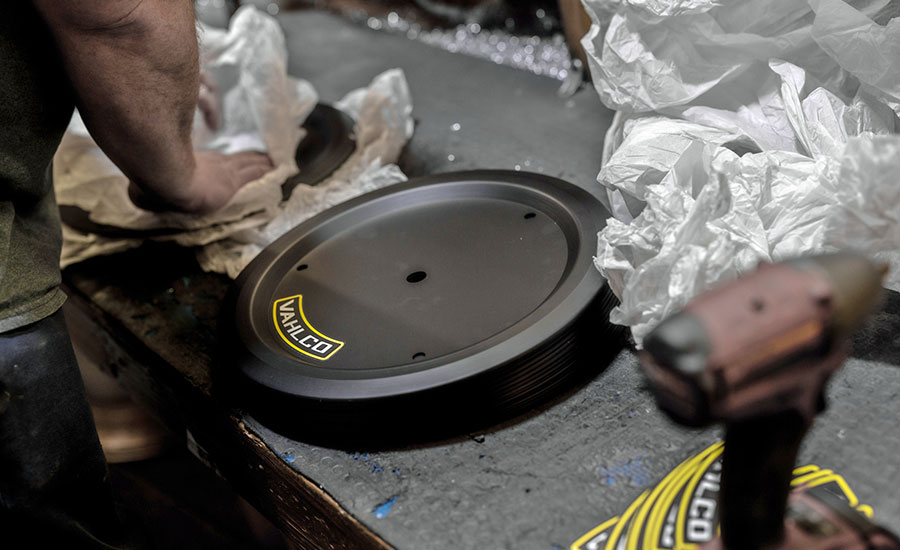
Vahlco was losing valuable time on a repetitive prep operation that tied up skilled labor and limited machine uptime. Photo courtesy Phillips Corp.
The result was a 50 percent increase in spindle uptime, an 80 percent reduction in operator input, and a projected return on investment in less than 12 months. With the robot keeping the machine fed throughout the day, Vahlco’s team was able to shift focus to higher-value tasks—without slowing down production.
“It was fast. They came in, set it up, and we were running. The robot keeps the machine fed all day,” reports one Vahlco worker. “We load parts two or three times a day. After that, the robot runs it. We’re free to work the rest of the shop.”
After this successful deployment, Vahlco is identifying other prep tasks to automate and exploring lights-out capability for additional machines.
More than 900 miles southeast of Vahlco, in Centerville, TN, a manufacturer of agricultural equipment was having the same issue. Farmer’s Friend makes products for growing and harvesting lettuce, tomatoes, strawberries and other produce.
The company was growing fast, but its production capabilities weren’t keeping pace. As demand for its small-scale agricultural tools surged, founder Jonathan Eisinger faced serious throughput limitations and operational bottlenecks.
Despite a well-developed machining process and skilled team, several key issues stood in the way of scaling efficiently. With only one operator and one shift, the company’s shop was maxed out at 45 to 50 parts per day, far short of what was needed. That was a problem, because a large customer order required higher volume, faster turnaround, and more consistency. And, if machines went down, outside support meant extended downtime and lost productivity.
Farmer’s Friend needed a reliable, repeatable way to grow output—without adding headcount or losing agility. Partnering with Phillips, Farmer’s integrated a custom robotic cell to automate machine tending, streamline workflow and increase output. The cell includes a UR cobot and a custom feeding platform for raw materials. Phillips also provided expert-led training to Farmer’s staff, so maintenance and troubleshooting could be handled in-house.
The results were impressive. Daily part production tripled, and the company has full “lights-out” manufacturing capability. What used to run one shift now operates continuously, including overnight. And, an in-house team now diagnoses and repairs production machines themselves.
“We didn’t have time to figure it out ourselves,” recalls Eisinger. “Phillips brought the experience and did it right. We went from barely keeping up to thinking bigger—now we’re programming more parts and planning our next robot.”
For more information on machine tools and robotics, visit www.phillipscorp.com.
