



Authored by Marc Kavinsky, Lead Editor at IoT Business News.
Quectel has unveiled the FCM365X, a small-scale wireless module built on NXP’s RW612 microcontroller that brings together dual-band Wi-Fi 6, Bluetooth LE 5.4, Zigbee, and Thread capabilities for smart home and industrial IoT applications.
Short-range IoT development is shifting away from the idea of picking just one radio technology and toward the challenge of making multiple radios work together smoothly. A connected appliance, sensor hub, or industrial controller might rely on Wi-Fi for internet connectivity, Bluetooth LE for initial setup, and a mesh networking protocol like Thread or Zigbee for energy-efficient local communication. Juggling all of these can make hardware design, software development, and managing product variants significantly more complicated.
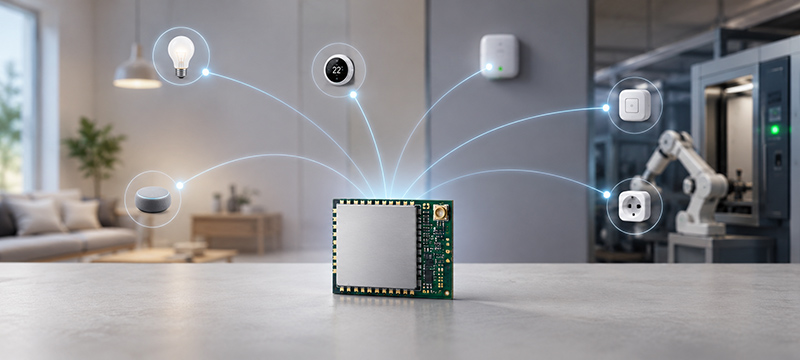
Quectel’s newest offering, the FCM365X, tackles that exact convergence challenge by bundling several short-range communication technologies into a single component. Built on top of NXP Semiconductors’ RW612 wireless microcontroller, the module delivers dual-band Wi-Fi 6, Bluetooth Low Energy 5.4, Zigbee, and Thread all in one package. For manufacturers creating products that need to function in both smart home and industrial settings, the real importance isn’t merely having another Wi-Fi module — it’s having internet networking, Bluetooth-based provisioning, and mesh protocol support all within one compact piece of hardware.
At its core, the FCM365X employs an Arm Cortex-M33 processor featuring TrustZone security technology, clocked at speeds up to 260MHz. According to Quectel, the module comes equipped with 1.2MB of SRAM and 8MB of Flash memory, with the possibility of adding PSRAM for extra capacity. It also incorporates multiple power-saving modes and persistent connectivity mechanisms, making it well-suited for battery-operated devices and not solely for mains-powered gateway equipment.
What sets this announcement apart is the combination of protocols and the underlying chip architecture
A large number of embedded wireless modules concentrate on Wi-Fi and Bluetooth alone, pushing Zigbee or Thread onto a separate radio chip. In this case, Quectel leverages NXP’s RW612 platform to deliver Wi-Fi 6, BLE 5.4, Zigbee, and Thread from within the same module. This is significant for situations where a manufacturer desires a single hardware foundation capable of meeting diverse ecosystem demands — for instance, a product line that might call for Wi-Fi connectivity in one variant and mesh networking in another.
The Thread support is especially noteworthy because Thread has become tightly linked with Matter-based smart home frameworks, while Zigbee continues to see extensive adoption in home and building automation systems. Quectel has not claimed that the FCM365X carries Matter certification, and that distinction is a key one. The module is capable of running the underlying Thread protocol, but product developers would still be responsible for addressing the additional software, certification, and ecosystem requirements needed to deliver a fully compliant Matter product.
When it comes to industrial IoT, the appeal shifts somewhat. Factories and commercial facilities frequently host a blend of older and newer short-range networks. A module that accommodates both Zigbee and Thread alongside Wi-Fi and BLE could help equipment manufacturers avoid committing a device’s design too rigidly to any single local networking standard. The practical upside is greater design versatility; the caveat is that system integrators must still handle protocol selection, network topology planning, and application-level compatibility.
Quectel has also revealed a wide range of supported interfaces. The FCM365X natively provides GPIO, SDIO, UART, USB, and JTAG, while I2C, I2S, ADC, LCD, and PWM are available through the company’s QuecOpen solution. For embedded developers, this interface selection matters because these modules aren’t simply radio attachments — they frequently sit alongside sensors, displays, control circuits, or host processors. The presence of JTAG also speaks to the debugging requirements of more sophisticated embedded software projects.
On the security front, the module supports WPA-PSK, WPA2-PSK, and WPA3-SAE, in addition to AES-128 encryption. Paired with the Cortex-M33 TrustZone capabilities of the underlying processor, the module targets connected devices where secure communication is a fundamental design requirement. As is always the case, features at the module level don’t replace a well-architected product security strategy, but they can offer manufacturers a more robust starting point than a basic radio solution.
In terms of physical dimensions, the FCM365X measures 25.5mm x 18.0mm x 3.16mm and weighs just 1.51g. It accommodates 2.4GHz and 5GHz Wi-Fi through a 1×1 antenna setup, includes an RF coaxial connector, and provides a PCB antenna alternative. Quectel lists an operating temperature span from −40 °C to +85 °C, which broadens the module’s relevance past consumer electronics and into more demanding industrial or commercial building environments.
The wider industry backdrop is that short-range IoT is becoming increasingly fragmented at the application layer even as module suppliers work to consolidate radio hardware. Wi-Fi, BLE, Thread, and Zigbee each address distinct needs, and none of them is fading from real-world use. Modules like the FCM365X represent a practical path forward for the ecosystem: rather than wagering on a single protocol coming out on top, they empower device makers to accommodate multiple standards without having to re-engineer the wireless subsystem for every product generation.
For connectivity providers and platform companies, this kind of module could drive greater demand for tools capable of managing diverse local networks in conjunction with cloud connectivity. For manufacturers and industrial stakeholders, the immediate takeaway is increased flexibility at the product design phase — particularly in cases where product lifecycles outlast the typical wireless protocol trend cycle.
