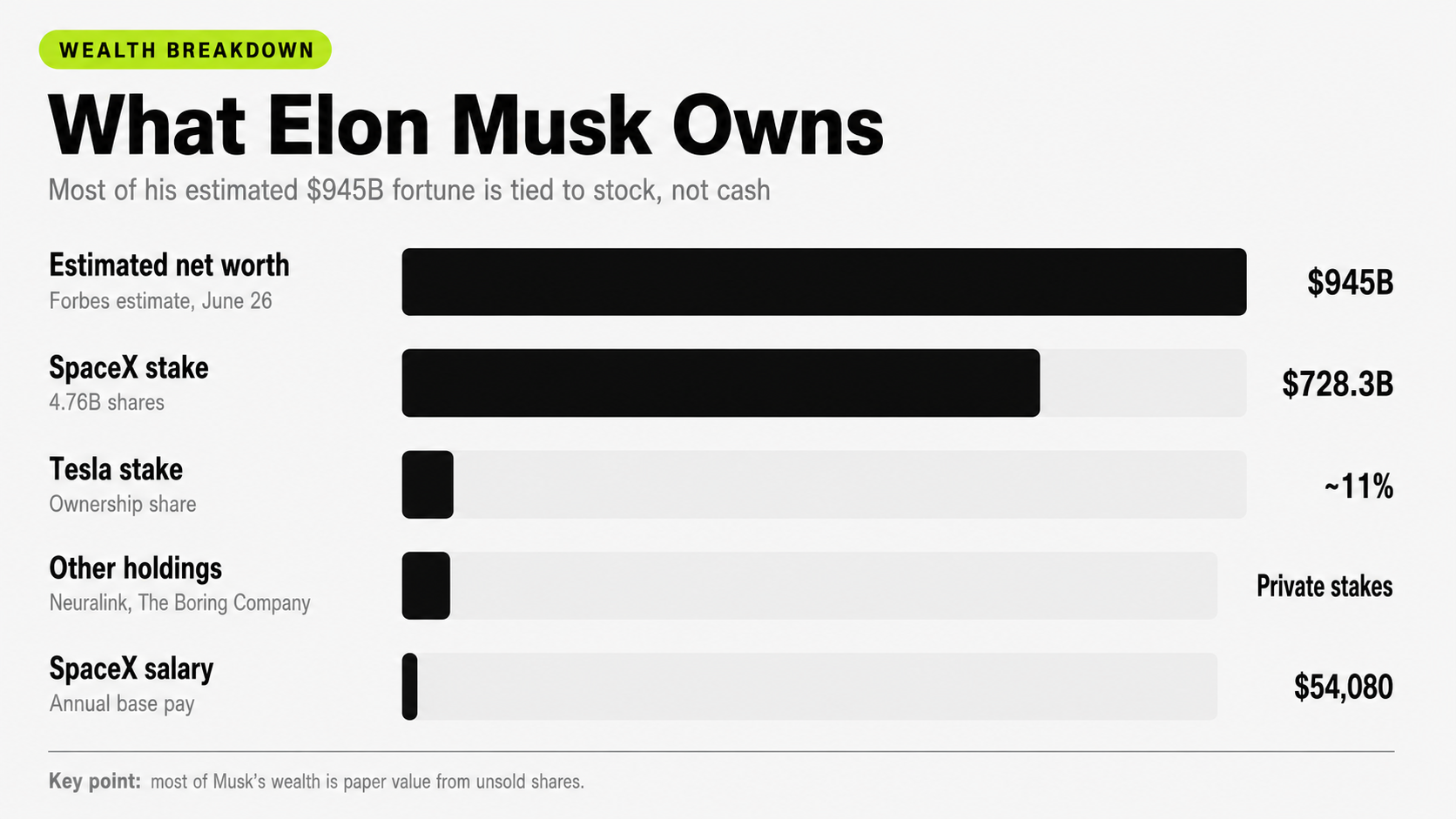
How do America’s wealthiest individuals manage to avoid paying taxes? The answer lies in the fact that they don’t actually possess large sums of money in liquid form. Instead, their fortunes—often worth billions—are concentrated in company shares, and current law doesn’t impose taxes on value that hasn’t been converted to cash through a sale.
But imagine if the rules shifted. South Korea is moving in that direction. The Netherlands made a similar attempt. Certain legislators in the United States are weighing comparable proposals. Each of these measures is aimed at fortunes like Elon Musk’s.
On June 12, he became the first person in history to reach a net worth exceeding one trillion dollars, nearly all of it tied up in stock he’s never sold. Transfer him to South Korea, or alter American tax legislation, and the invoice becomes real. But just how large would that invoice be?
Tax Policies Gaining Momentum Around the Globe
The most recent development unfolded in Seoul. This week, legislators and labor organizations put forward a proposal to include unrealized profits from shares and property within taxable income.
🚨 SOUTH KOREA JUST PROPOSED TAXING UNREALIZED GAINS. And this is one of the major reasons behind today’s massive selloff in the Korean market, now being called BLACK TUESDAY in Korea. At a forum hosted by South Korea’s ruling Democratic Party, lawmakers called for… pic.twitter.com/O1BfbbgIVY
— Bull Theory (@BullTheoryio) June 23, 2026
Across the globe, the Netherlands’ lower parliamentary chamber approved the Box 3 Actual Return Act on February 12, which applies a flat 36% tax each year on paper profits from equities, fixed-income instruments, and cryptocurrency. The legislation is slated to take effect in 2028 but must still clear the Senate.
The reaction was immediate. By February 25, the finance minister acknowledged the measure couldn’t advance in its current form and would need revisions. According to the Financial Times, Prime Minister Rob Jetten’s coalition government is now drafting a set of modifications.
American Legislators Take Aim at the “Buy, Borrow, Die” Strategy
Here in the U.S., Senator Ron Wyden put forward the Billionaires Income Tax bill, backed by over 20 cosponsors. The proposal would subject marketable assets—stocks, for example—to annual taxation based on their current market value.
“This legislation is designed to ensure that billionaires contribute their fair share each year by closing the loopholes that allow extremely wealthy individuals to exploit tactics like ‘buy, borrow, d
Approximately $945 billion. The 2% rate applies to the range between $50 million and $1 billion. The 3% rate kicks in for every dollar beyond $1 billion. Combined, these rates generate around $28.3 billion annually.
Wyden’s proposal takes a different approach, targeting gains rather than total wealth. Assuming a minimal cost basis, virtually his entire fortune could be classified as unrealized gains.
The first year stands out as unusual. Without any previous mark-to-market, the initial assessment would capture all his accumulated gains. At 23.8%, that one-time catch-up payment would total roughly $220 billion, though the bill permits him to spread it across five years.
After that initial period, his cost basis gets reset, meaning each subsequent year only taxes that year’s fresh gains. A $100 billion jump in wealth would trigger about $24 billion in taxes. A stagnant year would yield almost nothing, while a declining year would generate a loss he could carry backward.
California’s proposal is a one-time levy rather than a recurring annual tax. A 5% tax on his net worth would amount to roughly $47 billion. The 2% compromise that supporters have floated would still extract about $19 billion.
Potential Tax Elon Musk Would Have To Pay Under Different Laws. Source: BeInCrypto
These numbers are purely hypothetical. Musk resides in Texas, and none of these proposals have become law. They simply illustrate what each plan would extract if it ever reached his fortune.
What That Money Could Do
These figures become more meaningful when measured against global needs. The UN World Food Programme estimates that eradicating world hunger by 2030 would require about $93 billion per year. Its complete 2026 plan to feed 110 million people costs $13 billion.
Warren’s tax on Musk alone, roughly $28.3 billion annually, would more than double that yearly budget. It would also fund approximately 30% of the annual cost to eliminate world hunger, from a single individual.
Wyden’s $220 billion first-year catch-up payment would finance the global hunger objective for over two years. California’s $47 billion would cover about half of a single year.
Looking closer to home, the pattern persists. The National Alliance to End Homelessness put a price tag on the issue in 2025.
It estimated that around $9.6 billion would suffice to provide a Housing First placement for every household that used a US shelter in a given year. Warren’s annual tax on Musk alone would cover that figure with money left over.
The Bill Could Vanish as Fast as It Appears
These numbers come with a significant caveat, and recent weeks have highlighted it. Most of Musk’s wealth sits in stock he cannot liquidate quickly, and its value can fluctuate by hundreds of billions in a single day. The stock has already dropped 24% from its June 16 peak.
That volatility cuts both ways. A tax on paper gains only generates revenue when those gains actually exist. During a down year, Musk would record unrealized losses instead, owe nothing on them, and could carry them forward to offset gains in future years. The same dramatic swing that produces a massive tax bill one year can wipe it out the next.
Liquidity presents another constraint. A hefty annual tax bill might pressure him to sell shares to cover it, but his SpaceX lockup currently blocks him from doing so.
Mobility adds a third factor. California has already seen billionaires leave before its tax deadline, and the Dutch proposal raised similar emigration worries.
For the time being, the gap remains. It is substantial enough to keep him ranked first globally, yet entirely untaxed until he decides to sell.
Subscribe to our YouTube channel to watch leaders and journalists provide expert insights
The post How Much Tax Would Elon Musk Pay If This US Bill Passes? appeared first on BeInCrypto.