




According to people who previously worked on the project, Ethereum is facing a financial shortfall.
This alert has triggered one of the most intense governance discussions on Ethereum in recent months: should the network support developers by imposing a fee on staking returns, or simply depend on affluent Ether supporters to finance the ecosystem?
At the heart of this discussion is a divisive idea from Kleros co-founder Clément Lesaege. He proposed diverting as much as 10% of validator earnings to support the ecosystem via a system known as Validator Redirected Revenue.
Lesaege claimed this action might be needed to tackle Ethereum’s “coordination failure” and alleviate the chronic underfunding of collective ecosystem projects.
The proposal encountered significant opposition, with detractors raising concerns about cartel-like motivations and setting a risky standard for wealth redistribution controlled by validators.
Validator Redirected Revenue proposal. Source: Eth Research
Just as the Ethereum community was preparing to fiercely debate the idea, a “fair and unbiased” alternative began to take shape: Ethlabs.
Introduced on Monday by five ex-Ethereum Foundation researchers, the newly established nonprofit research and development lab for Ethereum received support from major backers in the space, such as BitMine, Sharplink, and ConsenSys creator Joseph Lubin.
Related: Ethereum Foundation sacks 20% of workforce amid strategic restructuring
With significant investors prepared to open their wallets, the core issue shifts from whether Ethereum can finance itself to the method by which it prefers to be supported.
Ethereum’s ‘slow-burning funding crisis’
The latest controversy surrounding ETH erupted on Friday when former Ethereum Foundation contributor Trenton Van Epps raised an alarm. He indicated that the core development environment of Ethereum might encounter a “gradual funding crisis” within three to nine months, as older funding initiatives diminish and the Foundation’s expenditures drop.
He calculated that supporting over 10 client, research, and coordination groups requires approximately $30 million annually, and that the Client Incentive Program along with other support structures were no longer sufficient to cover these costs.
Van Epps contended that Ethereum is moving into an institutional “succession” phase, where the Foundation will step back from its role as the primary guardian of protocol funding, and that new systems must replace the expiring programs he previously helped manage.
Having spent much of the year navigating leadership changes, public disagreement over priorities, and an escalating dispute over core protocol funding, Van Epps’ alert resonated deeply.
However, certain figures within the Ethereum community disagreed, asserting that the EF possesses “sufficient capital to operate for at least 30 years, meaning there is no funding crisis.” Tom Lee of Bitmine similarly dismissed the alert, stating there was “no chance” Ethereum would lack the funds for protocol development.

Ethereum Foundation Treasury Policy. Source: Ethereum Foundation
The Ethereum Foundation’s own financial guidelines already indicate a multi-year operational reserve and a structured plan to decrease yearly expenditures.
In June 2025, the EF announced its intention to hold an operating expense buffer covering 2.5 years in cash and stablecoins, vowing to keep annual spending below 15% of total treasury holdings and progressively lower that expenditure rate to a baseline of 5% over the next five years.
Related: Ethereum can quantum-proof accounts for just 7 cents, says Ethereum’s Kohaku lead
On Tuesday, Ethereum founder Vitalik Buterin announced that the Foundation is reducing its budget by approximately 40%, consistent with that policy. This move marks a shift from spending around 15% of its funds annually before 2026 toward a long-term goal of roughly 5% per year after 2030. The organization let go of 54 employees.
The proposal everyone hates
While the Foundation might not go bankrupt, it is cutting costs and has significantly less money available for research and development compared to its peak years. Lesaege argued that Ethereum suffers from a coordination breakdown where everyone gains from shared infrastructure, but nobody wants to pay for it.
His plan would ask validators to indicate what percentage of their staking returns they would be willing to redirect, with a range between 0% and 10%. If most validators favored a non-zero rate, that redirection would become compulsory for everyone.
Based on current staking figures, he projected that even a 5%-10% redirection could yield approximately 50,000 to 70,000 ETH per year for ecosystem projects, equating to roughly $82.5 million to $115.5 million at present ETH values.
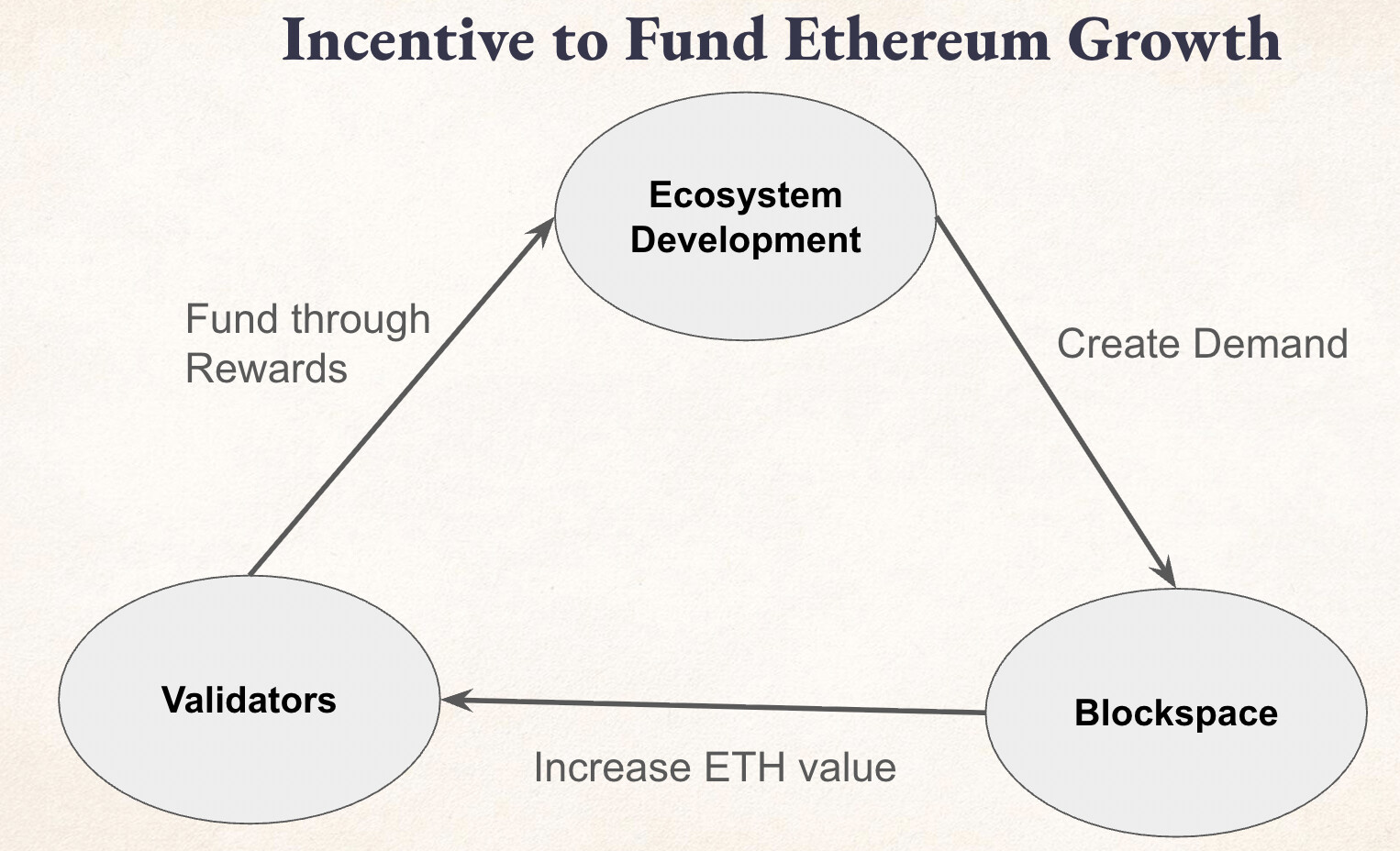
Incentive to fund Ethereum growth. Source: Eth Research
Detractors quickly focused on the power dynamics of the mechanism, warning that it could solidify the position of large validators, confuse the distinction between operators and governance participants, and grant a majority weighted by stake new influence over ecosystem funding choices.
What staking providers say
A representative from Figment informed Cointelegraph that the proposal would squeeze profit margins, which “generally pushes the validator set toward larger, more integrated operators” catering to institutional clients, like Figment.
This shift would occur “at the expense of some operator diversity and possibly fewer new ETH stakers joining the network,” the representative noted.
Andrew Gibb, CEO and co-founder of the institutional staking firm Twinstake, told Cointelegraph that various types of investors would react in different ways.
While long-term ETH holders might appreciate the prospect of a better-funded ecosystem, short-term investors, such as retail participants, liquid multi-asset funds, and those focused on immediate returns, might be less enthusiastic.
He mentioned that the proposal would “shrink the addressable staking market to some degree,” with the most price-sensitive groups likely to “scale back or pull out their stakes,” adding that he expects some clients to reconsider their staking commitments.
Related: Buterin fires back at Ethereum Foundation critics, recommits to neutrality
Max Shannon, a senior research associate at Bitwise, told Cointelegraph that Ethereum staking participation has so far shown little reaction to reduced rewards.
He pointed out that the staking annual percentage rate (APR) has dropped from about 4.6% in June 2023 to around 2.7% currently, yet the staked supply and the staking ratio have roughly doubled. However, further reward reduction would make “slashing risks and exit-queue liquidity risks more significant relative to the returns.”
He also noted that a lower net consensus-layer yield could force validators to depend more on maximal extractable value (MEV) to compensate for lost APR, which could potentially undermine the network’s resistance to censorship.
How large is the problem, really? /Evaluating the Financial Gap
At first glance, the deficit appears relatively small. Shannon pointed out that if the yearly funding gap hovers near $30 million while annual staking yields sit at roughly $1.9 billion, bridging that gap would require diverting only about 1.6% of those staking returns.
This puts Lesaege’s proposal into perspective — it may seem restrained on paper, yet it remains deeply contentious from a governance standpoint. Economically speaking, trimming staking rewards by a single-digit percentage is perfectly feasible. However, from a community governance angle, a significant number of Ethereum stakeholders view such a move as crossing a critical threshold, effectively casting validators in the role of a taxing body.
Shannon further made the case that networks with built-in, hardcoded development funding aren’t automatically in a stronger position simply because they set aside a portion of rewards. In his assessment, a protocol’s long-term success hinges much more on token market performance and the incentives driving its contributors than on any single mechanism for funding development.
A Fresh Funding Approach Takes Shape
Tom Lee’s assertion that there was “zero chance” of an Ethereum funding emergency and that capital was “secured” served as a precursor to the announcement of the newly formed nonprofit entity, EthLabs, just days later.
Instead of imposing a tax on staking rewards at the protocol layer, EthLabs creates a pathway for major ETH-aligned organizations — including BitMine and Sharplink — to directly finance ongoing development efforts.
Ethlabs nonprofit R&D for Ethereum. Source: Ethlabs
EthLabs does not aim to supplant the Ethereum Foundation; rather, it serves as a complementary force. Its arrival suggests that the smart contract platform’s next chapter could feature a more decentralized funding architecture — one where the EF continues to steward the protocol’s foundational layer, while independent labs and well-capitalized institutions support peripheral and adjacent initiatives.
In a Monday post on X, Ethereum co-founder Joe Lubin emphasized that the Ethereum Foundation still houses “an enormous amount of top tier talent” dedicated to “the cypherpunk core components” of the protocol. At the same time, he noted that numerous other Ethereum-focused R&D teams will now branch out into new and diverse areas of exploration.
Gibb weighed in by stating that the onus for funding ecosystem advancement rests squarely with foundations and protocol treasuries. He suggested that alternative avenues — such as staking yield allocation or priority fee mechanisms — should be thoroughly explored before any modifications to validator economics are enacted at the protocol level.
Whether EthLabs will ultimately prove adequate as a funding solution is still an open question. Nevertheless, its arrival has already reframed the conversation: the debate has shifted away from how Ethereum ought to tax itself, and toward a more fundamental question — whether such self-taxation is even necessary.
Market Moves: Why is Ethereum Foundation selling? BTC futures warning signs
