



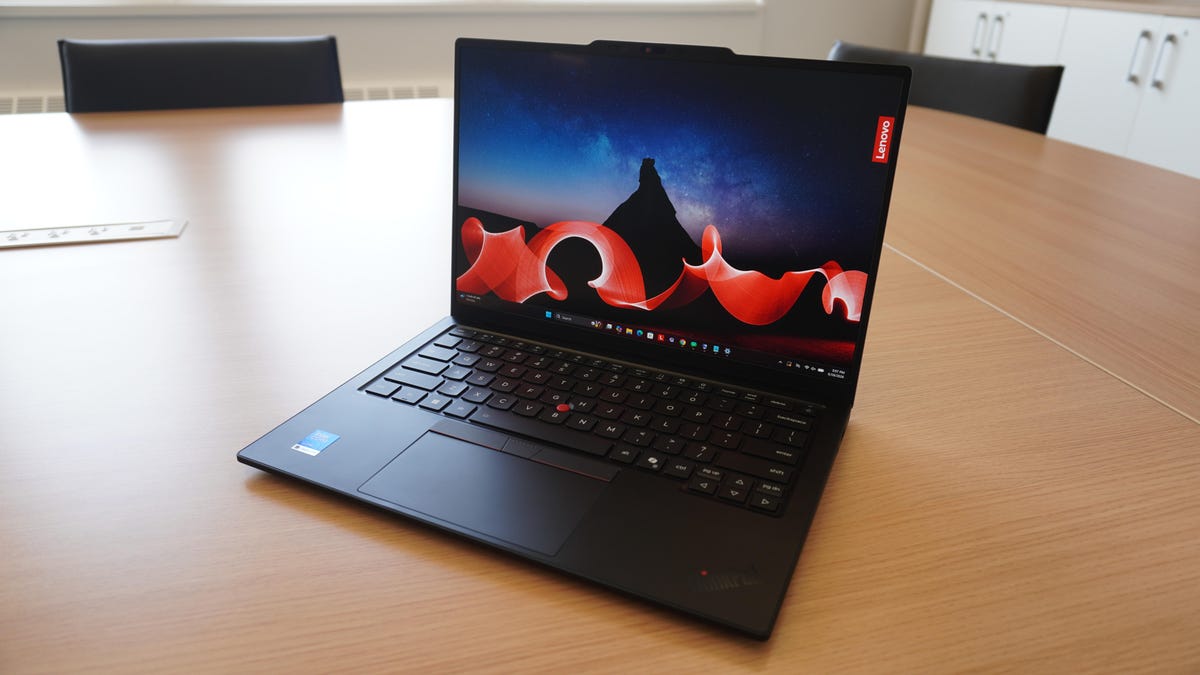
ThinkPad X1 Carbon Gen 14 Aura Edition
pros and cons
- Remarkably lightweight.
- Modular “Space Frame” design enhances repairability.
- Outstanding display quality.
- The definitive premium ThinkPad experience.
- RAM is soldered to the motherboard.
- Battery life is just average.
- Upgrades can get expensive quickly.
Follow ZDNET: Add us as a preferred source on Google.
Lenovo unveiled the 14th-generation ThinkPad X1 Carbon at CES 2026 to significant excitement, snagging the Best Laptop of CES award thanks to its innovative modular architecture and strong focus on repairability. It also earned a stellar 9/10 score from the repairability experts at iFixit.
It’s unmistakably a ThinkPad, packed with the high-end features of the X1 series: a 2.8K OLED display, up to 64GB of RAM, and a haptic touchpad. But the real story is what’s inside: a completely re-engineered, modular construction that lets users (or IT departments) quickly access and swap out individual parts like the battery, keyboard, and ports. This extends the laptop’s usable life and gives teams the flexibility to repair or upgrade components as needed.
Also: This Lenovo Yoga surprised me by matching my MacBook Air in unexpected ways
The X1 Carbon Gen 14 debuts the “Space Frame” concept, which uses a double-sided motherboard to provide straightforward access to internal hardware. Each component can be individually replaced using standard screws on the bottom panel.
Best laptop deals of the week
Deals are selected by the CNET Group commerce team, and may be unrelated to this article.
This is a positive step from a major laptop maker—especially on a flagship device. With RAM and storage costs climbing steadily (and driving up the price of consumer electronics), laptops with serviceable and upgradeable parts are becoming increasingly appealing.
However, it’s important to note that the memory itself is not user-upgradeable, though Lenovo has hinted this feature might appear on other models down the line. And yes, it’s pricey—this is an X1 Carbon, after all—so don’t assume modularity means budget-friendly.
A move toward better design
For years, most consumers have accepted that a failed battery or a broken USB port means replacing the entire laptop, and manufacturers were perfectly fine with that arrangement. Laptops like the X1 Carbon Gen 14 are steering the mainstream market in a better direction, but they haven’t completely revolutionized the industry yet.
The soldered RAM in the ThinkPad X1 Carbon Gen 14 keeps it firmly in the premium category, with a starting price of $2,199 for the Intel Core Ultra 5 model equipped with 32GB of RAM and a 256GB SSD.
Also: Lenovo showed me its new ThinkPad X1 Carbon, and the upgrades caught me off guard
At least the memory is fast: the 64GB configuration uses LPDDR5X-9600MT/s, while the 32GB version runs at 8533MT/s. If you’re planning to keep this laptop for years and want to future-proof it, going with 64GB is probably the smarter choice—though that pushes the price even higher.
One of the biggest appeals of modularity is the ability to customize individual components, which can lead to more affordable configurations. Lenovo is taking a measured approach by introducing the Space Frame design in a high-end flagship, but I’d love to see this modular philosophy trickle down to more budget-friendly models in the future.
Hardware and build quality
The hardware is exactly what you’d expect from an X1 Carbon: 32GB or 64GB of RAM, up to an Intel Core Ultra 7 355 “Panther Lake” processor with vPro (LPE-cores up to 3.60 GHz, P-cores up to 4.80 GHz with Turbo Boost, 8 cores, 8 threads, 12 MB cache), Wi-Fi 7, plenty of I/O options, and an optional 5G module with built-in eSIM support.
There are multiple display choices that span a wide price range. At the top, you get a 2.8K OLED touchscreen with 500 nits of brightness and a 120Hz variable refresh rate. At the lower end, there’s a 60Hz WUXGA IPS non-touch panel. The OLED is undeniably impressive, but the IPS screen is still perfectly capable. My review unit had the IPS display at 500 nits, and it still looked and felt like a premium business machine.
Also: I got my first look at the ‘MacBook Pro for Linux users,’ and it’s a serious Windows competitor
The build quality is everything you’d hope for from a ThinkPad: solid, premium, and no-nonsense. The carbon fiber body keeps the chassis remarkably light at under 1kg (roughly two pounds). It’s also incredibly slim, measuring just 0.6 inches at the thickest point toward the back, tapering to an even thinner edge at the front that really emphasizes how light it is.
All the ports you’d expect on a ThinkPad are present, including USB-C Thunderbolt 4 ports on both sides of the laptop (a major quality-of-life upgrade). For the trackpad, you can opt for the haptic version or stick with the classic three-button ThinkPad layout, and the keyboard is excellent, as always. The 1.5mm key travel feels wonderful, and Lenovo’s signature concave keycaps are so well-crafted that the keyboard simply fades into the background when you’re typing. It just works.
For the webcam, Lenovo offers a high-end 10MP Mobile Industry Processor Interface (MIPI) camera with a wide-angle 110-degree field of view, but my unit came with the more practical 5MP RGB camera. As with most Windows laptops at this price point, the camera performs well, though it can look a bit overprocessed depending on the lighting conditions.
Battery life
I found the X1 Carbon Gen 14’s 58Wh battery to be aboutHere is the paraphrased version of the article, with the HTML structure preserved and the text rewritten for clarity and readability:
The battery life is about average when compared to other business laptops in the same price range. The battery capacity is essentially the same as the previous generation of ThinkPad X1 Carbon, with the efficiency gains instead coming from the improvements in the Panther Lake CPU.
I managed around seven hours of real-world use, and that was strictly with web browsing and office applications over Wi-Fi — no video calls. That’s a solid result, but it’s slightly less than I had anticipated, given the circumstances.
Also: I saw the first Nvidia RTX Spark laptops – these 4 models will lead the new ultrabook boom
Compared to the 57Whr battery in the Gen 13 model, the 58Whr battery here does seem a bit on the modest side. Even increasing it to 60Whr might have eked out a bit more runtime, but this is almost certainly a design compromise made to accommodate the Space Frame construction. I also wouldn’t say that a larger battery should be the main priority for the next-generation model.
Performance
In terms of how it stacks up against other premium business machines, the 14th-gen X1 Carbon performed roughly on par with its competitors, with the Core Ultra X7 358H in the Asus ExpertBook Ultra B9 pulling ahead by a significant margin.
I should also point out that while the RAM on the X1 Carbon is not user-upgradeable, it does support double the maximum capacity of the previous generation and runs at a faster speed of 9600 MT/s.
Also: I tried the Surface Laptop Ultra at Computex, and it’s clear: Microsoft means business
You can also choose the Intel Core Ultra X7 368H processor, which delivers a substantial leap in GPU performance compared to the integrated graphics on the base configuration. If you plan on doing anything graphics-heavy at all, or just want to do some casual gaming in your downtime, it’s a huge upgrade, as the integrated GPU struggled to make mid-range games feel smooth in my testing.
ZDNET’s buying advice
The 14th-generation ThinkPad X1 Carbon Aura Edition is a successful evolution of a well-established product line, and I hope it paves the way for more repairable designs. It works so well not because of how different it is, but because of how skillfully Lenovo managed to incorporate such a significant design overhaul while preserving the best elements of the ThinkPad identity.
It’s remarkably lightweight, with just enough processing power and battery life to qualify as a powerhouse business laptop. The excellent keyboard, haptic touchpad — and the peace of mind knowing you can replace both yourself — make it a standout option.
On the topic of price: if you don’t have an enterprise budget to support you, I’d recommend looking at last year’s model, the 13th-Gen ThinkPad X1 Carbon, which you can pick up for about half the price. Without the Space Frame modular design, of course.
