



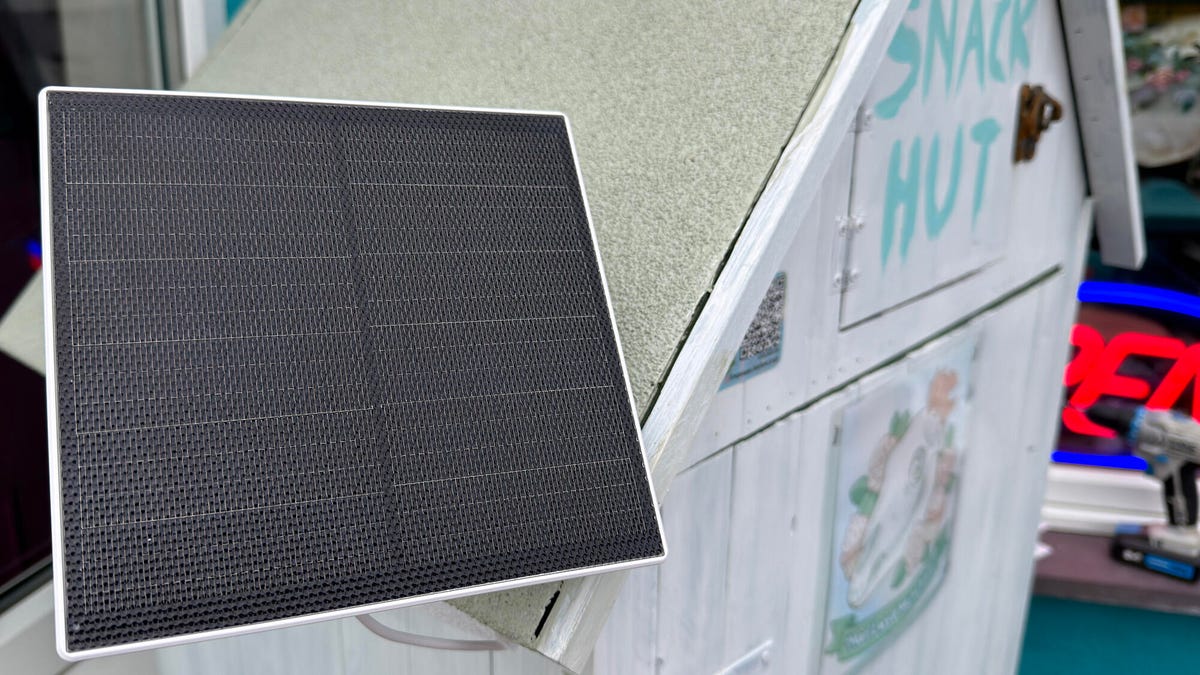
EverExceed 5V Weatherproof Solar Panel
Advantages & Drawbacks
- A solar panel that genuinely performs, even in overcast conditions
- Extended cable provides versatile placement options
- Completely weatherproof design.
- The wall mounting bracket is made from plastic (durable plastic, though)
- Reportedly incompatible with certain cameras.
Follow ZDNET: Add us as a preferred source on Google.
Trust, but verify.
I was asked to help set up an honor box along a popular trail here in the UK. You know the setup — a box stocked with cakes, drinks, and snacks for tired hikers, who are then trusted to pay for whatever they grab, either by dropping cash into a box or using a contactless payment method.
Also: I’ve been testing solar power at home for years — 12 myths you shouldn’t believe in 2026
As much as I’d like to believe that most people are decent and act with good intentions, there’s no denying that a few bad eggs exist. So I recommended adding a security camera to the box. I had a battery-powered cameras collecting dust in my office, so putting one to use seemed like a natural solution.
The catch is, these cameras would need to be removed and recharged every few weeks. While it isn’t exactly strenuous work, it is “another thing on the list to remember.” That got me brainstorming — could I improvise a setup and harness energy from the sun?
I still had a pair of compact EverExceed solar panels that had been sent to me for review, but I hadn’t tested them yet. Would they be up to the task? There’s only one way to find out!
Best solar deals of the week
Deals are selected by the CNET Group commerce team, and may be unrelated to this article.
Designed for outdoor use
These panels were rated at 5W, measured roughly 7 x 6.5 inches, and came with a 10-foot cable tipped with a swappable microUSB/USB-C connector. The manufacturer states they’re IP65-rated for water resistance and rated to operate across a temperature range of -4°F to 122°F.
Also: Why lithium-ion batteries let us down — and the devices I’m counting on instead
Seems like just the thing for British weather!
The panel also ships with a 360-degree adjustable wall bracket. Although it’s largely plastic, it’s strong enough to handle the demands of the job.
The mount can hold up against fierce winds and storms. I speak from experience!
Adrian Kingsley-Hughes/ZDNET
The package includes screws and wall plugs — the essentials, for the most part. Well, aside from a drill, the right drill bit for whatever surface you’re attaching to, and a screwdriver. You’ll also want a way to tidy up the cable so it doesn’t whip around in the wind.
Nothing ruins a cable faster than letting it rub against a surface in the breeze for a few weeks. And if the cable fails, replacing it would mean dismantling the whole panel.
For a neat, professional finish, you could opt for cable clips (either self-adhesive or nail-in), but since I was mounting it on a wooden shed, I went old-school with duct tape and a staple gun.
Thoughtful placement makes all the difference
You’ll want to put some thought into where the panel goes. With 10 feet of cable at your disposal, you’ve got decent flexibility. If you’re in the northern hemisphere, aim for as close to a south-facing orientation as possible, and steer clear of shaded areas (the less direct sunlight you get, the more critical it is to squeeze every bit of energy from available light).
Perfect south-facing alignment.
Adrian Kingsley-Hughes/ZDNET
The tilt angle should roughly match the latitude of your location (or 45 degrees if you’d rather skip the calculations).
There are apps to help with this. I used the built-in Measure app on my iPhone for both tasks, but if you’re on Android, you’ve got plenty of options available as well.
It delivers on its promise
Hooking up the camera is straightforward. Decide where you want it mounted, screw the bracket into the wall, attach the panel, angle it toward the sun, route the cable to the device you’re powering (don’t forget to include a drip loop where the cable passes through a wall into a building or shed — this prevents water from running along the wire, and you can seal the hole with silicone caulk), and finally plug the cable into whatever needs charging.
A drip loop is recommended wherever a cable passes through a wall.
Adrian Kingsley-Hughes/ZDNET
I installed this setup several weeks ago, and it has performed admirably. Not only did it recharge the camera from roughly 75% to full capacity within a single day, but it has also maintained a full charge ever since.
Also: Why lithium-ion batteries let us down — and the gadgets I’m counting on to stay protected
And the weather has been far from bright and sunny for much of that time. I also inspected the solar panel recently for any signs of wear or rust, and found none — which is quite encouraging.
You could lend the solar panel a helping hand and ensure the doorbell camera stays fully topped off, particularly if the skies have been mostly overcast.
ZDNET’s buying advice
At $16, this EverExceed 5V solar panel is a solid pick. You can purchase them individually, or grab a 2-pack or 3-pack. You will, however, need a camera with a battery that supports USB charging. The Amazon listing for the panel states that it is not compatible with Arlo, Blink, or Ring cameras. I’ve tried it with several cameras from these brands that I have on hand, and it appears to work without issue — though I haven’t tested every model.
Arlo cameras feature a magnetic connector, so for those, you’ll need a USB-C-to-USB-C adapter to link the cable to the solar panel (wrap it in shrink tubing to seal out moisture).
So if you own one of these cameras, you may need to channel your inner MacGyver.
Also, regardless of which camera you own, you may need to get inventive with weatherproofing the connection point between the camera and the charging cable. A dab of silicone sealant should do the trick.
But overall, this is an excellent solution for anyone who would rather not keep removing their cameras or doorbells from the wall every few weeks just to recharge them.
