



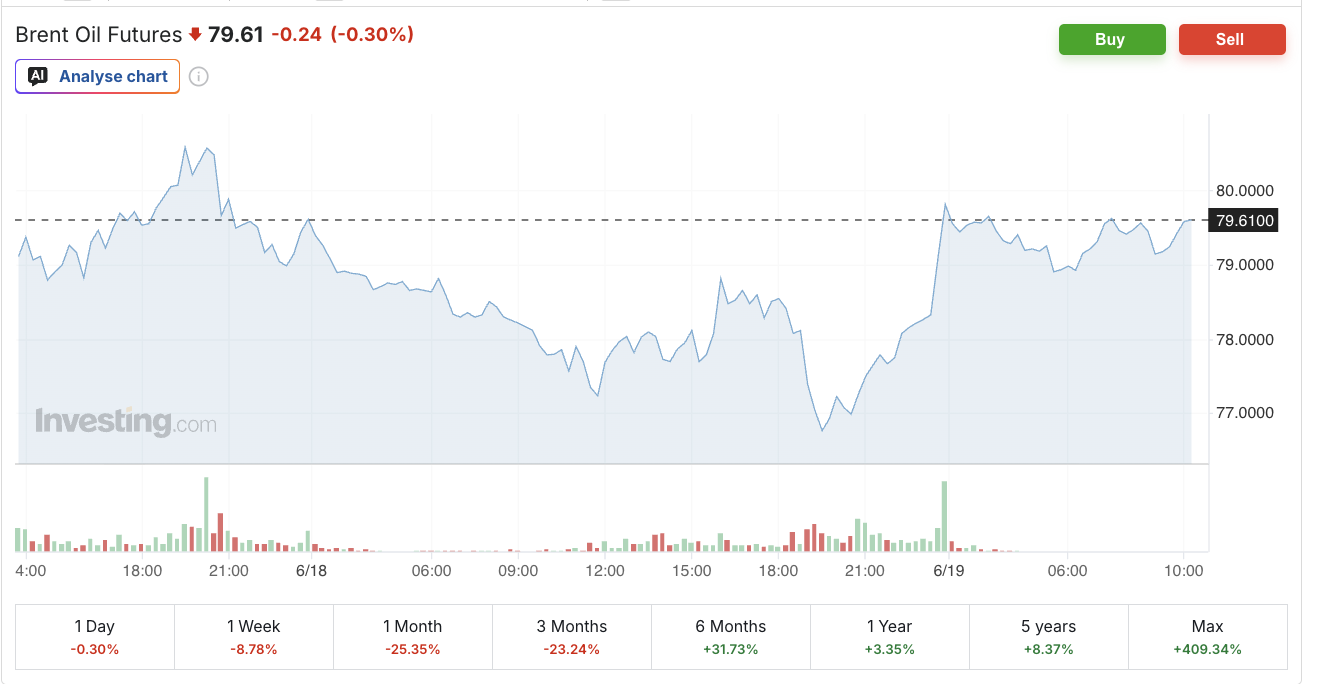
Brent crude just posted its sharpest weekly decline in months, yet Bitcoin (BTC) barely moved. To put it in numbers, Brent dropped 9% over the week compared to BTC’s 1% dip. That gap is putting the oil-Bitcoin relationship to the test — a connection many traders and analysts have long treated as gospel.
A number of market participants see falling oil as a signal that Bitcoin could bounce back. But the real picture involves inflation, how positions are structured across markets, and Bitcoin’s own mining ecosystem — and it leads somewhere few expect.
Why Traders Connect Bitcoin’s Bottom to Falling Oil
Brent crude, the world’s main oil benchmark, slipped below $80 this week, losing roughly 9%. WTI crude, the US benchmark, followed suit and dropped into the mid-$70s.

The US-Iran agreement to reopen the Strait of Hormuz sent crude prices tumbling.
A popular view among traders is that whenever oil takes a nosedive, Bitcoin tends to form a macro bottom not long after. Some believe crude will climb again later this year if Iran-Israel tensions flare up and shipping through the Strait of Hormuz faces new disruptions. That rebound, they argue, would trigger one last Bitcoin selloff — marking the ultimate low before a recovery.
That risk isn’t just hypothetical. Iran recently paused its 60-day negotiations with the US, which could push crude higher again. Still, a single price relationship rarely captures the full picture, and five years of data offer little support for a consistent Bitcoin-oil connection.
Five Years of Data Show the Bitcoin-Oil Link Is Weak at Best
Over a five-year window, the correlation between Bitcoin and crude oil stands at just 0.036. Correlation ranges from +1 (assets moving perfectly together) to −1 (assets moving in opposite directions). At 0.036, oil and Bitcoin show virtually no dependable relationship.

That said, a single average can be misleading. It’s often argued that the connection only shows up during periods of oil market turmoil. So we divided the data into two buckets — calm oil markets and highly volatile ones. If oil and Bitcoin behaved differently in each environment, a single number would obscure that.

Even when split, both readings hover near zero. The correlation comes in at −0.02 during periods of sharp oil swings and +0.05 during calm stretches. Both are essentially zero, meaning neither scenario reveals a meaningful link.
Looking for more insights like this? Sign up for Editor Harsh Notariya’s Daily Crypto Newsletter here.
The most recent 30-day reading is −0.21. This means oil and Bitcoin have moved slightly in opposite directions lately — but only to a small degree. Bottom line: no market condition makes oil a reliable predictor of Bitcoin’s direction.
The chain connecting oil to Bitcoin is also partly broken. Oil influences breakeven inflation — the market’s measure of expected price growth — at a moderate 0.41. But that inflation signal has only a weak connection to real yields, which are bond returns adjusted for inflation. And those yields, in turn, have just a faint tie to Bitcoin. So the oil-to-Bitcoin pathway loses strength at every step along the way.
Instead, the more immediate pressure on Bitcoin now comes from the Federal Reserve. New Chair Kevin Warsh kept rates steady on June 17, and nine out of eighteen officials projected at least one rate hike in 2026.
So monetary policy reaches Bitcoin faster than oil prices do. If oil isn’t driving Bitcoin, the next question is what is — and the data points to investor behavior.
When Oil Surged, Bitcoin’s Most Committed Holders Didn’t Flinch
Past price action tells the story. When Brent hit a cycle peak near $119 in late March, Bitcoin held its ground rather than collapsing.

Long-term holders — wallets that have held coins for extended periods (over 155 days) — continued accumulating throughout that stretch. Their net position stayed positive into June, a notable shift from the heavy selling seen in late 2025. This pattern suggests that the most patient investors weren’t shaken by rising oil costs.

The one genuine connection between oil and Bitcoin runs through mining. Energy is the primary cost
Generating Bitcoin requires significant energy, so persistently high oil prices can erode miners’ profit margins. However, the Bitcoin hash rate—the total computing power securing the network—has recently increased even as WTI crude prices decline. This rising hash rate amid lower energy costs signals miner confidence rather than retreat.
Notably, the hash rate held steady even during the March oil price surge.

With both holders and miners holding firm, the downward pressure is emerging from a different source: the derivatives market.
What Is Really Pressuring Bitcoin Right Now
This pressure is evident in derivatives activity. Bitcoin open interest—the total value of outstanding futures contracts—has risen since June 11, climbing from $21.83 billion to approximately $23.45 billion. Over the same period, the Bitcoin funding rate shifted from around +0.0023% to roughly −0.002%.
Funding refers to the periodic payments exchanged between long and short traders. A negative rate means short positions are now paying longs, indicating bearish sentiment. The combination of rising open interest and negative funding suggests traders are increasing short positions rather than buying the dip driven by falling oil prices.
The reasoning is key. If lower oil prices were inherently bullish for Bitcoin, market positioning would favor longs. Instead, it leans bearish. This dynamic could trigger a short squeeze—a scenario where even a modest price increase forces short sellers to buy back their positions, accelerating upward momentum.

Here’s the catch: if such a squeeze occurs, many will likely attribute the rally to falling oil prices. In reality, the bounce would stem from short covering, not crude oil movements. Underlying market sentiment remains negative, meaning any price surge would be technical in nature—not a genuine signal from oil markets.
For now, the connection between Bitcoin and oil is too weak to drive price action. Brent crude trades near $79, down about 9% for the week. Bitcoin hovers around $62,800—roughly half its October peak near $126,200—but has fallen only 1% over the same period. The next significant move will likely depend on funding dynamics and Federal Reserve policy, not oil prices.
If short sellers capitulate, a squeeze could rapidly push Bitcoin higher. If the Fed maintains a hawkish stance, downward pressure will persist regardless of oil’s trajectory. While oil still influences inflation and the Fed’s policy path, its impact on Bitcoin weakens at each step of that chain—fading before it meaningfully affects price.
The post Bitcoin Didn’t Care about the Oil Market Recovery, 5-Years of Data Shows Why appeared first on BeInCrypto.
