



The Rising Computational Demands of Endpoint Detection
Have you ever wondered how modern Endpoint Detection and Response (EDR) systems actually work? Unlike older antivirus tools that rely on recognizing known malware signatures, today’s EDR platforms focus on behavioral analysis to identify threats. Instead of just scanning for malicious files, they continuously monitor activity across operating systems, applications, and running processes. This includes tracking things like new process launches, parent–child process chains, command-line inputs, memory usage patterns, network connections, and system calls. By piecing together these signals, security tools can spot suspicious sequences such as:
User → Microsoft Word → PowerShell → execution of a harmful command
This behavioral approach is critical because many current cyberattacks use “living-off-the-land” tactics—exploiting legitimate software already installed on a system. As the volume of endpoint data explodes across large organizations, a key question arises: Can traditional CPU-based detection systems keep up efficiently? One promising solution may lie in leveraging Graphics Processing Units (GPUs) to accelerate analytics at scale. With telemetry growing rapidly, detection systems must evolve not only in how they analyze threats but also in the underlying hardware they run on.
CPU vs. GPU: Why Hardware Design Matters
A CPU is built for handling complex, sequential tasks—like running an operating system, managing diverse applications, and making quick decisions based on branching logic. It typically has a small number of high-performance cores optimized for versatility. In contrast, a GPU is engineered for massive parallelism. Instead of a few powerful cores, it contains thousands of smaller ones that can perform the same operation across huge datasets simultaneously. This makes GPUs exceptionally efficient for repetitive, data-heavy computations.
As IBM notes, GPUs excel at workloads involving highly parallel math operations—exactly the kind used in machine learning and large-scale data analysis (Schneider & Smalley, n.d.). These strengths could also benefit cybersecurity analytics, especially when processing vast streams of security telemetry to quickly flag anomalies or potential threats.
Behavioral Detection Demands Large-Scale Pattern Recognition
CPUs and GPUs are tailored for very different jobs. Modern EDR systems don’t just log events—they actively hunt for abnormal behavior by examining how activities relate to one another across the system. This includes analyzing process lineage, spotting unusual command patterns, identifying deviations from normal baselines, and correlating endpoint actions with network behavior.
Many of these advanced detection methods now depend on machine learning models that sift through enormous volumes of telemetry. Research into GPU-powered intrusion detection has shown that parallel processing can dramatically speed up both training and inference phases of these models—without sacrificing accuracy (Çolhak et al., 2025). As detection pipelines grow more data-hungry, the ability to process information in parallel becomes increasingly valuable.
Hardware-Boisted Threat Detection Is Already Here
While full GPU-accelerated EDR remains experimental, elements of hardware-assisted security are already in use. For instance, Intel’s Threat Detection Technology (TDT) includes a feature called Accelerated Memory Scanning, which offloads memory inspection tasks to the integrated GPU instead of burdening the CPU. This lets security tools scan for malicious code with minimal impact on system performance (Intel, n.d.). This shift reflects a broader trend: moving parts of threat analysis closer to specialized hardware to boost both speed and effectiveness.
Why Aren’t GPUs Standard in EDR Yet?
Despite their potential, GPUs aren’t yet common in endpoint detection. Several real-world hurdles remain: Not all devices have GPUs powerful enough for security analytics. Transferring data between CPU and GPU memory can add latency, potentially offsetting performance gains. EDR systems often handle many small, real-time events—not the large, batched workloads GPUs are traditionally optimized for. And developing for GPU frameworks like CUDA or OpenCL adds significant engineering complexity for security vendors. For these reasons, most EDR platforms still rely primarily on CPU-based architectures.
A Vision for Future Detection Systems
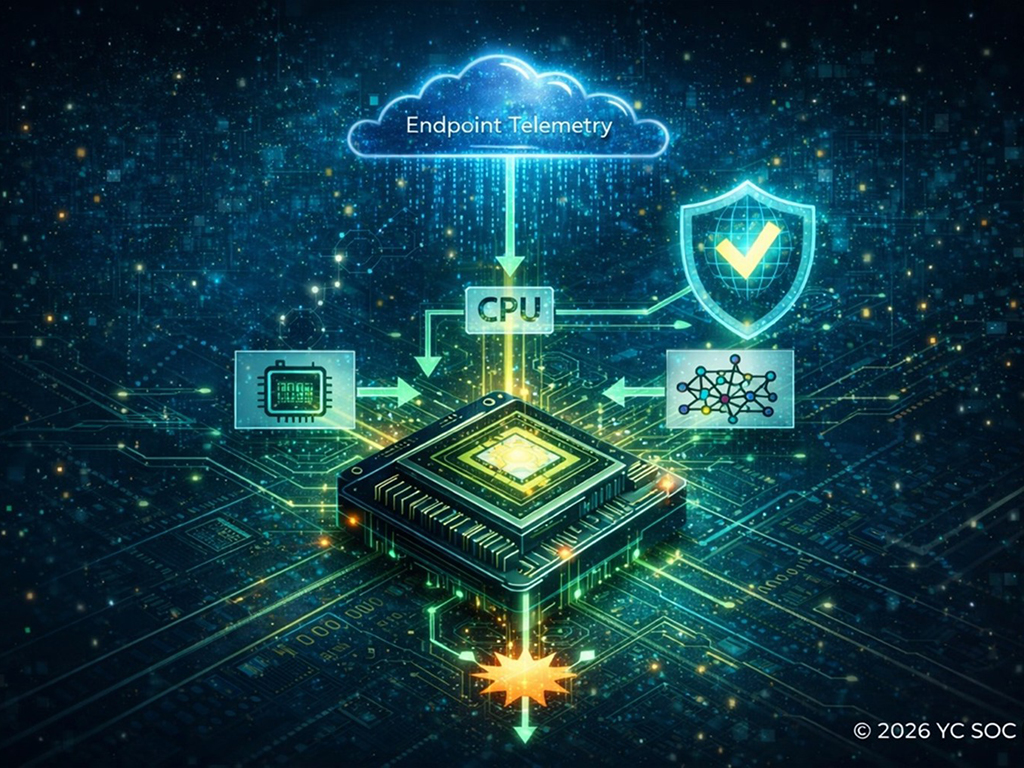
As telemetry volumes continue to surge, next-generation detection platforms may adopt hybrid architectures that combine different types of processors: CPUs would handle OS interaction, event collection, and process monitoring; GPUs would take on large-scale behavioral analysis, anomaly detection, and pattern matching across telemetry streams; and dedicated AI accelerators like Neural Processing Units (NPUs) could manage machine learning inference for classifying threats. In this model, each processor handles the tasks it’s best suited for (see Graphic 1-1).
(Graphic 1-1)
This distributed approach could enable security platforms to analyze ever-growing telemetry data while preserving real-time detection capabilities.
Looking to the Future
Today’s attacks increasingly exploit trusted relationships within operating systems, chaining together legitimate tools to carry out malicious actions. Uncovering these attack sequences requires analyzing intricate behavioral patterns across massive datasets. As security analytics advance, progress may come not just from smarter algorithms but also from better use of modern hardware. While GPU-accelerated analytics aren’t yet mainstream in EDR, they represent a compelling direction for future innovation. As detection systems grow more data-intensive, parallel computing architectures could become central to the next wave of cybersecurity solutions.
About the Author
 Yongmei Concepcion is the founder of the YC Security Operations Center (SOC) Lab. A cybersecurity professional and PMP-certified leader with over 12 years of experience in risk-driven operational environments, she leads a dedicated research lab that simulates real-world detection and response scenarios. Her work centers on adversary tactics, techniques, and procedures (TTPs) aligned with the MITRE ATT&CK framework, detection engineering, and control validation based on NIST and CIS standards. She also shares cybersecurity insights through her YouTube channel and is developing a nonprofit initiative to strengthen cyber resilience for military families.
Yongmei can be reached at [email protected] or via her company’s YouTube channel: www.youtube.com/@YC_SOC_Lab
