



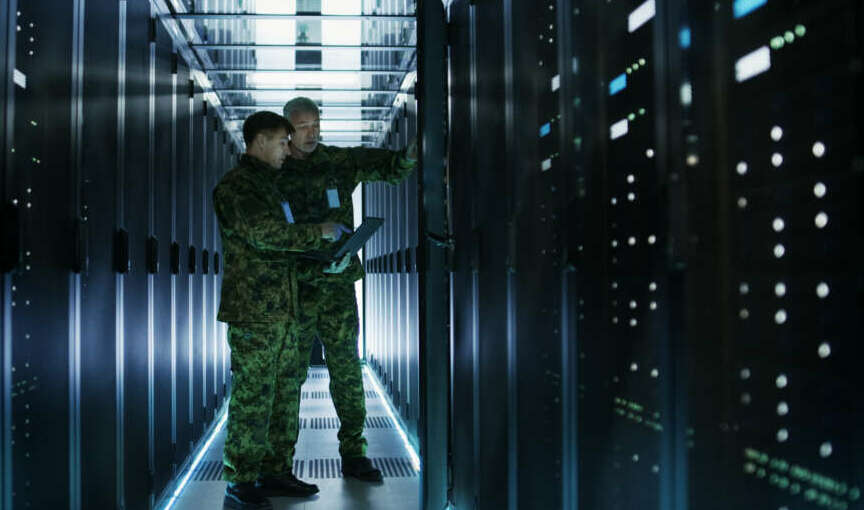
A proposed change in the House Armed Services Committee’s draft of the 2027 defense policy bill could deter tech firms from constructing data centers on military bases. An Army official warned this would undermine Army modernization plans and discourage future private investment.
Introduced by Representative Cory Mills (R-Fla.), the measure would prohibit the Department of Defense from leasing its land for private data centers unless companies pledge not to install or run equipment containing parts made in China, Russia, Iran, or North Korea.
This ban targets specific items like advanced semiconductors, chipsets, and certain printed circuit boards that the Pentagon views as a threat to national security.
“I’m proud to advance this amendment to safeguard our military bases against the use of Chinese components in on-site data centers,” Mills wrote on X. “This measure strengthens national security, supports U.S. businesses, and boosts domestic industry capacity.”
Because the U.S. industrial base currently cannot produce some essential data center equipment domestically, Army officials argue the amendment would create a “federal land penalty.” Companies building on military property would face strict rules that wouldn’t apply to those constructing similar facilities elsewhere.
“If a company builds just outside our gates, they avoid these regulations. But if they build on our land, they must comply,” an Army official told Federal News Network. “This unrealistic standard will push top-tier commercial partners—and more than $1.3 billion in private investment—away from Army installations.”
“In the long run, the Army would lose access to reliable, shared power and data infrastructure. We’d then have to fund these multi-billion-dollar upgrades ourselves with taxpayer dollars—or risk falling behind rival nations,” the official added.
This proposal comes amid the Trump administration’s push to fast-track AI data center development by opening federal land to private firms. The Army has already picked Carlyle Group Inc.—one of the world’s largest private equity firms—to build a large-scale data center at Fort Bliss in Texas. Another project is underway at Utah’s Dugway Proving Ground with CyrusOne, a company jointly owned by KKR and BlackRock. Additional projects are being planned for Fort Bragg, North Carolina, and Fort Hood, Texas.
Under these partnerships, the Army would gain access to part of the data center’s computing power to support its growing AI initiatives. The centers would be fully commercial operations, free to sell surplus processing capacity to outside clients.
Construction at Fort Bliss is expected to be completed by 2027.
Likewise, the U.S. Air Force is opening unused land at five military installations to private developers interested in building AI-focused facilities.
The Army official noted that Congress has been open to hearing these concerns.
“We’ve provided technical feedback on how this clause affects our leasing authority,” the official said. “Lawmakers generally share our goal of securing networks and supply chains. Like them, we want to protect national security—but we also need them to understand when a well-meaning policy could unintentionally stall our modernization.”
The Army didn’t demand the clause be scrapped entirely but urged Congress to adopt a policy that “keeps our systems secure without crippling our partnerships.”
“We want rules that encourage tech companies to build on secure federal land—not barriers that push them away. When a commercial tenant on federal land already serves the government, they’re already subject to rigorous federal security standards,” the official explained.
A spokesperson for Representative Mills did not respond to a request for comment.
Separately, Representative John Garamendi (D-Calif.) raised concerns about the military’s broader plan to host commercial data centers, which consume enormous amounts of energy and water—resources critical to base operations.
“We’re not against data centers,” Garamendi said. “But if one is built on a federal facility, it must not degrade that base’s capabilities.”
“What impact will it have on energy and water supplies? Is there backup power? Does it create noise or light pollution that could interfere with training? Does it encroach on operations or compromise supply chain security?” he asked.
If you’d like to speak with this reporter about recent federal government changes, email anastasia.obis@federalnewsnetwork.com or message via Signal at (301) 830-2747.
Copyright
© 2026 Federal News Network. All rights reserved. This site is not intended for visitors located within the European Economic Area.
