



Stay connected with ZDNET: Set us as your go-to source on Google.
ZDNET’s main highlights
- Fitness trackers are shrinking in size.
- They’re also becoming harder to spot.
- This shift in design mirrors the broader ambition for health tech.
About a decade ago, spotting whether those around you were monitoring their health was fairly straightforward. You could glance at their wrists for an Apple Watch, Fitbit, or Nike Fuelband. These days, it’s not so easy. Certainly, smartwatches and fitness bands are still going strong, but a whole range of new form factors have appeared on the scene.
Continuous glucose monitors (CGMs) are tucked beneath shirt cuffs. Smart rings, earrings, bracelets, and even necklaces blend seamlessly with everyday accessories, and fitness bands are designed to disappear against neutral-toned clothing to complement an outfit. The creators of these understated trackers want them to be as unnoticeable as possible.
Also: What you sacrifice when you wear a smartwatch or ring
Thanks to progress in both hardware and software, companies are crafting the next wave of wearables that are even lighter, more compact, more capable, and less conspicuous than their predecessors.
“Over the years, we’ve seen these products shrink in size,” said Arielle Trzcinski, a principal analyst at Forrester, in a conversation with ZDNET about health wearables.
Tech companies have long focused on making things smaller. Apple’s first MacBook tipped the scales at 5 pounds. The newest version weighs just half that. Yet while phone manufacturers are rolling out larger smartphones with expansive screens and foldable designs, the accessories that pair with these phones have done the opposite — they’ve shrunk.
So, what caused these devices to shift from chunky and logo-covered to subtle and hard to detect? And what’s driving this transformation?
Honey, we shrunk the health tracker
When Tim Cook introduced the Apple Watch in 2014, he ignited the rapidly growing wearable device category and opened up a new way to interact with your phone (this time, by keeping its companion strapped to your wrist). Its distinctive, rounded-square look was unmistakably Apple.
The smartwatch stood out, and in its early days, it was a talking point. As more brands entered the arena, they set themselves apart with eye-catching designs.
I can’t recall the last time a smartwatch truly stunned me or compelled me to strike up a conversation about it.
Also: How I used Airtable to trade my daily fast-food routine for 5-minute meal prep
“Typically, when products hit the market, including the Apple Watch, they’re meant to be recognizable,” Khosravi said. More than 550 million people around the world now own a smartwatch, according to data from DemandSage. Tech companies no longer need to convince consumers of the worth of tracking their sleep, steps, or stress — or the health benefits that come with wearing a device. We’re already on board.
Beyond smartwatches, even the more compact trackers are getting even smaller. While Oura wasn’t the first company to launch smart rings as health monitors, it’s the one that brought this design into the mainstream and convinced consumers of the appeal of low-profile sleep-tracking devices. Its commitment to an almost invisible form factor has proven successful; in September, Oura revealed it had sold 5.5 million Oura Rings. It also recently filed confidentially for an IPO.
In late May, Oura introduced the Oura Ring 5, its slimmest smart ring to date — 40% thinner than the Oura Ring 4. Achieving this smaller size required miniaturizing the LEDs responsible for tracking health metrics and reworking the battery. While Oura trimmed down the Ring 5, it simultaneously improved battery life — extending it from five to eight days up to six to nine days.
The blend of more powerful LEDs, an improved battery, and Oura’s refined algorithm enabled the fifth-generation ring to deliver greater capability in a sleeker form, Oura VP of product Maz Brumand told ZDNET.
“My prediction is that, once this ring launches, it’ll be extremely difficult to tell that it’s actually an Oura Ring. People might wonder, ‘Don’t you want others to know someone is wearing an Oura Ring?’ That’s nice, but the goal or the mission is to integrate into people’s lives in the way they want,” Brumand explained.
Also: I should’ve paid attention to my Oura Ring when it warned me about my health
Companies are designing smart jewelry where being recognizable isn’t even a secondary concern. Consider the Lumia smart earrings, for instance. Lumia’s smart earrings monitor blood flow and attach behind an earring post. The device’s earring back can be swapped onto any stud earring, making the product remarkably discreet.
But it’s not just consumer health technology that’s getting smaller. Dexcom, a diabetes management and CGM manufacturer, announced in May that it’s cutting the size of its newest CGM by half.
“They’re trying to design these wearables in a way that feels more invisible and fits more naturally into our daily lives,” Safoora Khosravi, a senior research associate at Lux Research Inc., told ZDNET.
Once worn consistently, these devices can surface more actionable, behavior-shifting health insights. A more complete picture of a person’s activity, daily routines, sleep quality, and eating habits takes shape over time as they wear a health tracker and log these data points. With more accumulated data, a device becomes better at detecting anomalies or flagging potential conditions — as demonstrated by Apple’s sleep apnea, hypertension, and atrial fibrillation detection features.
Meanwhile, wearers are also gaining deeper insight into the physical impact of their own habits — like how that evening glass of wine affects their sleep and heart health — simply by wearing a tracker to bed each night.
The physical design of these devices reflects the objective that tech companies are steadily working toward: create something wearable around the clock, capable of diagnosing or detecting health conditions with FDA-cleared features, able to connect with healthcare providers when needed, and able to build a comprehensive health profile through a small, always-on device.
Small device, big job
Another major reason these devices are becoming smaller and more inconspicuous is actually quite straightforward.
They simply don’t need to be large to do what they do.
The vast majority of these devices operate quietly in the background. Health trackers collect data on the device itself, relay it to the companion app, and the software processes it to generate a detailed health overview that the user can review and take action on.
Also: Wearables generate massive amounts of health data — and doctors are struggling to keep pace
A health tracker delivers the most value when it’s passively monitoring in the background — ideally with a passive, unremarkable physical design to match. That’s why many of today’s health trackers don’t draw much attention to themselves — or even resemble traditional trackers in the first place.
Data fuels all of these groundbreaking diagnostics, and most of the time, the analysis happens after the fact. Unless a user is logging a workout or taking an instant heart rate reading, which requires real-time processing and on-screen information, that data transfer doesn’t need to occur instantly, Khosravi pointed out. Data storage occupies only a small portion of the device. “They don’t need the computing power surge required for processing the data. They just need to transmit the data to the
phone,” Khosravi mentioned.
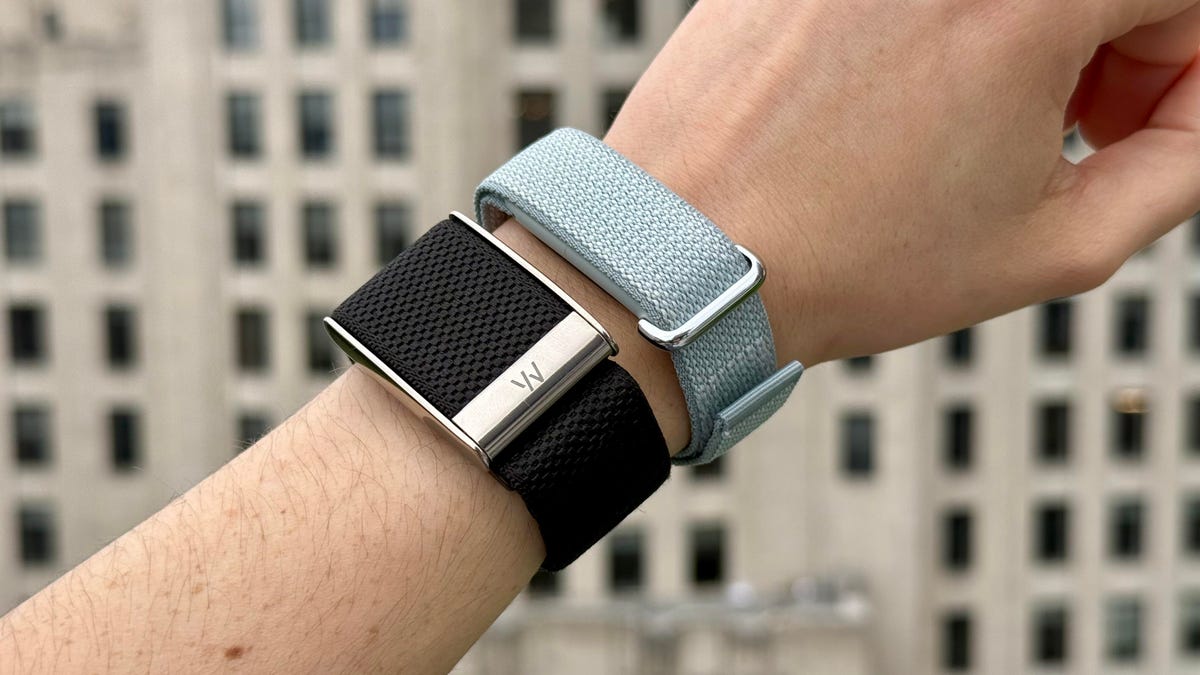
The Whoop band (shown in black) and Fitbit Air (shown in blue) resting on a wrist.
Nina Raemont/ZDNET
Although these health-focused tech gadgets are marketed with the promise that they might warn you of a heart emergency or even contact emergency services on your behalf, Trzcinski described that scenario as rare—a situation where instant health alerts are truly necessary.
Also: The hidden dangers in your personal DNA and health test kits
This is quite different from AI-powered wearables such as smart glasses or smart pins. They tend to be bulkier since they’re worn on the body or face, Trzcinski noted, because they’re designed to address immediate, real-time needs. Think language translation, live AI support, photo or video capture, or audio playback—all tasks that demand significantly more processing power than simply monitoring heart rate or body temperature and syncing that data to a smartphone.
Trzcinski emphasized that the real value doesn’t come from the device itself but from the companion app. “The insights you gain are delivered through the app,” she explained. It’s the app’s software—analyzing your data and turning it into clear, actionable, or even diagnostic information—that keeps users engaged.
Leading tech brands have cracked the code on effective health trackers: pack powerful health-monitoring and lifestyle analysis capabilities into small, unobtrusive designs. To be worn consistently, these devices must be comfortable and nearly invisible in daily routines.
“Today’s wearables are built to seamlessly blend into your everyday life,” Khosravi added.
