



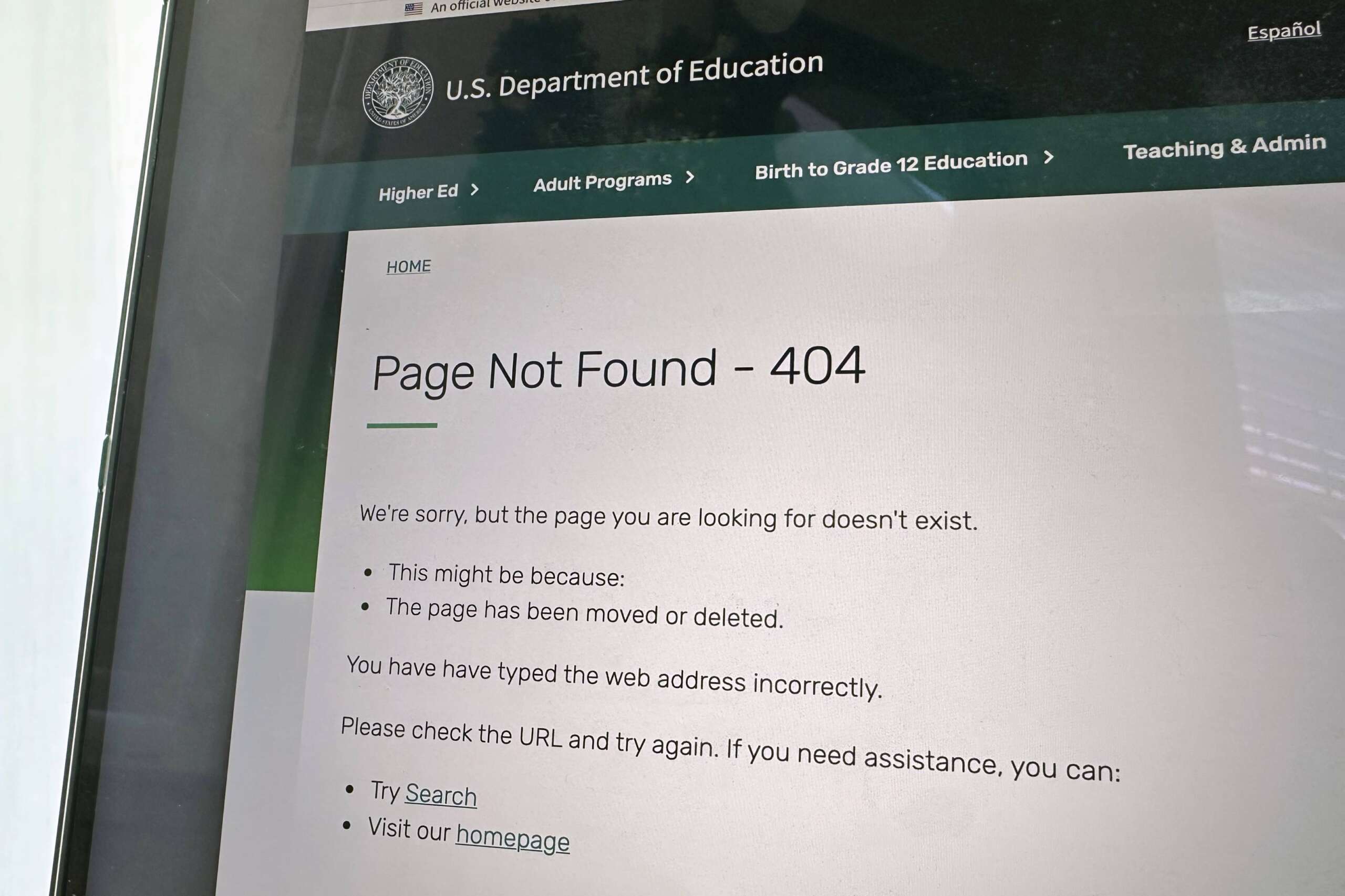
Federal agencies are actively pursuing the Trump administration’s government-wide initiative to cut down on .gov websites that are considered “confusing” or redundant.
The Department of Commerce, in collaboration with the Office of Management and Budget, is working to slash its number of websites by almost half.
Brian Epley, the department’s chief information officer, explained at an industry conference on Thursday that the goal is to make it simpler for visitors to find the information and services offered by Commerce and its sub-agencies.
“This public-facing portal must be intuitive, straightforward, and it must successfully provide the services that we are designed to deliver to you,” Epley mentioned at the Government Service Delivery Conference.
The Trump administration is targeting the reduction of “confusing government websites” as a key part of the President’s Management Agenda.
Last year, the General Services Administration (GSA) carried out a comprehensive review of government websites. According to GSA records secured by Federal News Network, departments prepared to remove 332 websites, roughly 5% of the 7,200 total sites under evaluation across the 24 largest federal departments and agencies.
Per records obtained by Federal News Network, Thomas Shedd, the former head of GSA’s Technology Transformation Services, directed agencies in the past summer to focus on “low-hanging fruit,” such as separate sites for blogs, image galleries, and forums.
The GSA also instructed agencies to remove sites for initiatives or events that have been irrelevant for several years, along with independent pages dedicated to “niche subjects or working groups.”
Federal Chief Information Officer Gregory Barbaccia, who is also the current lead of GSA’s Technology Transformation Services, commented that many departments are struggling with “fragmented delivery channels,” which includes having overlapping websites.
“You frequently have to bounce between multiple websites for the same services, and it’s really a breakdown when a citizen has to submit the same personal information multiple times to different agencies,” Barbaccia said.
Joe Gebbia, the chief design officer of the United States and a co-founder of Airbnb, noted in a recent podcast discussion that his team, the National Design Studio, is planning a massive redesign of tens of thousands of federal sites.
“We’re fixing all of them,” Gebbia stated in January on the American Optimist show. He noted that many official websites “look like they’re straight out of the mid-90s.”
Roughly 27,000 federal websites currently exist, serving millions of users every day.
“The potential for improvement here is immense,” Barbaccia explained. “Even a minor change, like decreasing the number of clicks needed to navigate a site, could positively affect a huge number of people,” he said.
In January, Barbaccia presented his “one government” vision for web design, pointing out that “it’s confusing for the public when the online experience of one agency differs entirely from another.”
Barbaccia emphasized that his approach involves making sure the digital platforms used by agencies are “built for our citizens, not for internal bureaucracy.”
“You shouldn’t need an insider’s knowledge of government structure just to successfully use an online service. That’s us being insensitive to users’ needs,” Barbaccia said.
Greg Boone, a former innovation specialist at GSA’s now-defunct 18F tech shop, now working as the customer success director for WordPress VIP’s public sector accounts, stated that there is a critical need to manage the explosion of federal websites, some of which have existed since the early days of the internet.
“The government has a massive content management challenge, and it’s been that way for decades,” Boone said. “The downside of being the entity that invented the internet is that you end up maintaining websites that went live before the World Wide Web was mainstream.”
Boone mentioned that NASA, which operates some of the oldest active sites in the federal sphere, is currently trying to streamline its web presence, similar to the Department of Commerce. He revealed that NASA is leveraging artificial intelligence to “uncover duplicate content that was missed while they were combining sites.”
In one instance, Boone mentioned that a NASA user discovered four distinct online profiles for a single astronaut, and the AI tool was effective in merging or removing those outdated duplicates.
“The software scans the entire web domain to locate these duplicates and determines which version is accurate,” Boone said. “Content audits—I remember doing them at GSA—they used to consume months of time and endless spreadsheets. AI can significantly accelerate that process. However, human oversight is still essential to verify the final decisions.”
Copyright
© 2026 Federal News Network. All rights reserved. This website is not intended for users located within the European Economic Area.
