



By Marc Kavinsky, Lead Editor at IoT Business News.
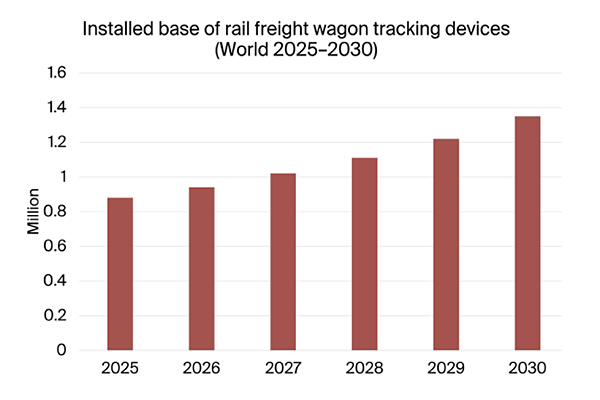
Berg Insight projects that the number of tracking devices installed on rail freight wagons will rise from 875,000 units at the close of 2025 to nearly 1.4 million by 2030, underscoring both the momentum and the untapped potential in rail telematics adoption.
Rail freight is among the most challenging transport sectors to digitize at scale. Wagons are durable assets that frequently cross borders and operate across multiple networks, often detached from the locomotives and operators that haul them. This makes real-time visibility far more difficult to achieve than in road transport, where the vehicle, driver, and fleet management system are usually under unified operational control.
Fresh analysis from Berg Insight signals ongoing growth in IoT-based monitoring within this space, yet also reveals that tracking on rail freight wagons is still far from widespread. The firm reports that the worldwide installed base of tracking devices on rail freight wagons hit 875,000 units by the end of 2025. By the close of 2030, Berg Insight anticipates that number will climb to roughly 1.4 million units.
Yearly shipments are likewise expected to double, rising from an estimated 175,000 units in 2025 to approximately 350,000 units in 2030. Despite this upward trajectory, penetration in the rail freight wagon segment is forecast to edge up only from 16.6 percent at the end of 2025 to 24.5 percent by the end of 2030.
This penetration rate is the key takeaway from the report. It indicates that, even with increasing device shipments and a broadening supplier landscape, around three-quarters of the global rail freight wagon fleet will still lack dedicated tracking devices by 2030. For IoT vendors, this represents a substantial addressable market. For rail operators and cargo owners, it also highlights how inconsistent digital visibility continues to be across rail-based supply chains.
A market driven by aftermarket telematics
What sets this market apart from many other connected transport segments is the divide between freight wagons and powered rolling stock. Berg Insight observes that modern locomotives and passenger trains generally come equipped with some form of tracking and monitoring technology as a standard feature, with OEMs like Alstom, Siemens Mobility, CAF, Hitachi Rail, and Stadler Rail building connected solutions into their trains from the factory.
Freight wagons tell a different story. Tracking and monitoring solutions for these assets are mainly offered by specialist telematics companies providing aftermarket systems. The firms cited by Berg Insight include Nexxiot, DOT Telematik und Systemtechnik, SAVVY Telematic Systems, Intermodal Telematics, Level Systems, Giesecke+Devrient, Cargomon Systems, and PJM in Europe, alongside Amsted Rail, BlackBerry, and ORBCOMM in North America.
This distinction is significant because aftermarket adoption follows a fundamentally different commercial and technical path compared to factory-installed connectivity. Wagon owners and operators need to make a clear business case for retrofitting existing assets rather than simply enabling built-in systems that come with new rolling stock. Integration also goes well beyond location tracking: the return on investment often hinges on combining positioning data with sensor inputs such as mileage, impacts, temperature, load status, and component health.
In practical terms, this shifts rail telematics from a straightforward asset-location tool toward a source of operational intelligence. The real value lies not just in pinpointing where a wagon is, but in leveraging condition and usage data to support maintenance scheduling, boost service reliability, and share more accurate information throughout the rail value chain.
Berg Insight’s report also highlights a distinct group of suppliers that serve locomotives and multiple units with aftermarket hardware and software for remote monitoring. These include EKE-Electronics, HaslerRail, Nomad Digital, and Railnova in Europe, as well as Railhead, Wi-Tronix, Quester Tangent, and ZTR Control Systems in North America.
What this means for the IoT ecosystem
For OEMs, the findings reinforce the gap between newly built connected rolling stock and the far larger challenge of digitizing existing wagon fleets. For telematics vendors and connectivity providers, rail freight presents a long-term growth opportunity, but the modest penetration outlook indicates adoption will remain gradual rather than sudden.
System integrators and industrial IoT providers should also pay close attention to the importance of interoperability among stakeholders. Rail freight operations involve wagon owners, operators, shippers, maintenance providers, and infrastructure managers. A tracking device that merely reports position may deliver limited value if the data cannot be fed into maintenance workflows, logistics platforms, or customer-facing visibility tools.
For businesses that rely on rail as part of multimodal logistics, the forecast points to better—but still patchy—visibility. As more wagons are fitted with tracking and sensor devices, rail can provide richer insights into asset utilization and cargo conditions. However, the penetration numbers suggest that companies should not expect uniform data availability across routes, fleets, or regions.
The broader takeaway is that rail telematics is moving into a more mature stage. Growth is no longer simply about demonstrating that wagons can be tracked. The next chapter is about transforming scattered sensor and location data into operationally meaningful intelligence in a market where the majority of assets remain unconnected.
