




By Ryan Carlson, Technology Evangelist at Soracom
IoT suffers from a pilot problem that rarely gets discussed. It’s not a technical issue. It’s the frustrating scenario where a successful proof of concept gathers dust in a presentation for two years, gets rebranded as a “Phase 2 initiative,” and silently fades away when the internal champion departs the organization.
We’ve become incredibly skilled at creating 90-day demonstrations that prove a concept functions. Where we fall short is proving that it’s actually worth pursuing.
This distinction is far more critical than the industry is willing to acknowledge.
The unplanned gap
When an IoT pilot stalls, the post-mortem typically points the finger at technology. The connection was unstable. Integration proved more complex than anticipated. The hardware underperformed in real-world conditions. These are legitimate challenges. But they’re seldom the actual killers.
The real killers are far more subtle. The executives who greenlit the pilot struggle to explain the return on investment to their leadership. The end users who were never asked for input can’t see how the solution fits into their daily routines. Operations teams suddenly find themselves responsible for managing a fleet of SIMs and data pipelines that nobody allocated headcount to oversee. IT shuts the project down over security issues that should have been flagged in the first week, not the ninth. Sales teams can’t articulate the value proposition. Distributors feel the non-connected version worked just fine.
Technology is almost never the roadblock. The real obstacle is that no one confirmed whether this connected deployment deserved to exist before development began. The sensors function properly. The connectivity is well-established. What’s absent is the organizational preparedness to run it.
Four questions that shape the outcome
Every IoT initiative, whether it’s a large enterprise rolling out sensors across 200 locations or a startup launching its first connected product, succeeds or fails based on four readiness dimensions.
Technology: Why does it work? The answer defines the impact. Without a well-defined mechanism for delivering value, you’ve created something technically impressive that nobody actually needs.
Market: Why does value exist? This is where most teams stumble. You have buyers focused on cost savings and ROI calculations. Meanwhile, end users are judging whether the connected devices genuinely simplify their everyday work. Think of a maintenance technician receiving predictive maintenance alerts, a floor nurse locating connected medical equipment, or a field engineer troubleshooting remote device failures. Buyers authorize purchases and approve rollouts. Users decide whether the solution actually gets adopted.
Business: Why will customers purchase it? The price must align with the value of solving the problem. Countless pilots have performed flawlessly, users have loved them, and the project still died because the cost couldn’t be justified compared to the existing approach.
Organization: Can we build and maintain it? Not just the initial development. It’s about the support infrastructure, the operational tools, and the cross-functional collaboration needed to keep a connected product functioning in the field.
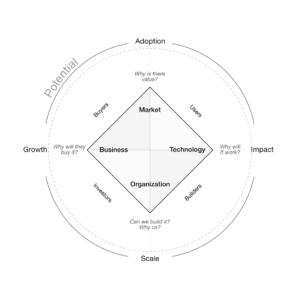
These dimensions exist in direct tension with each other. Weak organizational capacity undermines market adoption. Insufficient technology impact stunts business growth. The readiness diamond isn’t a simple checklist. It’s a map of competing pressures.
The validation phase that gets overlooked
Here’s a pattern that repeats constantly. Teams leap from brainstorming an idea straight into planning, hiring engineers, and launching an IoT pilot. They bypass the step that determines whether the entire effort is worth the investment.
That step is validation. And it has two parallel tracks that need to run simultaneously. The technology track is the proof of concept. Most teams understand this one. Build a prototype, test the integration, confirm the hardware performs. Standard procedure.
The business track is the proof of viability, or proof of value (PoV). Almost nobody handles this well. A proof of viability involves field research. It means documenting the downstream implications across the value chain. If you’re installing a remote monitoring sensor to predict motor failure, what does the maintenance technician’s current inspection schedule look like? How much time does removing a bi-monthly physical inspection truly save? Does a quarterly compliance report still demand manual data entry because an integration was overlooked? Can you put a real number on the labor savings, or are you just estimating?
Proof of viability addresses the questions buyers need answered: What are the alternatives? What’s the cost of maintaining the status quo? Is this solving a problem that’s urgent and widespread enough that customers will pay to resolve it? For enterprises, it’s the ROI justification for deploying and scaling connected systems. For product companies, it’s market validation confirming that the IoT solution delivers measurable operational value. Without it, you’re running a pilot of connected devices and workflows based purely on hope.
When both tracks advance together, insights from the POC shape the business case, and market findings guide engineering priorities. When they don’t, you end up with one of two outcomes: a solution searching for a problem, or vaporware that generates excitement while eroding trust in equal measure.
Where AI belongs (and where it doesn’t)
AI delivers genuine value in the first three phases of the project lifecycle. IoT projects, from the initial sensor prototype to a full fleet-wide deployment, progress through four stages: exploration, validation, acceleration, and commercialization. That final phase is when teams go to market or roll out across the enterprise.
AI’s influence is most powerful before you reach that point. Deep research tools can map market conditions and competitive landscapes in hours rather than weeks. AI-assisted prototyping has made the proof-of-concept stage remarkably fast. The ability to present a working clickable mockup to a potential customer, gather feedback, and iterate all within the same day dramatically compresses the ideation loop between POC and market validation.
That speed brings both opportunity and risk. Over-dependence on AI-generated code becomes a serious liability the moment a customer pilot carries real consequences, particularly in firmware and edge computing where bugs can’t be resolved with a simple server-side patch. QA and code audits are critical steps where AI can help but not replace human judgment. And embedding AI into the product itself demands the same discipline as any other feature. The market is saturated with “Powered by AI” applications that are difficult to tell apart. If the AI component isn’t addressing a specific, validated problem, it’s just another feature that overpromises.
The more compelling use case is leveraging AI to strengthen the validation work that most teams skip. Record user interviews and extract meaningful insights. Build custom dashboards to gather stakeholder feedback. Estimate the true operational costs of running models in production. On a factory floor, different PLC models on the same production line
Here’s the paraphrased version:
Frequently, sensors output data in inconsistent formats. AI can standardize that data across different equipment models during the validation phase, confirming that the integration will work before a pilot puts its credibility on the line. Think of AI as a research collaborator, a junior analyst, a rapid prototyping engine. Leveraged in this way, it allows small teams to bridge gaps in knowledge, capabilities, and bandwidth.
The currency that truly counts
Every pilot is fundamentally a test of trust. The technology must work reliably. But equally, the business case must be sound, the users must have confidence in it, and the organization must be prepared to maintain connected operations at scale. Trust is the currency that drives adoption, fuels growth, and unlocks the potential to expand IoT deployments across the entire business. You won’t earn it with a simple demo of connected devices or eye-catching dashboards. You earn it by putting in the validation work before you even draw up the plan.
Author biography:

Ryan Carlson serves as Technology Evangelist at Soracom, a company specialising in cloud-native cellular connectivity for IoT applications. Ryan has played a key role in pioneering connected products across energy, healthcare, transportation, and commercial services, having worked as a product owner, solutions architect, researcher, and principal IoT consultant. His direct experience spans product design, health data interoperability, user research, IoT corporate strategy, and managing product development and go-to-market initiatives.
