



Follow ZDNET: Add us as a preferred source on Google.
ZDNET’s key takeaways
- MX Linux Xfce AHS is a Linux distribution designed for modern hardware.
- From laptops to desktops, MX Linux AHS is ready to run without any extra setup.
- MX Linux is free and open for anyone to download.
MX Linux is a collaborative effort from the antiX and MX Linux communities, delivering a suite of open-source operating systems all built on the rock-solid Debian Stable foundation. Thanks to its Debian roots, MX Linux is incredibly stable and delivers excellent performance across a wide range of PCs — from aging machines to mid-tier systems and high-powered workstations.
MX Linux comes in five flavors:
- MX-25.2_Xfce_x66 — The default edition, based on the Debian 6.12 kernel, pulling hardware support from Debian Stable. Best suited for PCs that are a few years old.
- MX-25.2_KDE_x64 — Also built on the 6.12 kernel, with Advanced Hardware Support repositories turned on, featuring the KDE Plasma desktop.
- MX-25.2_fluxbox_x64 — Identical to the KDE version above, but swapping in a custom Fluxbox desktop instead.
- MX-25.2_rpi_respin — A tailored spin of Raspberry Pi OS with MX Linux integration, optimized for Pi 4, Pi 400, and Pi 5 models.
And then there’s MX-25.2_Xfce_ahs_x64, which ships with the 7.07 kernel along with updated graphics drivers and firmware. This edition is perfect for newer systems — roughly 1 to 3 years old.
Also: CachyOS vs. MX Linux: Are you chasing speed or stability in your distro?
The MX-25.2_Xfce_ahs_x64 edition runs a Liquorix kernel specifically tuned for high-performance audio and video, making it a fantastic pick for gaming. It also includes DKMS packages so that the latest GPUs and Wi-Fi adapters work straight away. The pairing of this kernel and Mesa stack enables crisp HiDPI scaling in XFCE at 125% and 150%, and you get the MX Nvidia installer to make setting up proper GPU drivers a breeze.
Thanks to the Xfce desktop, MX Linux XFCE-AHS is just as fast — if not faster — than any other desktop operating system out there. I’ve reviewed MX Linux many times for ZDNET, and it has never failed to impress. It carries that classic desktop aesthetic but with modern speed and usability underneath.
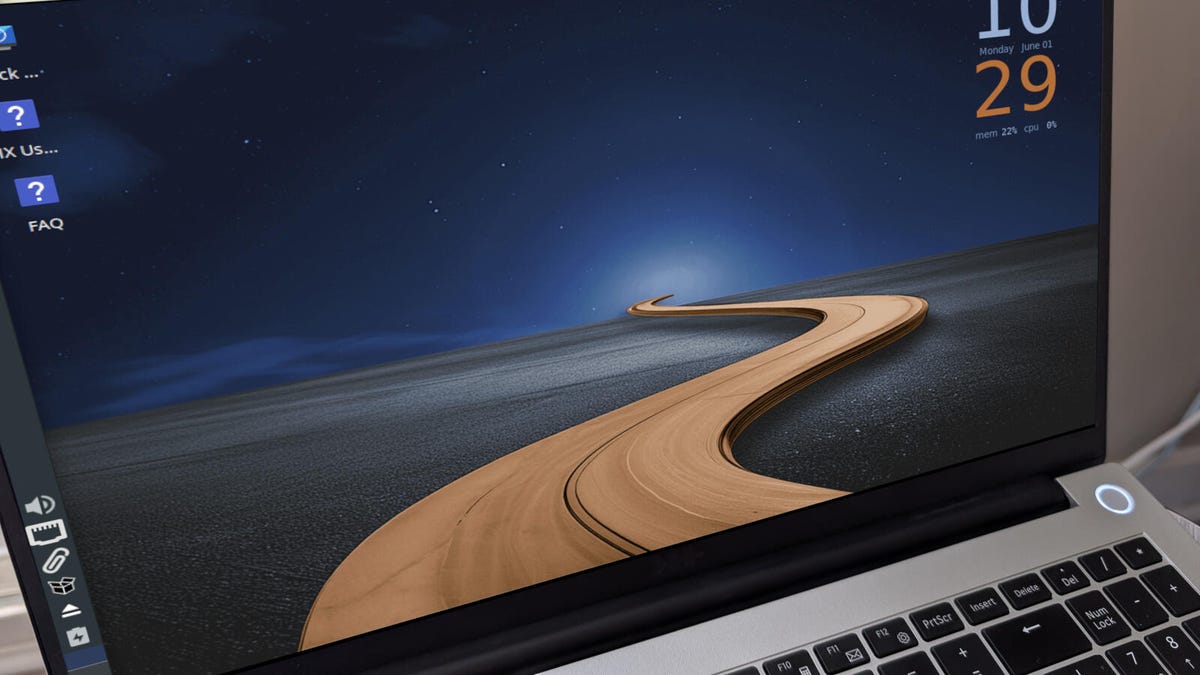
I set up MX Linux XFCE-AHS as a virtual machine, and it wowed me from the first boot. Admittedly, I’ve never been the biggest fan of Xfce, but MX Linux gives it a refreshingly modern twist through a custom layout and a well-designed Conky panel showing the time, date, and real-time RAM and CPU stats.
The Xfce desktop on MX Linux AHS doesn’t look cutting-edge, but it does the job admirably.
Jack Wallen/ZDNET
Out of the box, you get a rich set of preloaded software: Firefox, LibreOffice, Asunder CD Ripper, a handy Bash configuration GUI, Catfish file search tool, a graphical installer for downloaded .deb packages, FeatherPad text editor, a UFW firewall GUI, LuckyBackup, Thunderbird, the full suite of MX Tools, and more.
What sets this distro apart?
With countless Linux distributions competing for your attention, why should MX Linux AHS be your pick?
The answer boils down to modern hardware. If you’ve just bought a new PC and want Linux to work seamlessly without any tinkering, MX Linux AHS has you covered. Concerned about whether your Wi-Fi, audio, or discrete GPU will function correctly? The Liquorix kernel, a fresh Mesa release, and DKMS (Dynamic Kernel Module Support) ensure that your newer components work right out of the box.
Also: How much RAM does your Linux PC actually need in 2026? An expert’s sweet spot
And combined with the Xfce desktop, newer hardware will exceed your expectations. Running on just 4 GB of RAM and 2 CPU cores, MX Linux AHS performed like a powerhouse inside a virtual machine.
MX Linux isn’t exclusively for modern desktops. If you’re using a current-generation laptop, MX Linux 25.2 AHS was crafted with you in mind.
It’s also worth noting that the Liquorix 7.0.9-2 kernel (updated to 7.07 shortly after installation) is a low-latency kernel, meaning it’s engineered to reduce response delays for tasks like audio processing, gaming, and industrial automation.
If you’re a gamer or audio professional working with hardware from the last 1–3 years, MX Linux AHS could be your best bet. Yes, the desktop interface leans toward the old-fashioned side, but the raw speed you gain from Xfce more than compensates.
If you prefer, you can always swap in a more contemporary desktop environment like KDE Plasma or COSMIC. Just for fun, I installed KDE Plasma with:
sudo apt-get install kde-plasma-desktop -y
I wanted to see how KDE Plasma would hold up on top of the MX Linux AHS base. The install wrapped up in about a minute. After rebooting and logging into the Wayland session of KDE Plasma, I found it running just as smoothly as Xfce — and it even retained the familiar Conky display on the desktop.
Also: I customized an Arch-based distro my way in under 5 minutes — and it looks glorious
If you’ve been following my work, you know I lean toward a modern desktop rather than something that harks back to the early 2000s. It’s nothing personal against Xfce — I just like things that feel current.
Now we’re really cooking.
Jack Wallen/ZDNET
The only gap in my KDE Plasma setup was the absence of standard KDE apps like Discover and Konsole. That was easily fixed with:
sudo apt-get install kde-full -y
Beyond performance, I was pleased to find KDE Plasma running without a hitch. So if you want the hardware compatibility and low latency of MX Linux AHS but crave something more visually refined, go ahead and install KDE Plasma on top of it.
Who is MX Linux AHS for?
The answer is straightforward: if you own a modern PC or laptop and want an operating system that works from the moment you boot, MX Linux AHS checks every box. The only minor gripe I have is that Steam doesn’t come preloaded. No worries — just install it from the terminal:
sudo apt-get install steam-installer steam-devices -y
MX Linux AHS is an outstanding choice for anyone with up-to-date hardware. Between the 7.09 Liquorix kernel, DKMS, and an updated Mesa stack, your components are almost certainly supported — and if you opt for a more polished desktop environment, you’ll end up with a powerful, elegant, and contemporary machine.
